Laser Physics 2.2 The Einstein A and B Coefficients, Emission and Absorption Rate of a Single Atom
Keywords
Summary
185 words
Critical Evaluation
Value of the Information & Strength of the Argument
The video provides a clear and structured derivation of the Einstein B coefficient, which is valuable for students learning laser physics. The argumentation is logical, starting from fundamental quantum mechanics and building up to the final expression. The presenter also connects the coefficients to physical quantities like radiative lifetime, enhancing the conceptual understanding. However, the derivation of the A coefficient is only briefly mentioned, with a reference to a textbook for the full calculation. The presentation could benefit from more visual aids and clearer notation, as some steps are rushed and the handwriting may be hard to follow.
Scientific Rigor, Source Quality, Title Accuracy
The scientific rigor is generally good, with the derivation following standard textbook methods. The presenter references a specific textbook (Loudon’s ‘Quantum Theory of Light’) for the A coefficient derivation, which adds credibility. However, no other sources are cited, and the video has very few views, so external validation is limited. The title accurately reflects the content, which is a focused lecture on the Einstein coefficients. The video is part of a series, so it assumes prior knowledge from previous lectures, which may limit its standalone accessibility.
199 words
Title / Content Match
The title accurately reflects the content, which focuses on the Einstein A and B coefficients and their application to absorption and emission rates.
Quality & Reliability
7/10
The derivation is mathematically sound and follows standard textbook approaches, but the presentation has some imprecisions and the video is very low view count with no external validation.
Key Moments
Markers derived by PSI from the transcript: the creator did not define chapters.
- Introduction to the lecture and overview of Einstein A and B coefficients.
- Explanation of the two-level system and the three fundamental interactions: absorption, stimulated emission, and spontaneous emission.
- Definition of the B coefficient and its relation to absorption and stimulated emission rates.
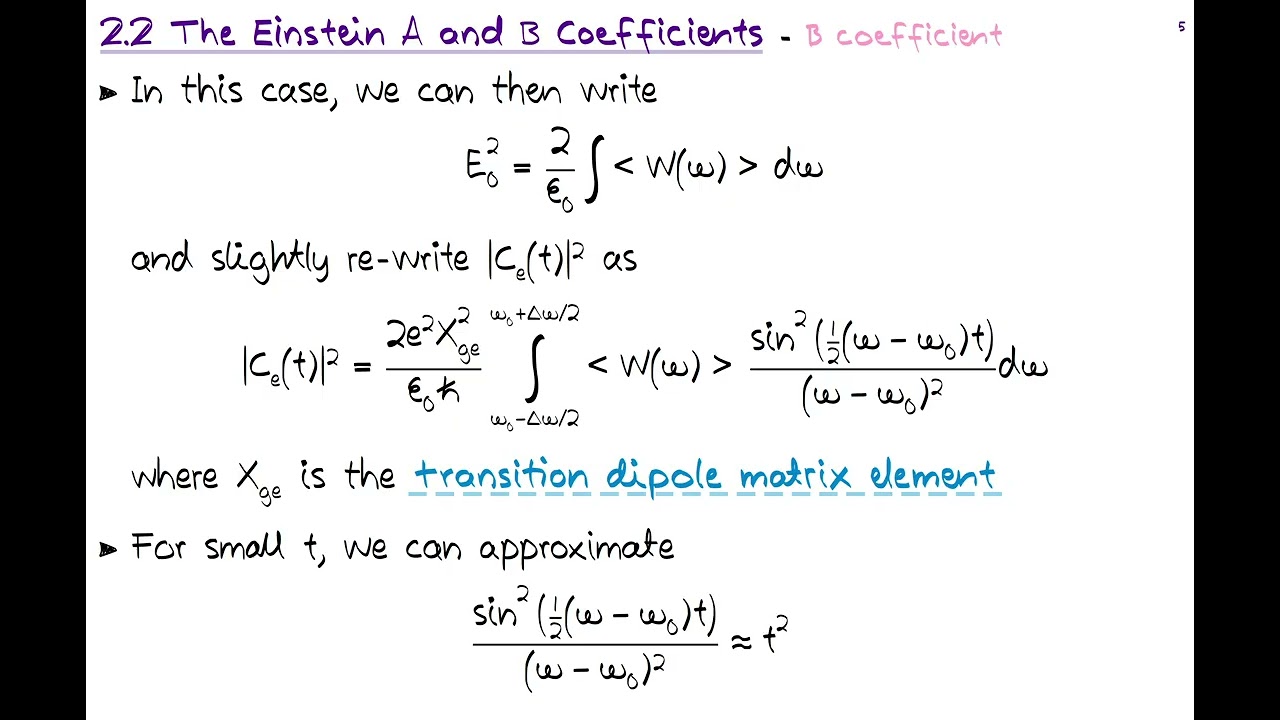
- Derivation of the radiative energy density and the transition dipole matrix element.
- Approximation for small time values and the time dependence of the transition rate.
- Asymptotic behavior for longer times and the final expression for the B coefficient.
- Introduction to the A coefficient and its relation to the B coefficient and radiative lifetime.
Cited Sources
- Quantum Theory of Light (Loudon) — Referenced for the derivation of the A coefficient.
Concurring Sources
- Einstein coefficients — Provides a general overview of the coefficients and their relationships.
Contribution & Novelties
The video provides a step-by-step derivation of the Einstein B coefficient, which is a fundamental concept in laser physics. It clarifies the mathematical details and connects the coefficient to physical parameters like the transition dipole moment and radiative energy density. The presentation is suitable for students who have a basic understanding of quantum mechanics.
Pour aller plus loin :
- Einstein coefficients — Wikipedia article providing an overview and context.
- Loudon, R. (2000). The Quantum Theory of Light. Oxford University Press. — The textbook referenced in the video for the A coefficient derivation.
- Transition dipole moment — Wikipedia article explaining the concept used in the derivation.
105 words
Radar Profile
The radar profile shows a balanced performance with high scores in technical level and information quality, but slightly lower in information quantity and reliability, reflecting the concise nature of the lecture and limited external validation.