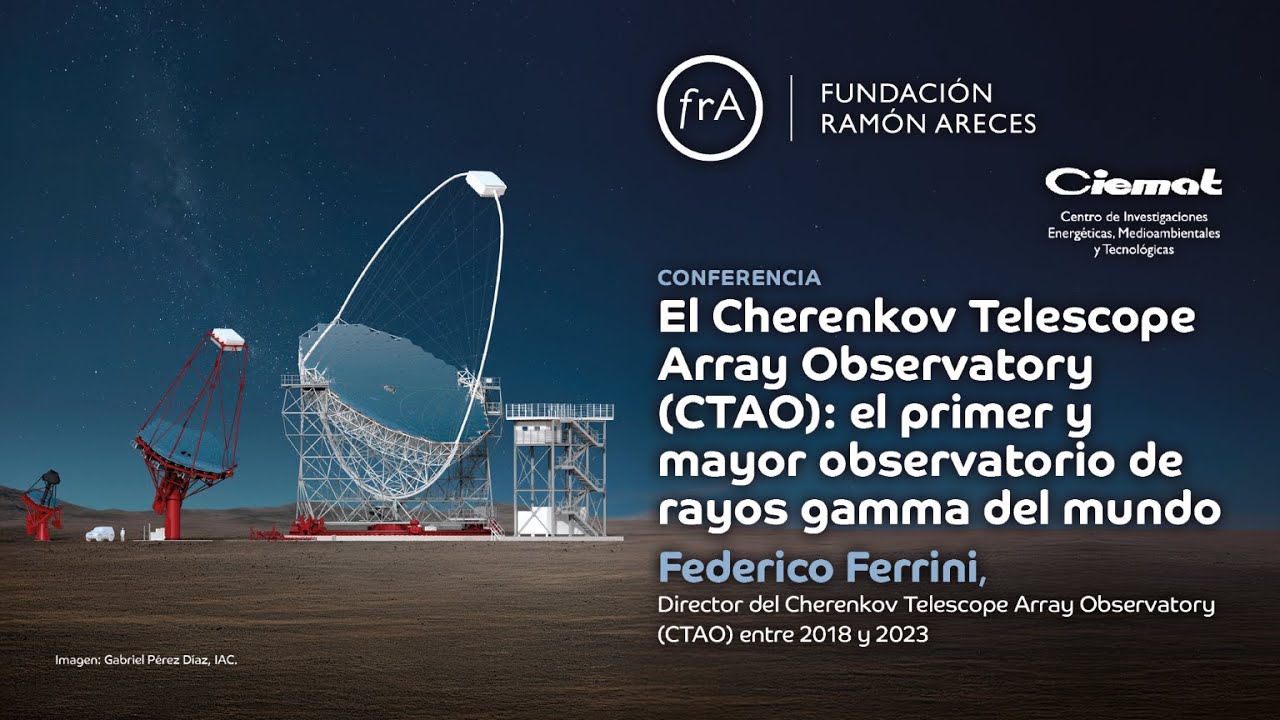
Federico Ferrini- CTAO: el primer y mayor observatorio de rayos gamma del mundo
Keywords
Summary
221 words
Critical Evaluation
The lecture provides a comprehensive and authoritative overview of the CTAO project, delivered by a scientist who was directly involved in its development. The content is scientifically accurate and well-structured, progressing from the historical context to the technical details and scientific goals. The speaker’s expertise is evident, and he effectively communicates complex concepts to a general audience without oversimplifying the underlying physics. The use of analogies, such as comparing the detection system to particle physics experiments at CERN, helps make the material accessible. The lecture is particularly strong in explaining the motivation for CTAO, highlighting the limitations of current instruments and the need for a larger, more sensitive observatory. The discussion of the two sites and the different telescope types is clear and informative. The scientific goals, including dark matter searches and cosmic ray origins, are presented in a compelling manner. The lecture also touches on the broader context of multi-messenger astronomy, which is a rapidly advancing field. However, the lecture is primarily descriptive and does not delve into the technical challenges or potential limitations of the project in great depth. The speaker’s enthusiasm for the project is evident, but a more critical perspective on the challenges and uncertainties would have been valuable. The sources cited are limited to the event page, and no specific scientific publications are referenced, which is typical for a public lecture. Overall, the lecture is a valuable resource for anyone interested in gamma-ray astronomy and the CTAO project. The title accurately reflects the content, and the presentation is engaging and informative. The lecture does not include any advertising or sponsored content. The public comments, if any, were not provided, so no analysis of audience reception is possible.
282 words
Title / Content Match
The title accurately reflects the content, which focuses on the CTAO as the first and largest gamma-ray observatory.
Quality & Reliability
8/10
The speaker is a highly qualified astrophysicist and former director of CTAO, providing authoritative and technically accurate information. The content is well-structured and based on established scientific knowledge, though it is a popular science lecture rather than a peer-reviewed presentation.
Key Moments
Markers derived by PSI from the transcript: the creator did not define chapters.
- Introduction by Manuel Aguilar, presenting Federico Ferrini's background and achievements.
- Ferrini begins his talk, thanking the audience and introducing the topic of CTAO.
- Discussion on the history of astronomy and the importance of telescopes.
- Explanation of why gamma rays are important and the challenges of detecting them from space.
- Introduction to the Cherenkov technique and how ground-based telescopes detect gamma rays.
- Review of previous gamma-ray observatories (MAGIC, VERITAS, H.E.S.S.) and their limitations.
- Detailed description of the CTAO design: 71 telescopes, two sites, and three telescope types.
- Scientific goals of CTAO: dark matter, cosmic rays, and extreme astrophysics.
- Synergies with multi-messenger astronomy and the future of CTAO.
Cited Sources
- Fundación Ramón Areces event page — Official event page for the lecture, providing context and registration information.
Concurring Sources
- Cherenkov Telescope Array Observatory official website — Official project website confirming the design, sites, and scientific objectives described in the lecture.
Contribution & Novelties
The lecture provides an authoritative overview of the CTAO project, highlighting its status as the first and largest gamma-ray observatory. It explains the scientific motivations and technical innovations, making it a valuable resource for understanding the future of gamma-ray astronomy. The speaker’s insider perspective adds depth to the presentation.
Pour aller plus loin :
- Cherenkov Telescope Array Observatory official website — Official site with detailed information on the project, telescopes, and science goals.
- Cherenkov radiation - Wikipedia — Background on the physical phenomenon used by CTAO.
- Gamma-ray astronomy - Wikipedia — Overview of the field and its history.
98 words
Radar Profile
The radar profile shows high scores in information quantity, quality, and reliability, reflecting the speaker's expertise and the comprehensive coverage of the topic. The technical level is also high, indicating a detailed yet accessible presentation.