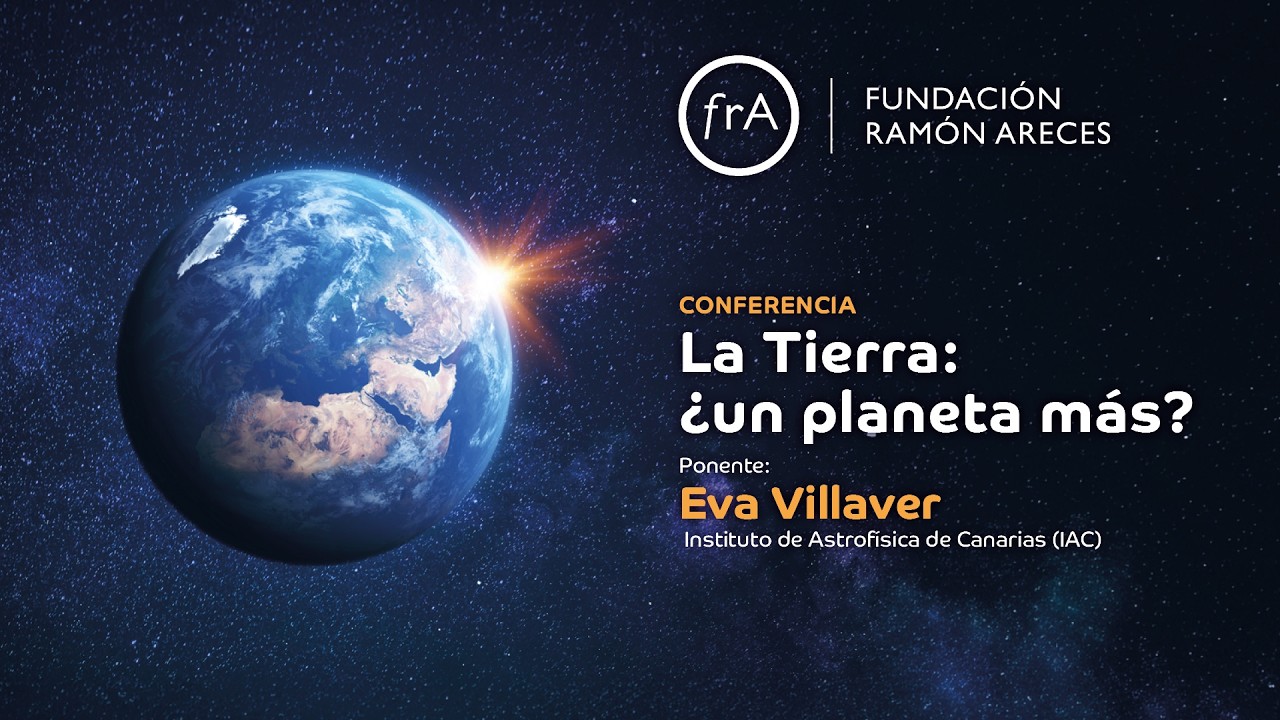
Eva Villaver- La Tierra: ¿un planeta más?
Keywords
Summary
181 words
Critical Evaluation
The lecture provides a comprehensive and accessible overview of the scientific context surrounding the question of Earth’s uniqueness. Villaver demonstrates a strong command of the subject, drawing on her expertise in astrophysics and astrobiology. The argumentation is logically structured, moving from the cosmic scale to the specific conditions on Earth. She effectively uses analogies and visual aids to explain complex concepts, such as the Big Bang and stellar nucleosynthesis. The scientific content is accurate and up-to-date, reflecting current knowledge in the field. However, as a popular science talk, it necessarily simplifies some topics, and the speaker does not provide specific citations for the claims made. The discussion of the origin of life is appropriately cautious, acknowledging the current lack of understanding of the transition from chemistry to biology. The talk does not delve into the latest exoplanet discoveries in detail, but it provides a solid foundation for understanding the broader context. The title is well-matched to the content, and the talk successfully conveys the excitement and open questions in this field. Overall, this is a high-quality lecture that is both informative and engaging for a general audience, while maintaining scientific rigor.
191 words
Title / Content Match
The title accurately reflects the central question of whether Earth is unique or common, which is the main theme of the talk.
Quality & Reliability
8/10
The speaker is a professional astrophysicist and deputy director of the Instituto de Astrofísica de Canarias, with extensive research experience. The content is based on established scientific knowledge and recent discoveries, presented with appropriate nuance. However, the talk is a popular science lecture, so some simplifications are made, and no specific sources are cited in the transcript.
Key Moments
Markers derived by PSI from the transcript: the creator did not define chapters.
- Introduction by the host, presenting Eva Villaver's background and the topic of the lecture.
- Villaver poses the central question: is Earth unique or common? She frames it as a scientific question that can now be addressed with data.
- Discussion of the Big Bang and the early universe, including the formation of hydrogen, helium, and lithium.
- Explanation of how stars form and produce heavier elements through nucleosynthesis, enriching the galaxy.
- Introduction to exoplanets and the revolution in our understanding of planetary systems over the last 25 years.
- Discussion of the habitable zone and the conditions necessary for life, including liquid water and chemical complexity.
- Exploration of the possibility of life on moons like Europa and Enceladus, and the implications for habitability.
- Villaver summarizes the current state of knowledge and emphasizes that the question of life elsewhere remains open.
- Conclusion and final remarks, encouraging continued scientific exploration.
Cited Sources
- Instituto de Astrofísica de Canarias (IAC) — The speaker's institution, mentioned in the introduction.
Concurring Sources
- NASA Exoplanet Archive — A database of confirmed exoplanets, supporting the claim that exoplanets are common.
Contribution & Novelties
The lecture synthesizes current knowledge in astrophysics and astrobiology to address the question of Earth’s uniqueness. It provides a clear framework for understanding the probabilistic nature of life’s emergence and highlights the interdisciplinary approach needed. The talk emphasizes that recent discoveries of exoplanets and advances in understanding the early universe allow us to begin quantifying the likelihood of habitable worlds.
Pour aller plus loin :
- Exoplanet exploration — NASA’s official page on exoplanets, providing up-to-date information on discoveries and missions.
- Drake equation — A probabilistic formula used to estimate the number of active, communicative extraterrestrial civilizations in the Milky Way galaxy.
- Habitability of natural satellites — Discusses the potential for life on moons like Europa and Enceladus.
117 words
Radar Profile
The radar profile shows high scores in quantity and quality of information, reflecting the comprehensive and accurate content. The technical level is moderate, suitable for a general audience, while reliability is high due to the speaker's expertise. The overall balance indicates a well-rounded and trustworthy presentation.