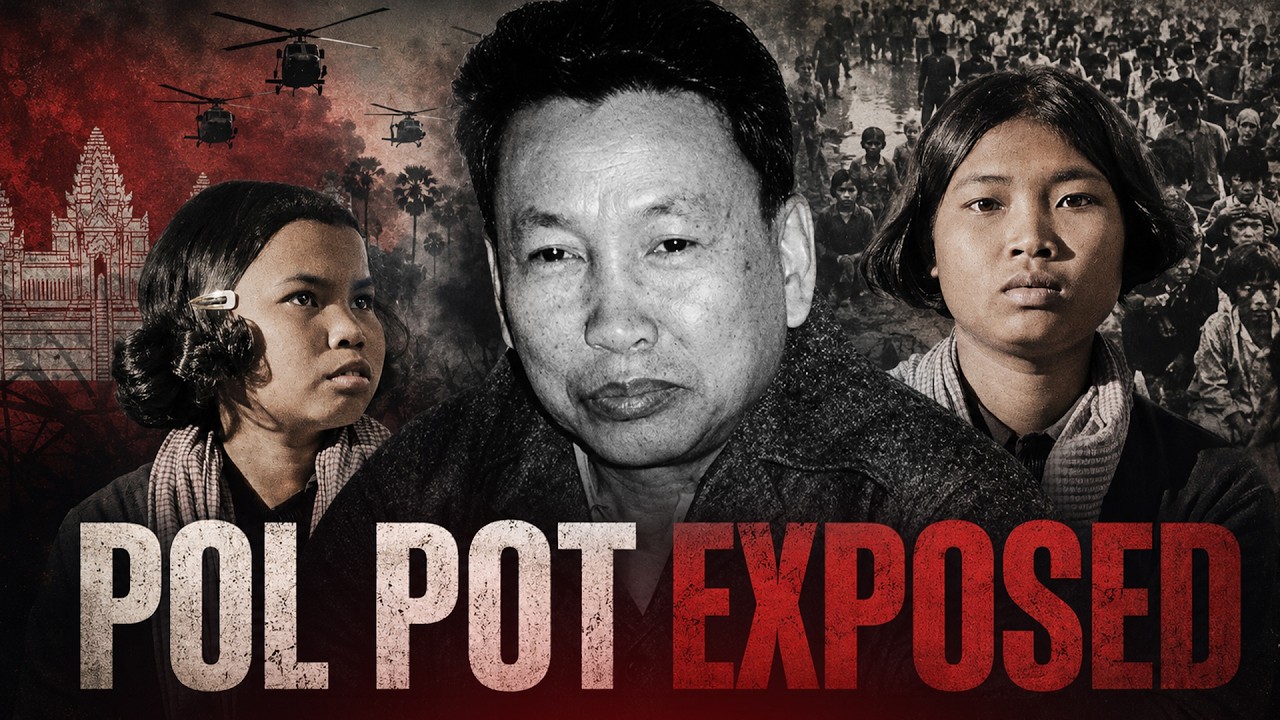
SHOCKING FACTS About the Khmer Rouge Nobody Talks About | History Channel | History | Documentary
Keywords
Summary
140 words
Critical Evaluation
Value of the Information & Strength of the Argument
The documentary provides valuable insights into the complex historical factors that enabled the Khmer Rouge’s rise, such as the interplay of Cold War geopolitics, US bombing, and internal political dynamics. It effectively argues that the regime’s ideology, rooted in a romanticized agrarian vision and ultranationalism, led to catastrophic policies. The inclusion of survivor testimonies adds emotional weight and personalizes the historical narrative. However, the argumentation sometimes relies on broad generalizations and lacks in-depth analysis of certain aspects, such as the internal power struggles within the Khmer Rouge. The documentary’s strength lies in its synthesis of multiple perspectives, but it could benefit from more critical examination of the sources and motivations behind the events.
Scientific Rigor, Source Quality, Title Accuracy
The documentary demonstrates a reasonable level of scientific rigor, featuring interviews with historians and survivors, and using archival footage. However, it does not provide explicit citations or references for the claims made, which limits its verifiability. The title, while attention-grabbing, is somewhat sensationalist but does not misrepresent the content. The documentary’s scope is broad, covering a complex historical period, and it manages to maintain a coherent narrative. The lack of clear sourcing is a notable weakness, as it prevents viewers from independently verifying the information presented. Overall, the documentary is informative but would benefit from more transparent sourcing to enhance its credibility.
230 words
Title / Content Match
The title is somewhat sensationalist ('SHOCKING FACTS') but accurately reflects the content, which covers lesser-known aspects of the Khmer Rouge regime.
Quality & Reliability
7/10
The documentary relies on expert interviews, archival footage, and survivor testimonies, providing a generally reliable historical account. However, the lack of explicit citations and the presence of some dramatized elements slightly reduce its scientific rigor.
Key Moments
Markers derived by PSI from the transcript: the creator did not define chapters.
- Introduction to the Khmer Rouge and Pol Pot's early life in the palace.
- Discussion of the First Indochina War and Ho Chi Minh's guerrilla tactics.
- Cambodia's neutrality under Sihanouk and tensions with the US.
- The coup by Lon Nol and the beginning of US secret bombing.
- Impact of the bombing on Cambodian society and Khmer Rouge recruitment.
- Fall of Phnom Penh and forced evacuations.
- Life under the Khmer Rouge: labor camps, famine, and repression.
- Vietnamese invasion and the fall of the regime.
- Establishment of the Khmer Rouge Tribunal and efforts to educate new generations.
Cited Sources
- No explicit sources cited in the video description — The video description does not list any external sources or references.
Concurring Sources
- Cambodian Genocide Program — Yale University's program provides extensive documentation and research on the Cambodian genocide, aligning with the documentary's historical account.
- Documentation Center of Cambodia — This organization's archives and research support the documentary's depiction of the Khmer Rouge atrocities.
Contribution & Novelties
The documentary offers a comprehensive overview of the Khmer Rouge regime, synthesizing historical analysis with personal testimonies. It highlights lesser-known aspects such as the regime’s ideological underpinnings and the role of US bombing in its rise. The inclusion of survivor stories provides a human dimension often missing from academic accounts.
Pour aller plus loin :
- Khmer Rouge Tribunal — Official website of the Extraordinary Chambers in the Courts of Cambodia.
- Cambodian Genocide Program — Yale University’s research initiative on the Cambodian genocide.
- Documentation Center of Cambodia — Organization dedicated to documenting the atrocities of the Khmer Rouge.
97 words
Radar Profile
The radar profile shows a balanced documentary with strong scores in information quantity and quality, but slightly lower in technical level and reliability. This suggests a well-researched but not deeply technical presentation, suitable for a general audience.
💬 No comments were provided for analysis.