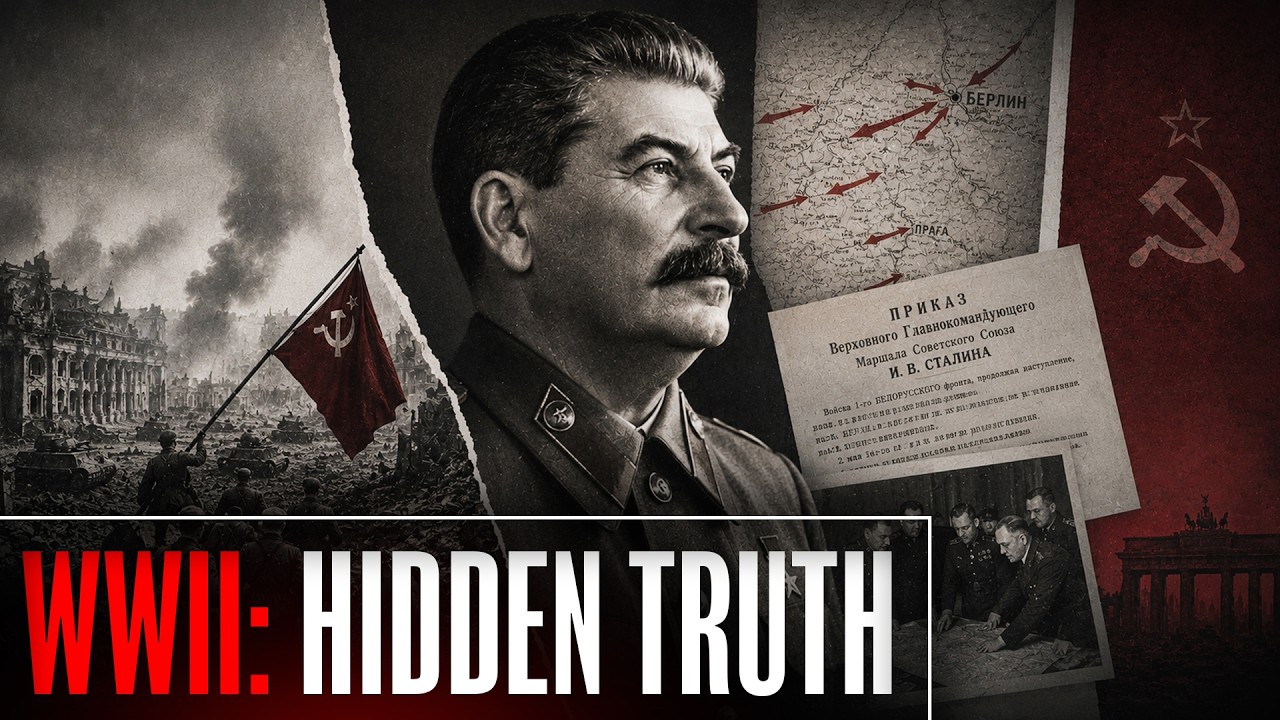
What They Never Told You About World War II: The Final Days of Europe | WWII Documentary | History
Keywords
Summary
134 words
Critical Evaluation
Value of the Information & Strength of the Argument
The documentary provides a broad overview of the end of WWII, with a mix of archival footage and expert commentary. The argumentation is generally coherent, presenting a chronological narrative of key events. However, it lacks depth in analyzing the political and strategic decisions, often glossing over complexities. The inclusion of personal anecdotes adds emotional value but does not substitute for rigorous historical analysis. The documentary’s value lies in its accessibility, but it does not offer new insights for a well-informed audience.
Scientific Rigor, Source Quality, Title Accuracy
The documentary relies on standard historical narrative and expert interviews, but does not cite specific sources or documents. The archival footage is authentic, but the lack of citations reduces its scientific rigor. The title is somewhat misleading, as it promises ‘what they never told you,’ but the content is largely conventional history. The adéquation between title and content is moderate, as the documentary covers well-known events without revealing new information.
166 words
Title / Content Match
The title is somewhat sensationalist ('What They Never Told You') but the content does cover the final days of WWII in Europe, including Mussolini's death, Hitler's suicide, and the surrender, aligning with the subtitle.
Quality & Reliability
6/10
The documentary combines archival footage, expert interviews, and narrative storytelling. It covers well-documented events, but lacks explicit citations or references to primary sources, and some claims (e.g., specific casualty figures) are presented without sourcing.
Key Moments
Markers derived by PSI from the transcript: the creator did not define chapters.
- Introduction to the final months of WWII, setting the stage for the collapse of fascism.
- Mussolini's capture and execution by Italian partisans.
- Hitler's suicide in the Führerbunker and the Soviet advance on Berlin.
- Germany's unconditional surrender at Reims and the end of the war in Europe.
- VE Day celebrations and the public reaction in Britain.
- The Potsdam Conference and the division of post-war Europe.
- The atomic bombings of Hiroshima and Nagasaki, and Japan's surrender.
Cited Sources
- No explicit sources cited in the video — The documentary does not mention specific sources or references.
Concurring Sources
- World War II - Encyclopaedia Britannica — General historical context aligns with the documentary's narrative.
Dissenting Sources
- No discordant sources identified — The documentary does not present controversial claims that would require discordant sources.
Contribution & Novelties
The documentary offers a synthesis of well-known events, with a focus on the human experience through personal recollections. It does not present new research or unique perspectives, but it serves as a comprehensive overview for general audiences.
Pour aller plus loin :
- World War II - Wikipedia — Provides a broad overview of the conflict.
- Potsdam Conference - Wikipedia — Details the conference and its outcomes.
- Atomic bombings of Hiroshima and Nagasaki - Wikipedia — In-depth analysis of the bombings and their consequences.
83 words
Radar Profile
The radar profile shows moderate scores across all dimensions, with a slight peak in quantity of information. This indicates a documentary that provides a decent amount of content but lacks depth in technical analysis and source rigor.
💬 No comments were provided for analysis.