Cours 17 - Types de modèles stochastiques utilisés en épidémiologie
Keywords
Summary
186 words
Critical Evaluation
Value of the Information & Strength of the Argument
The video provides valuable insights into the rationale for using stochastic models in epidemiology, particularly highlighting the phenomenon of extinction even when R0 > 1, which is often overlooked in deterministic frameworks. The argumentation is solid, supported by illustrative simulations and references to established models. The instructor clearly explains the differences between deterministic and stochastic approaches, and the conditions under which stochasticity is crucial. The presentation is logical and builds on previous knowledge, making it a useful resource for students and researchers.
Scientific Rigor, Source Quality, Title Accuracy
The scientific rigor is high, as the content is based on well-known stochastic modeling techniques and the instructor demonstrates deep understanding. However, the video does not cite specific sources or provide references beyond the course slides, which limits the ability to verify claims independently. The title accurately describes the content, and the lecture stays focused on the topic. The instructor acknowledges the influence of Linda Allen’s work, which adds credibility, but no formal citations are given.
173 words
Title / Content Match
The title accurately reflects the content, which focuses on stochastic models in epidemiology.
Quality & Reliability
8/10
The video is a well-structured lecture by a domain expert, with clear explanations and references to established models. The content is technically accurate, though it lacks formal citations and peer-reviewed sources.
Key Moments
Markers derived by PSI from the transcript: the creator did not define chapters.
- Introduction and motivation for stochastic models in epidemiology
- Deterministic SIS model and R0 threshold behavior
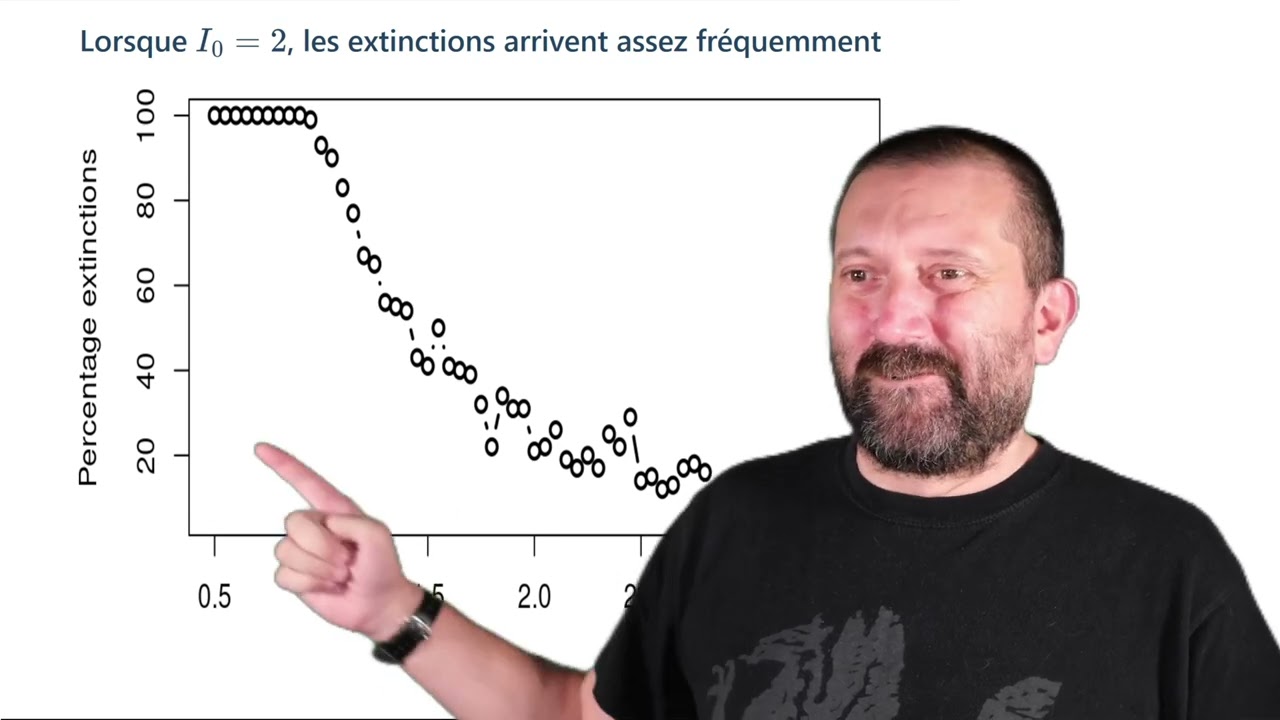
- Stochastic simulations showing extinction despite R0 > 1
- Percentage of extinctions as a function of R0
- Introduction to binomial chains (Reed-Frost model)
- Discrete-time Markov chains and their properties
- Continuous-time Markov chains and their relation to ODEs
- Branching processes and their applications
- Stochastic differential equations and personal perspective
Cited Sources
- Course slides for Cours 17 — The instructor references the slides for this lecture, which contain the material presented.
Concurring Sources
- An Introduction to Stochastic Epidemic Models — This reference provides a comprehensive introduction to stochastic epidemic models, aligning with the video's content.
Contribution & Novelties
The video provides a clear and concise overview of stochastic models in epidemiology, emphasizing the importance of considering stochasticity in early epidemic dynamics. It bridges the gap between deterministic and stochastic modeling, offering intuitive explanations and visual examples. The instructor’s perspective on SDEs is thought-provoking.
Pour aller plus loin :
- Reed–Frost model — The classic binomial chain model for epidemic spread.
- Markov chain — Fundamental concept underlying discrete and continuous-time stochastic processes.
- Branching process — Useful for modeling extinction probabilities in early epidemics.
- Stochastic differential equation — Mathematical framework for SDEs mentioned in the lecture.
95 words
Radar Profile
The radar profile shows high scores in quality, technical level, and reliability, with slightly lower quantity of information. This indicates a focused, expert-led tutorial that is technically sound but could benefit from more extensive coverage or additional examples.
💬 No comments were provided for analysis.