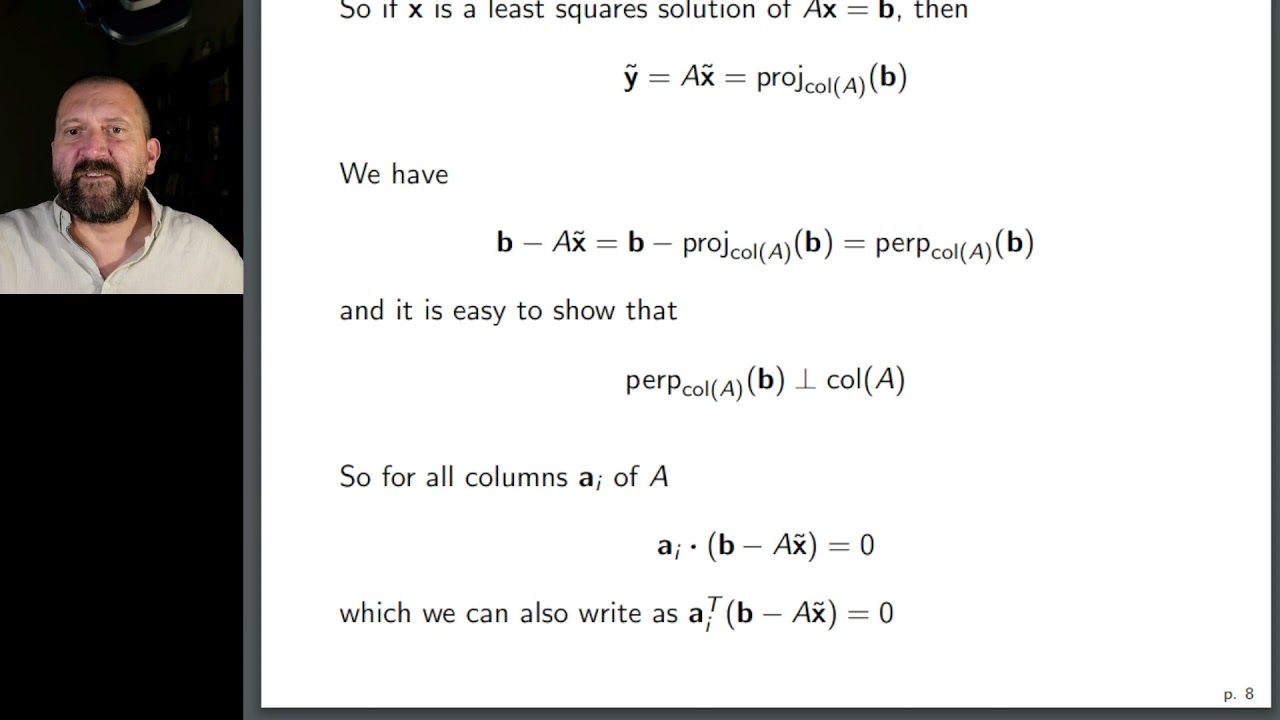
UofM - MATH 2740 - Lecture 05 - Part 1 - Linear least squares (continued)
Keywords
Summary
158 words
Critical Evaluation
Value of the Information & Strength of the Argument
The value of the information is high for students learning linear least squares. The lecture provides a clear conceptual foundation, linking the geometric idea of projection to the algebraic normal equations. The argumentation is solid: the instructor derives the normal equations from the best approximation theorem, making the logic transparent. He also provides a worked example that illustrates the computation process, and then shows how to implement it in R, which adds practical value. The explanation is thorough and accessible, though it assumes prior knowledge of linear algebra basics.
Scientific Rigor, Source Quality, Title Accuracy
The scientific rigor is appropriate for a university lecture. The mathematical derivations are correct and well-explained. However, no external sources are cited; the content is based on standard linear algebra theory. The title accurately reflects the content, and the lecture is well-structured with clear sections. The instructor acknowledges minor slide cutoffs but ensures the material is understandable. Overall, the lecture is reliable for educational purposes.
169 words
Title / Content Match
The title accurately describes the content: a continuation of a lecture on linear least squares, covering theory and examples.
Quality & Reliability
8/10
The lecture is a clear, step-by-step derivation of the least squares theorem and its application, with a worked example by hand and in R. The mathematical content is accurate and well-structured, though it is a lecture without external sources or references.
Chapters
Contribution & Novelties
This lecture provides a clear pedagogical exposition of linear least squares, emphasizing the geometric interpretation and derivation of the normal equations. It bridges theory and practice by including a worked example and an R implementation.
Pour aller plus loin :
- Least squares - Wikipedia — Overview of least squares methods.
- Normal equations - Wikipedia — Derivation and context.
- Orthogonal projection - Wikipedia — Geometric foundation.
65 words
Radar Profile
The radar profile shows high scores in information quantity, quality, and reliability, with a slightly lower technical level, indicating a solid educational resource that is accessible yet rigorous.