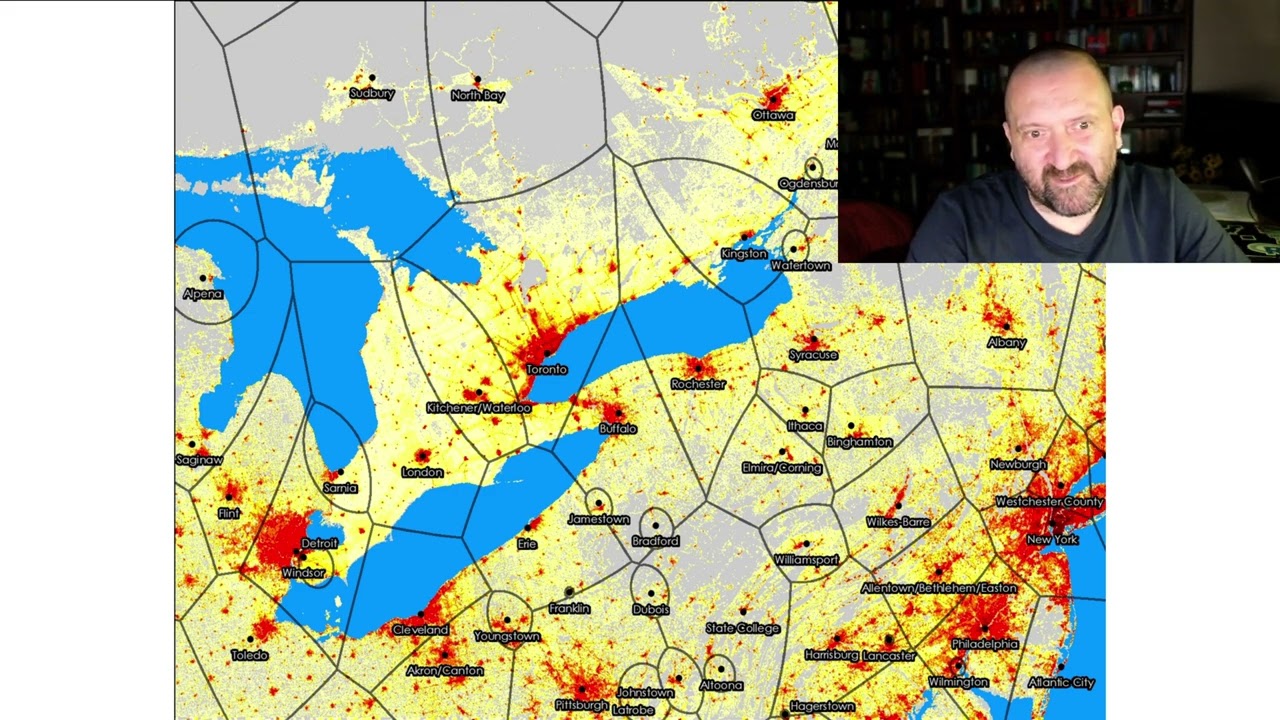
Mathematical Epidemiology - Lecture 05 - Metapopulation models
Keywords
Summary
156 words
Critical Evaluation
Value of the Information & Strength of the Argument
The lecture provides a comprehensive and rigorous introduction to metapopulation models, a key tool in spatial epidemiology. The value lies in its clear exposition of model formulation, from simple to more complex variants, and its emphasis on the mathematical structure that enables analysis. The argumentation is solid, as the presenter systematically builds from basic concepts to advanced topics, using examples and referencing standard literature. The discussion of R0 limitations adds critical depth, showing awareness of the model’s applicability. The presentation is well-paced and logically structured, making it a valuable resource for graduate students or researchers in mathematical biology.
Scientific Rigor, Source Quality, Title Accuracy
The scientific rigor is high: the presenter is an expert in the field, and the mathematical derivations are precise. The lecture references standard methods and papers, though specific citations are not always given in the talk. The provided slides link likely contains references to the literature. The title accurately reflects the content, which is a focused lecture on metapopulation models. The lecture is part of a structured course, indicating pedagogical intent. No comments were provided, so no analysis of public reception is possible.
196 words
Title / Content Match
The title accurately reflects the content: a lecture on metapopulation models in mathematical epidemiology.
Quality & Reliability
8/10
Lecture by a recognized researcher in mathematical epidemiology, with rigorous mathematical derivations and references to standard methods. The content is well-structured and technically sound, though it is a lecture rather than peer-reviewed material.
Key Moments
Markers derived by PSI from the transcript: the creator did not define chapters.
- Introduction to the lecture topics: formulation, analysis, R0 limitations, and stability.
- Explanation of the spatial spread process: transport, importation, amplification, exportation.
- Definition of patches and the multi-digraph structure for movement.
- Derivation of the movement equations and the trick to simplify notation.
- Presentation of the basic SLIRS metapopulation model with patch-specific parameters.
- Introduction of multi-species models and residence-patch models.
- General formulation of metapopulation models with uninfected and infected compartments.
- Discussion of the mathematical analysis, emphasizing matrix analysis and R0 computation.
- Limitations of R0 in metapopulation models and considerations for global stability.
Cited Sources
- Lecture slides — Slides for this lecture, likely containing references to the literature.
Concurring Sources
- Arino, J., & van den Driessche, P. (2003). The basic reproduction number in a multi-city compartmental epidemic model. — This paper is a foundational reference for computing R0 in metapopulation models, aligning with the lecture's content.
Contribution & Novelties
The lecture provides a clear and structured introduction to metapopulation models, highlighting their formulation, analysis, and limitations. It emphasizes the importance of matrix analysis and the role of R0, while cautioning against over-reliance on R0. The presentation of different model types (single-species, multi-species, residence-patch) offers a comprehensive overview. For further exploration, one can look into the following concepts and references:
Pour aller plus loin :
- Metapopulation — Foundational concept in ecology and epidemiology.
- Basic reproduction number — Key metric in epidemiology, with discussion of its computation and limitations.
- Compartmental models in epidemiology — Background on SIR-type models.
- Next-generation matrix — Method for computing R0 in structured populations.
- Arino, J., & van den Driessche, P. (2003). The basic reproduction number in a multi-city compartmental epidemic model. — Key paper on R0 in metapopulation models.
133 words
Radar Profile
The radar profile shows high scores across all dimensions, indicating a well-balanced and reliable lecture. The high technical level and information quality are balanced by a moderate score in novelty, as the content is standard in the field.