UofM - MATH 2740 - Lecture 14 - Part 1 - Graph theory (Cycles, spanning trees)
Keywords
Summary
136 words
Critical Evaluation
Value of the Information & Strength of the Argument
The lecture provides a solid foundation in graph theory concepts, particularly cycles and trees. The instructor carefully defines terms and illustrates with examples. The vector representation of cycles is a valuable insight, linking graph theory to linear algebra. The proof of the tree characterization theorem is methodical, using the cyclomatic number formula to establish equivalences. The argumentation is rigorous and logical, though the pace may be slow for some. The content is standard but presented clearly, making it a useful resource for students.
Scientific Rigor, Source Quality, Title Accuracy
The lecture is mathematically rigorous, with precise definitions and proofs. No external sources are cited, but the content is well-established graph theory. The title accurately reflects the content, though spanning trees are only briefly mentioned at the end. The video is a lecture, so it is not a research presentation, but it is reliable for educational purposes. The instructor occasionally makes minor errors (e.g., writing ’n prime’ instead of ’n’), but these are corrected. Overall, the scientific quality is high.
178 words
Title / Content Match
The title accurately describes the content: a lecture on graph theory focusing on cycles and spanning trees (though spanning trees are only introduced at the end).
Quality & Reliability
8/10
The lecture is a formal university course, mathematically rigorous, with definitions, theorems, and proofs. The instructor is clear and methodical, though the video has minor technical issues (small text, occasional erasing pauses). No external sources are cited, but the content is standard graph theory.
Key Moments
Markers derived by PSI from the transcript: the creator did not define chapters.
- Introduction to cycles and definition of elementary cycles.
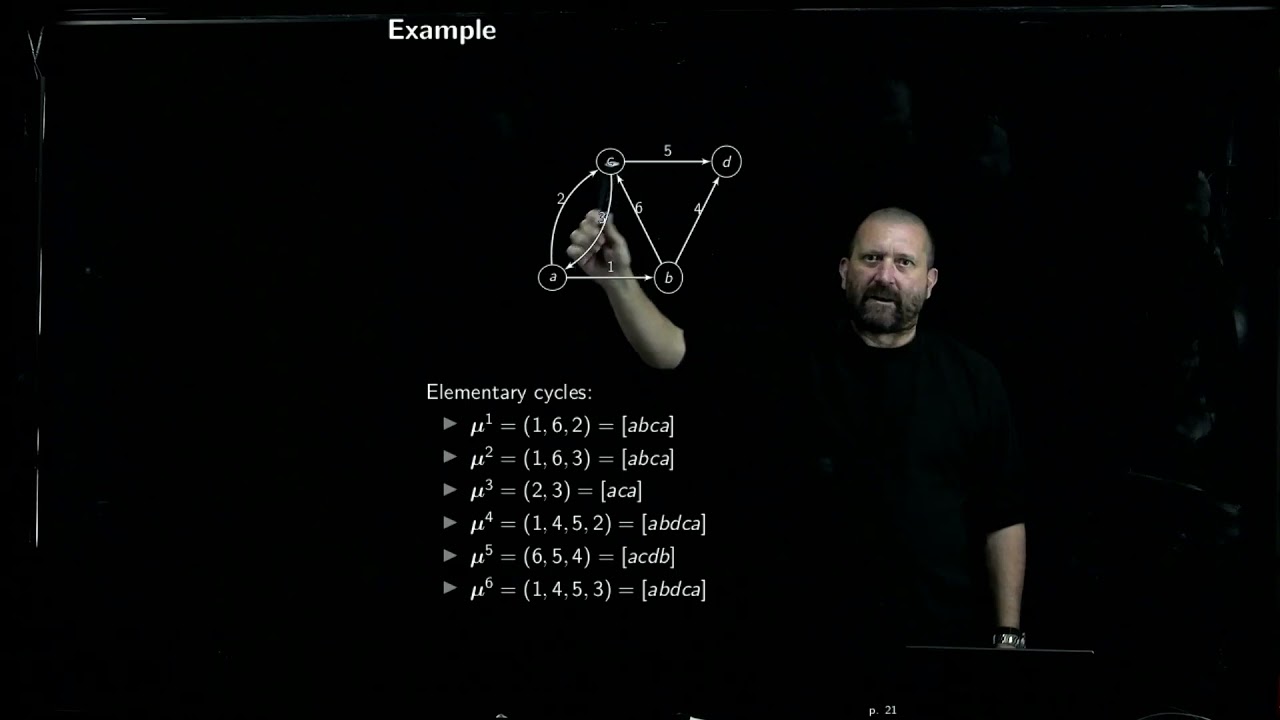
- Example of elementary cycles in a graph with labeled arcs.
- Vector representation of cycles using +1, -1, 0.
- Definition of co-cycles and elementary co-cycles.
- Coloring lemma presented.
- Linear independence of cycles and definition of cycle basis.
- Cyclomatic number formula nu(G) = m - n + p.
- Introduction to trees and forests.
- Theorem on characterization of trees: six equivalent properties.
- Proof of theorem: 1 implies 2, using cyclomatic number.
Contribution & Novelties
The lecture provides a clear and rigorous exposition of fundamental graph theory concepts, particularly the vector representation of cycles and the cyclomatic number. This algebraic perspective is valuable for understanding the structure of graphs. The proof of the tree characterization theorem is well-structured, demonstrating the power of the cyclomatic number formula. The lecture is a good resource for students seeking a solid foundation in these topics.
Pour aller plus loin :
- Graph theory — Overview of graph theory concepts.
- Cycle (graph theory) — Detailed discussion of cycles.
- Tree (graph theory) — Properties and characterizations of trees.
- Cyclomatic complexity — Application of cyclomatic number in software engineering.
106 words
Radar Profile
The radar profile shows high scores in information quantity, quality, technical level, and reliability, indicating a dense and rigorous lecture. The balance among these dimensions suggests a well-structured educational content.