Modelling livestock
Keywords
Summary
138 words
Critical Evaluation
Value of the Information & Strength of the Argument
The lecture provides a valuable overview of livestock modeling, showcasing a variety of approaches from mechanistic to statistical. The presenter argues for the importance of these models in understanding production and environmental impacts, and he supports his points with specific examples and experimental data. The argumentation is clear and logical, though the presenter admits his lack of expertise in this specific domain, which may affect the depth of critical analysis.
Scientific Rigor, Source Quality, Title Accuracy
The lecture is based on published scientific papers, and the presenter references them throughout, though not always with explicit citations. The sources appear credible and relevant, and the title accurately reflects the content. The presenter’s use of cut-and-paste figures and equations from papers is transparent, but it may limit the originality of the presentation. No comments were provided for analysis.
145 words
Title / Content Match
The title accurately reflects the content, which focuses on mathematical models of livestock, excluding infectious diseases.
Quality & Reliability
7/10
The lecture is based on published scientific papers, with clear references to experimental data and model details. The presenter is transparent about his lack of expertise in livestock modeling, but the content is well-structured and grounded in peer-reviewed literature. Some limitations include the use of cut-and-paste figures and equations, and the absence of explicit citations in the video itself.
Key Moments
Markers derived by PSI from the transcript: the creator did not define chapters.
- Introduction: why model livestock, scope of lecture
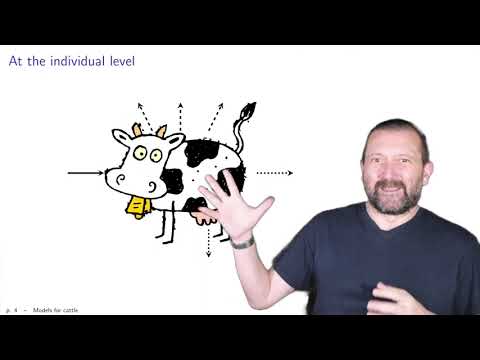
- Individual-level models: mammary gland metabolism for milk production
- Model for enteric methane emission in non-lactating dairy cows
- Statistical model for manure volume and composition
- Herd-level models: switched linear system for cow behavior
- Spatial model of grazing patterns
- Conclusion and summary
Cited Sources
- Model of mammary gland metabolism in lactating cows — Mentioned as a model for milk production, but no specific reference given.
- Model for enteric methane emission from non-lactating dairy cows — Paper from 2015, details on experimental setup with respiration chambers.
- Statistical model for manure volume and composition — Model for lactating cows, using model selection techniques.
- Switched linear system model for cow behavior — Abstract model with states eating, resting, standing, and social interactions.
- Spatial model of grazing patterns — Paper by two Japanese authors, includes data.
Concurring Sources
- Livestock models in agricultural research — General literature on livestock modeling, consistent with the lecture's content.
Dissenting Sources
- None — No discordant sources were mentioned or identified.
Contribution & Novelties
The lecture provides a comprehensive introduction to livestock modeling, highlighting the diversity of approaches and the importance of experimental data. It bridges the gap between epidemiological modeling and agricultural science, offering insights into mechanistic and statistical models. The presenter’s personal perspective adds value, though the content is largely a synthesis of existing literature.
Pour aller plus loin :
- Livestock systems modeling — Overview of modeling approaches in livestock production.
- Methane emissions from livestock — Background on the environmental impact of livestock methane.
- Agent-based model — Relevant to the herd behavior model discussed.
- Compartmental models in biology — Related to the metabolic model structure.
103 words
Radar Profile
The radar profile shows balanced scores across information quantity, quality, technical level, and reliability, indicating a well-rounded lecture. The technical level is moderately high, reflecting the mathematical nature of the content, while reliability is supported by references to published research.