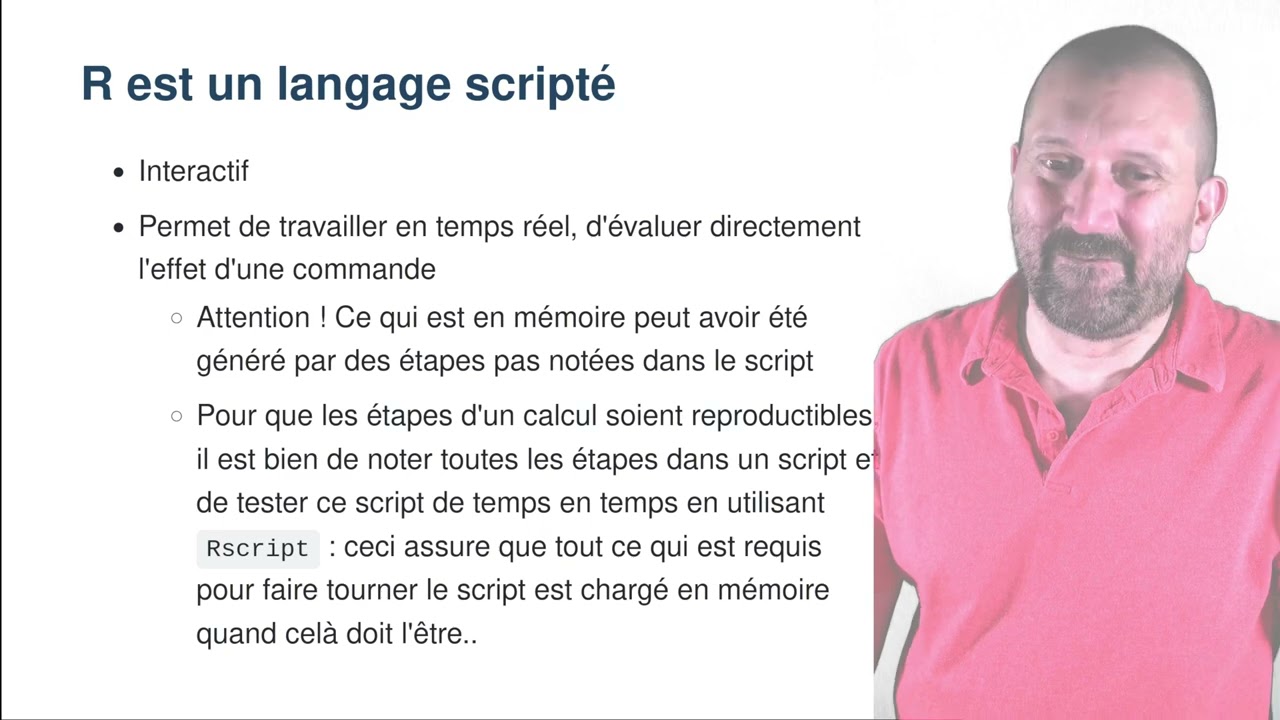
Cours 02 - Introduction à R et résolution numérique des EDO
Keywords
Summary
156 words
Critical Evaluation
Value of the Information & Strength of the Argument
The video provides valuable, practical information for beginners in R and numerical ODE solving. The instructor’s explanations are clear and well-structured, building from basic programming concepts to more advanced topics like the apply family and parallelization. The argumentation is solid, as the instructor justifies recommendations (e.g., using scripts, leveraging apply functions) with logical reasoning about efficiency and reproducibility. The demonstration of solving the logistic equation is concise and illustrative. The content is directly applicable to epidemiological modeling, which is the course’s context.
Scientific Rigor, Source Quality, Title Accuracy
The scientific rigor is high: the instructor is an expert in the field, and the techniques presented are standard and reliable. The quality of sources is good, as the video references the deSolve package and its underlying numerical methods (LSODA, Runge-Kutta) which are well-established. The provided slides (linked in the description) serve as a supplementary resource. The title accurately reflects the content, and the video fulfills its promise of introducing R and ODE resolution. No comments were provided, so no analysis of public reception is possible.
183 words
Title / Content Match
The title accurately reflects the content: an introduction to R and numerical resolution of ODEs.
Quality & Reliability
8/10
The content is a tutorial by a domain expert (mathematician/epidemiologist) providing accurate technical information about R programming and numerical ODE solving. The methods and tools described are standard and well-established. The presentation is clear and pedagogical, with practical examples. Minor limitations: no explicit citations of external sources, but the references to standard R packages and the provided slides enhance credibility.
Key Moments
Markers derived by PSI from the transcript: the creator did not define chapters.
- Introduction to the course and overview of R programming basics.
- Discussion on R's origins, open-source nature, and community support.
- Explanation of R's performance due to C and Fortran integration.
- Introduction to R development environments: RStudio, RStudio Server, Shiny, etc.
- Basic programming in R: assignment, lists, vectors, matrices, and data frames.
- Control flow and loops in R, with emphasis on using apply functions for efficiency.
- Introduction to numerical ODE solving in R using the deSolve package.
- Example of solving the logistic equation with R code.
- Conclusion and pointers to further resources.
Cited Sources
- Course slides: Cours 02 - Introduction à R et résolution numérique des EDO — The instructor refers to these slides as the source of the material presented in the video.
Concurring Sources
- deSolve package documentation — The video references the deSolve package for ODE solving; this is the official documentation.
Contribution & Novelties
The video offers a practical, hands-on introduction to R for epidemiological modeling, emphasizing efficient coding practices and the use of robust numerical solvers. It bridges the gap between theoretical ODEs and their computational solution, making it accessible for researchers and students. The instructor’s emphasis on using apply functions and parallelization is particularly valuable for large-scale simulations.
Pour aller plus loin :
- R for Data Science — A comprehensive online book covering data manipulation, visualization, and programming in R.
- deSolve package documentation — Official documentation for the R package used for solving ODEs.
- LSODA algorithm — Wikipedia article on the LSODA solver, which is a core component of deSolve.
108 words
Radar Profile
The radar profile shows high scores in information quantity, quality, and technical level, with a slightly lower but still strong reliability score. This indicates a well-rounded, informative tutorial with solid technical depth and trustworthy content.