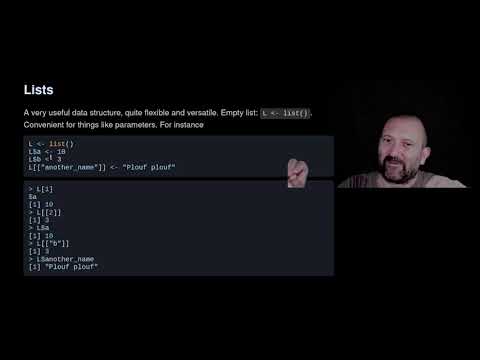
Using R to gather data and simulate ODE and CTMC systems
Keywords
Summary
145 words
Critical Evaluation
Value of the Information & Strength of the Argument
The video provides valuable practical knowledge for researchers and students needing to simulate epidemiological models. The instructor’s argumentation is clear and logical, building from language selection to specific R implementations. He justifies choices (e.g., using R over Python) with personal experience and practical considerations, and he demonstrates methods with concrete examples. The content is well-structured, with a logical flow from basics to advanced topics like parallelization. The value lies in its direct applicability to model simulation tasks, and the argumentation is solid, though it relies on the instructor’s expertise rather than formal citations.
Scientific Rigor, Source Quality, Title Accuracy
The scientific rigor is high for a tutorial: the instructor is knowledgeable, and the methods presented are standard and reliable. The sources cited include the course slides and references to R packages like deSolve, which are well-established. The title accurately matches the content. No external sources are cited beyond the slides, but the tutorial is self-contained and technically sound. The adequacy between title and content is excellent.
175 words
Title / Content Match
The title accurately reflects the content: the video demonstrates using R for data handling and simulating ODE and CTMC systems.
Quality & Reliability
8/10
The video is a technical tutorial by an academic (likely professor) covering R programming for scientific computing, with clear structure and practical examples. The content is accurate and well-presented, though it is a lecture rather than peer-reviewed research.
Chapters
Cited Sources
- Course slides: 2022-10-OMNI-03-simulation.html — Slides used in the lecture, containing code and explanations.
Concurring Sources
- deSolve: General Solvers for Initial Value Problems of Ordinary Differential Equations — The package used in the video for solving ODEs, confirming its reliability.
Contribution & Novelties
The lecture offers a comprehensive introduction to simulating ODE and CTMC systems in R, with practical guidance on data handling and parallelization. It bridges theoretical modeling with implementation, making it a valuable resource for students. The emphasis on using R for epidemiological modeling, including CTMC simulation, is particularly useful.
Pour aller plus loin :
- deSolve package documentation — Official documentation for solving ODEs in R.
- Continuous-time Markov chain — Wikipedia article on CTMCs, relevant to the simulation methods discussed.
- R for Data Science — A free online book covering data science with R, useful for further learning.
97 words
Radar Profile
The radar profile shows high scores across all dimensions, indicating a well-rounded and reliable tutorial. The balance between information quantity, quality, technical depth, and reliability suggests a highly useful resource for its intended audience.