UofM - MATH 2740 - Lecture 08 - Part1 - SVD (theory)
Keywords
Summary
196 words
Critical Evaluation
Value of the Information & Strength of the Argument
The lecture provides a solid theoretical foundation for SVD, with clear proofs for the non-negativity of eigenvalues and the orthogonality of eigenvectors for distinct eigenvalues. The instructor carefully explains the structure of the SVD and its geometric interpretation, which helps in understanding the decomposition. The argumentation is rigorous and follows a logical progression, making the material accessible for a university-level audience. The value lies in the thorough treatment of the theory, which is essential for applications in data science, signal processing, and other fields.
Scientific Rigor, Source Quality, Title Accuracy
The lecture is mathematically rigorous, with proofs and derivations. The instructor does not cite external sources, but the content is standard linear algebra material. The title accurately reflects the content: it is a lecture on the theory of SVD. The presentation is clear and well-structured, with a focus on understanding the underlying concepts.
152 words
Title / Content Match
The title accurately describes the content: a university lecture on the theory of Singular Value Decomposition.
Quality & Reliability
8/10
The lecture is mathematically rigorous, with proofs for key claims (non-negativity of eigenvalues, orthogonality of eigenvectors for distinct eigenvalues) and clear explanations of the SVD theorem and computation procedure. The instructor is knowledgeable and the content aligns with standard linear algebra curriculum.
Key Moments
Markers derived by PSI from the transcript: the creator did not define chapters.
- Introduction: recap of previous video, claim about eigenvalues of A^T A being real and non-negative.
- Proof that eigenvalues of A^T A are non-negative using norm and dot product.
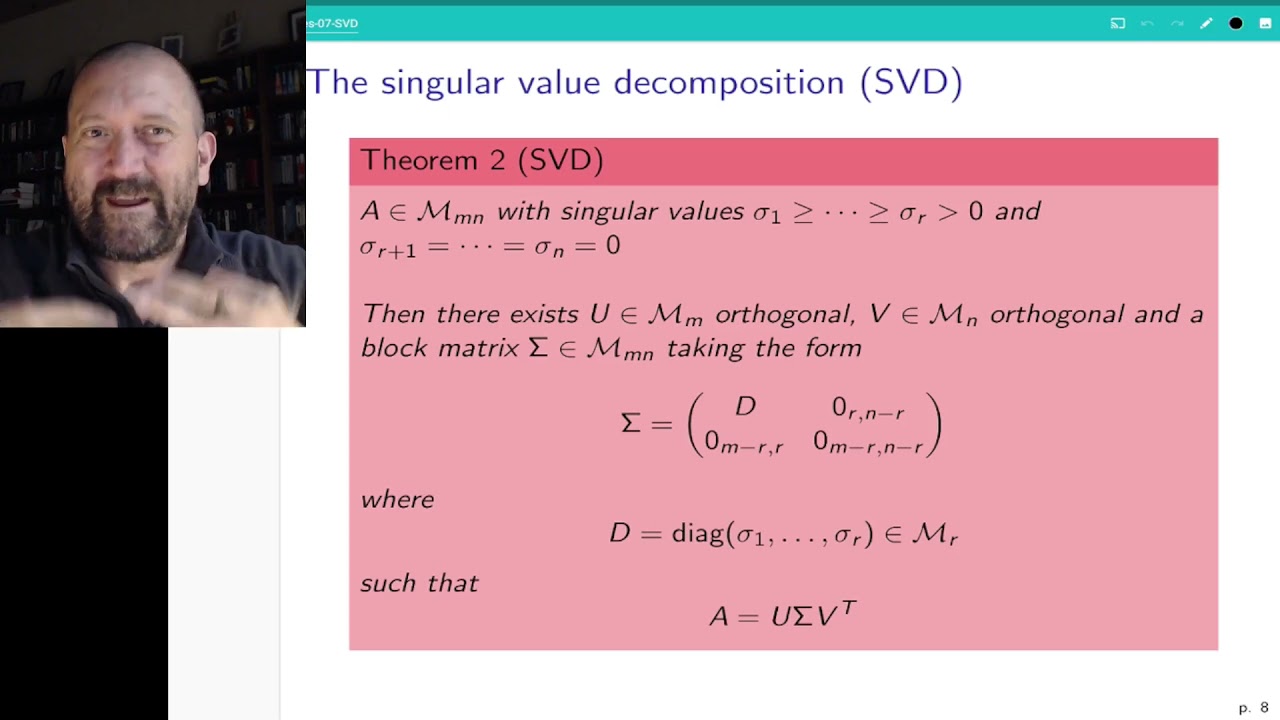
- Statement of the Singular Value Decomposition theorem.
- Explanation of block matrix Σ and its components.
- Geometric interpretation: U and V as rotations/reflections, Σ as scaling.
- Outer product form of SVD: A as sum of rank-1 matrices.
- Proof that eigenvectors for distinct eigenvalues are orthogonal.
- Procedure for computing SVD when eigenvalues are distinct.
- Discussion of repeated eigenvalues and algebraic/geometric multiplicity.
Contribution & Novelties
The lecture provides a clear and rigorous exposition of the theory of SVD, including proofs and computational procedures. It is particularly useful for students learning linear algebra. For further exploration, one can look into applications of SVD in data compression, principal component analysis, and recommendation systems.
Pour aller plus loin :
- Singular value decomposition - Wikipedia — Comprehensive overview of SVD, including applications.
- Principal component analysis - Wikipedia — SVD is used in PCA for dimensionality reduction.
- Low-rank approximation - Wikipedia — SVD provides optimal low-rank approximations.
87 words
Radar Profile
The radar profile shows high scores in quality, technical level, and reliability, with a slightly lower score in quantity, reflecting the focused theoretical nature of the lecture. This indicates a well-structured and reliable educational resource.