Mathematical Epidemiology - Lecture 07 - Stochastic models
Keywords
Summary
137 words
Critical Evaluation
Value of the Information & Strength of the Argument
The lecture provides valuable insights into the importance of stochastic modeling in epidemiology, using clear examples to demonstrate how stochastic models can yield different outcomes compared to deterministic ones. The argumentation is solid, grounded in mathematical theory and illustrated with simulations. The instructor effectively explains the concepts of DTMCs and CTMCs, including their construction and simulation, and highlights practical considerations such as the choice of time step and the use of software packages.
Scientific Rigor, Source Quality, Title Accuracy
The lecture is scientifically rigorous, with clear definitions and mathematical formulations. The instructor references authoritative sources, including a book by Linda Allen and a primer on stochastic epidemic models. The title accurately reflects the content, which is focused on stochastic models in epidemiology. The lecture is well-structured and suitable for an advanced audience.
141 words
Title / Content Match
The title accurately reflects the content, which focuses on stochastic models in mathematical epidemiology.
Quality & Reliability
8/10
The lecture is given by a university professor with expertise in mathematical epidemiology, and it is part of a structured course. The content is based on established theory and includes references to authoritative sources. The presentation is clear and rigorous, with mathematical formulations and simulation examples.
Key Moments
Markers derived by PSI from the transcript: the creator did not define chapters.
- Introduction to the lecture on stochastic epidemic models.
- Discussion on why stochasticity matters, with examples.
- Comparison of deterministic and stochastic SIS model outcomes.
- Introduction to discrete-time Markov chains (DTMCs).
- Construction of transition matrix for SIS model as DTMC.
- Simulation of DTMC using R packages.
- Introduction to continuous-time Markov chains (CTMCs).
- Derivation of CTMC from ODE model.
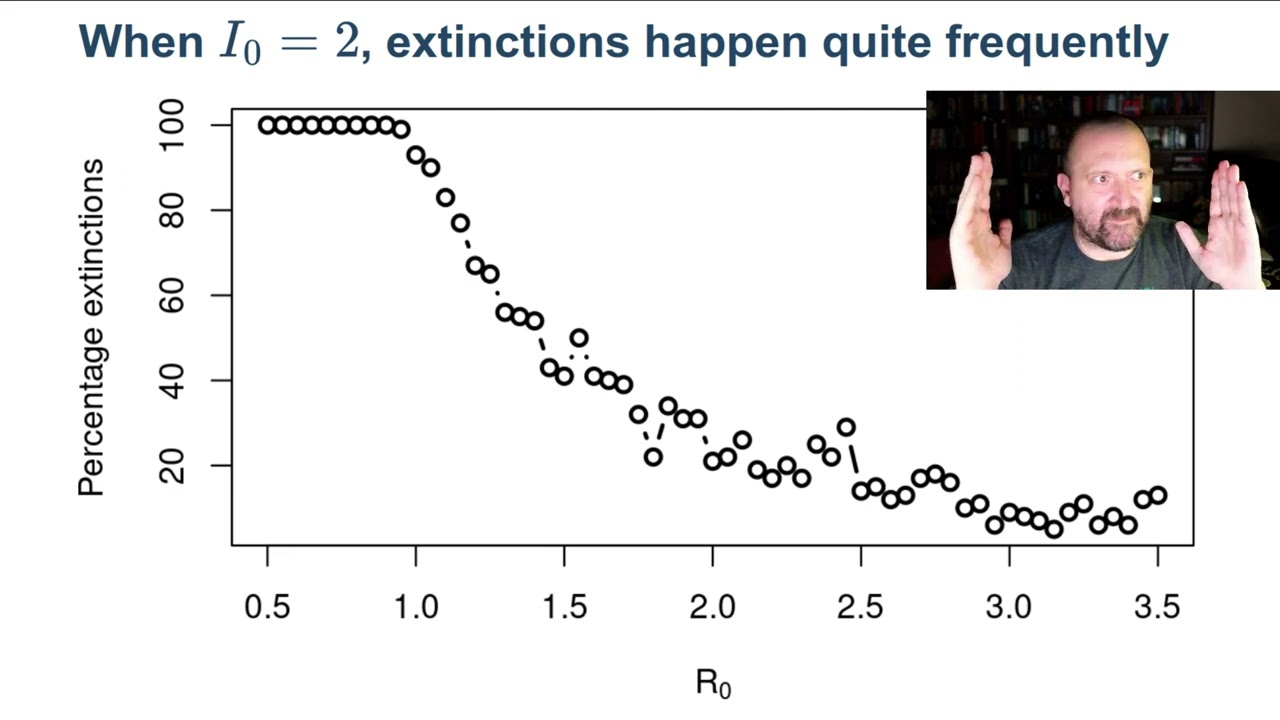
- Discussion on extinction probabilities and practical implications.
Cited Sources
- Slides for Lecture 07: Stochastic models — The slides used in the lecture, containing the material presented.
Concurring Sources
- Stochastic epidemic models: A primer — Referenced in the lecture as a recommended resource for stochastic epidemic models.
Contribution & Novelties
The lecture provides a clear pedagogical introduction to stochastic epidemic models, emphasizing the practical differences from deterministic models. It highlights the phenomenon of stochastic extinction even when R0 > 1, which is crucial for understanding disease dynamics in small populations. The lecture also offers practical guidance on simulating DTMCs and CTMCs using R packages.
Pour aller plus loin :
- Stochastic epidemic models: A primer — A comprehensive primer by Linda Allen on stochastic epidemic models.
- An Introduction to Stochastic Processes with Applications to Biology — A book by Linda Allen covering stochastic processes in biology.
- Markov chain — Wikipedia article on Markov chains, providing background on the mathematical concept.
109 words
Radar Profile
The radar profile shows high scores across all dimensions, indicating a well-rounded and reliable lecture. The strong scores in information quantity and quality reflect the depth of content, while the high technical level and reliability underscore its scientific rigor.