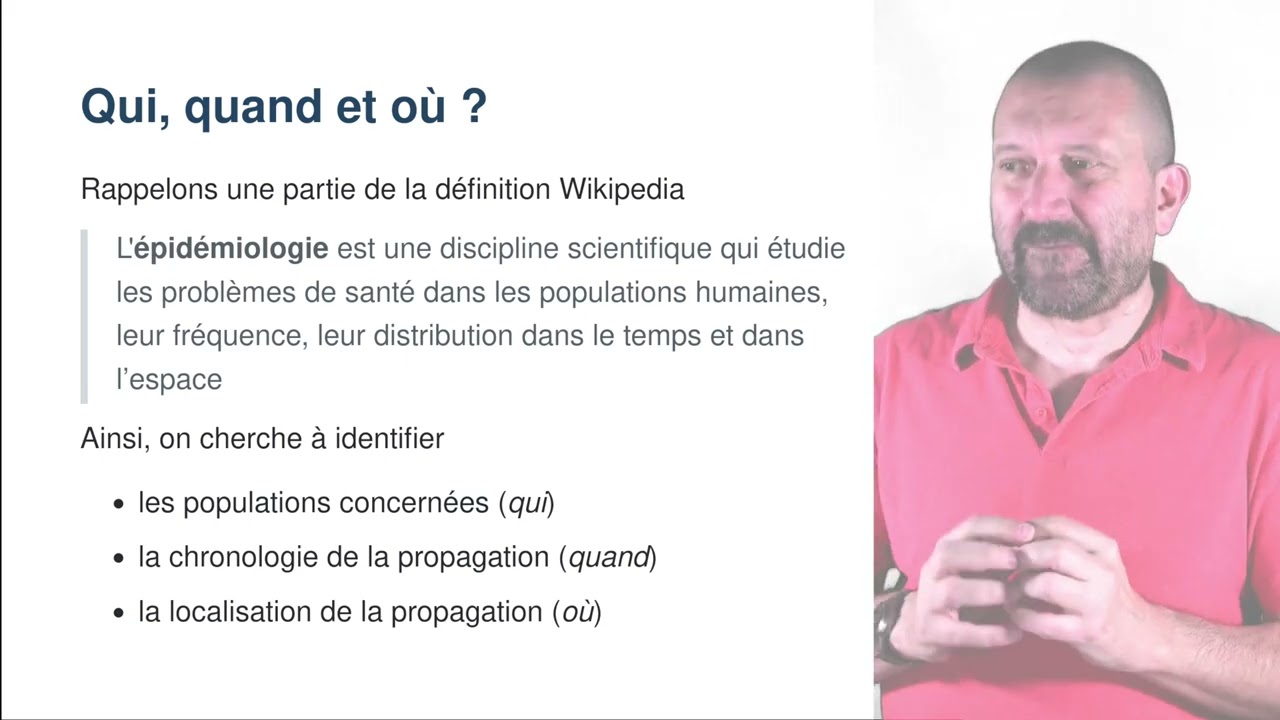
Cours 01 - Épidémies, épidémiologie et épidémiologie mathématique
Keywords
Summary
151 words
Critical Evaluation
Value of the Information & Strength of the Argument
The video provides a solid foundational overview of epidemiological concepts, clearly explaining key terms and distinctions. The argumentation is logical and well-structured, moving from historical examples to definitions and then to practical applications. The lecturer effectively uses examples and visual aids to illustrate points, such as epidemic curves and John Snow’s map. However, the depth is limited as it is an introductory course, and some topics are only briefly touched upon. The value lies in its clarity and accessibility for beginners, though experts may find it too basic.
Scientific Rigor, Source Quality, Title Accuracy
The scientific rigor is high for an introductory lecture. The lecturer references historical sources and WHO definitions, and provides a link to course slides for further study. The content aligns with established epidemiological knowledge. The title accurately reflects the content, covering all three areas mentioned. No comments were provided for analysis.
154 words
Title / Content Match
The title accurately reflects the content, covering epidemics, epidemiology, and mathematical epidemiology as promised.
Quality & Reliability
8/10
The video is an academic lecture by a university professor, providing a structured introduction to epidemiology and mathematical epidemiology. It references historical sources, WHO definitions, and includes a link to course slides. The content is accurate and well-organized, though it is an introductory overview rather than a detailed study.
Chapters
Cited Sources
- Course slides (corrected) — The lecturer refers to these slides throughout the video, which contain the material presented.
Concurring Sources
- WHO pandemic phases — The lecturer references the WHO's six-phase pandemic classification, which is consistent with this official source.
Contribution & Novelties
The video offers a clear and concise introduction to epidemiology and mathematical epidemiology, making it a useful starting point for students. It emphasizes the importance of terminology and the distinction between incidence and prevalence, which is often misunderstood. The inclusion of historical context and the One Health perspective adds depth.
Pour aller plus loin :
- One Health — A concept central to the lecture, emphasizing the interconnection between human, animal, and environmental health.
- John Snow — The pioneering epidemiologist whose work on cholera is highlighted in the video.
- Compartmental models in epidemiology — The mathematical models that build on the concepts introduced here.
103 words
Radar Profile
The radar profile shows high scores in quality and reliability, with moderate scores in quantity and technical level. This indicates a well-structured and accurate introductory lecture, but with limited depth and technical detail, suitable for beginners.