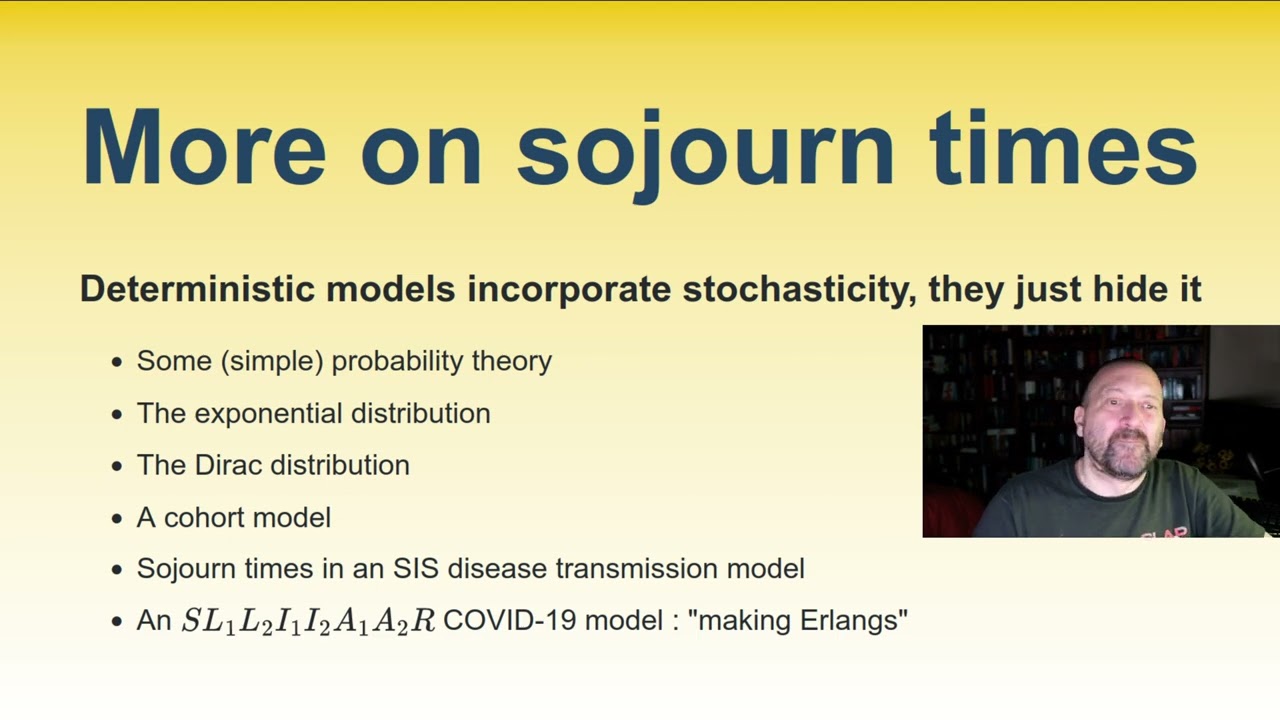
Mathematical Epidemiology - Lecture 06 - Stochastic aspects in the spread of epidemics
Keywords
Summary
143 words
Critical Evaluation
Value of the Information & Strength of the Argument
The lecture provides valuable insights into the often-overlooked stochastic assumptions underlying deterministic epidemic models. The argumentation is solid, systematically deriving how different sojourn time distributions lead to different model types (ODE vs. DDE). The instructor effectively uses examples and mathematical derivations to support his points, making a compelling case for careful consideration of sojourn time distributions in modeling.
Scientific Rigor, Source Quality, Title Accuracy
The lecture is scientifically rigorous, with clear definitions and derivations. The instructor references standard probability theory and demonstrates the mathematical connections. The title accurately reflects the content. The slides are available online, providing additional resources. The audio issue is acknowledged but does not detract from the scientific value.
121 words
Title / Content Match
The title accurately reflects the content, which focuses on stochastic aspects in epidemic spread, including sojourn times and their implications for model structure.
Quality & Reliability
8/10
The lecture is part of a university course, presented by an academic expert in mathematical epidemiology. The content is rigorous, with clear mathematical derivations and references to standard probability theory. The audio issue is noted but does not affect the scientific content.
Key Moments
Markers derived by PSI from the transcript: the creator did not define chapters.
- Introduction to stochastic aspects in epidemic modeling
- Motivation for stochasticity in biological processes
- Discussion on sojourn times and their importance
- Review of probability theory: density, cumulative distribution, survival function
- Hazard rate and its interpretation
- Exponential distribution and its properties
- Cohort model with exponential sojourn time leads to ODE
- SIS model with general sojourn time distribution
- Exponential sojourn time yields classic SIS ODE
- Fixed sojourn time leads to delay differential equation
Cited Sources
- Lecture slides — Slides used in the lecture, containing detailed mathematical derivations and figures.
Concurring Sources
- Wikipedia: Exponential distribution — Provides background on the exponential distribution and its properties.
- Wikipedia: Delay differential equation — Explains delay differential equations, which arise from fixed sojourn times.
Contribution & Novelties
This lecture provides a clear pedagogical explanation of how stochastic assumptions are embedded in deterministic epidemic models, specifically through sojourn time distributions. It bridges probability theory and compartmental modeling, offering a valuable perspective for modelers. The comparison between exponential and fixed sojourn times and their implications for ODE vs. DDE models is particularly insightful.
Pour aller plus loin :
- Exponential distribution — Key distribution in stochastic modeling, memoryless property.
- Delay differential equation — Equations with time delays, arising from fixed sojourn times.
- Survival analysis — Statistical methods for time-to-event data, relevant to sojourn times.
94 words
Radar Profile
The radar profile shows high scores across all dimensions, indicating a technically rigorous and well-structured lecture. The balance between information quantity, quality, and technical depth suggests a comprehensive treatment of the topic, suitable for an advanced audience.