UofM - MATH 2740 - Lecture 06 - Part 1 - QR factorisation (theory)
Keywords
Summary
180 words
Critical Evaluation
Value of the Information & Strength of the Argument
The lecture provides a solid theoretical foundation for QR factorization, which is a valuable technique in numerical linear algebra. The argumentation is rigorous and well-structured: definitions are clearly stated, theorems are presented with proofs, and the reasoning is logical. The instructor emphasizes the importance of linear independence and orthogonality, and connects these concepts to practical applications like least squares. The proof of the eigenvalue property of orthogonal matrices is particularly well-explained, demonstrating the isometry property. The value lies in its clear exposition of abstract concepts, making them accessible to students. However, the lecture is purely theoretical and does not include numerical examples or applications, which might limit its immediate practical value for some viewers.
Scientific Rigor, Source Quality, Title Accuracy
The lecture is scientifically rigorous, adhering to standard mathematical conventions and proofs. The instructor does not cite external sources, but this is typical for a course lecture where the content is based on established textbooks. The title accurately reflects the content, focusing on the theory of QR factorization. The presentation is coherent and well-paced, with clear explanations of each concept. The lack of citations is not a significant issue for a lecture, but for a standalone resource, it might be beneficial to reference standard textbooks. The content is consistent with the expected curriculum for a linear algebra course.
227 words
Title / Content Match
The title accurately reflects the content: the lecture focuses on the theoretical foundations of QR factorization, including orthogonal sets, orthogonal matrices, and projections.
Quality & Reliability
8/10
The lecture is a formal mathematical exposition, presenting definitions, theorems, and proofs with logical rigor. The content aligns with standard linear algebra curriculum, and the instructor demonstrates a clear understanding of the subject. However, the video is a single lecture without external citations or peer review, and the presentation is pedagogical rather than research-oriented.
Key Moments
Markers derived by PSI from the transcript: the creator did not define chapters.
- Introduction to the lecture and motivation for QR factorization in least squares problems.
- Definition of orthogonal sets and the theorem that orthogonal sets of non-zero vectors are linearly independent.
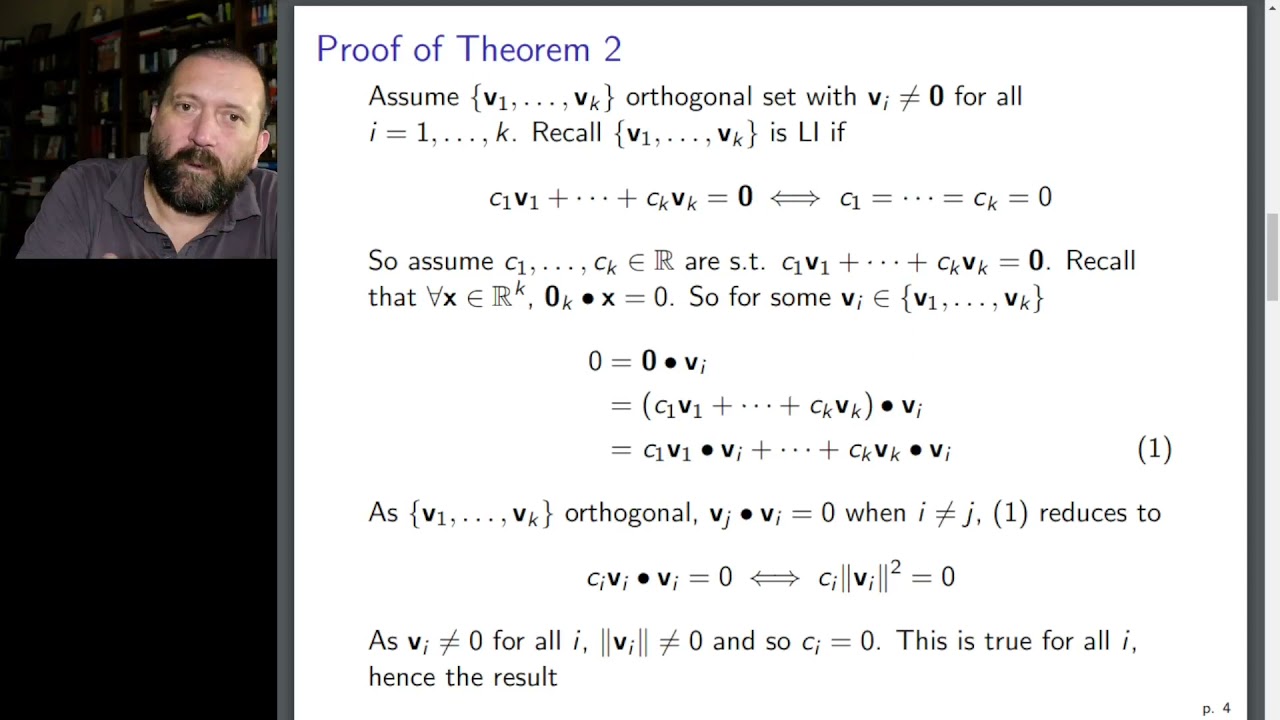
- Proof of the theorem that orthogonal sets are linearly independent.
- Example with the standard basis of R^3, illustrating orthogonal and orthonormal bases.
- Definition of orthogonal matrices and the property that Q^T Q = I.
- Properties of orthogonal matrices: isometry, determinant ±1, eigenvalues modulus 1, and closure under multiplication.
- Proof that eigenvalues of orthogonal matrices have modulus 1.
- Introduction to orthogonal projections and the projection formula onto a subspace with an orthogonal basis.
Contribution & Novelties
This lecture provides a clear and rigorous exposition of the theoretical underpinnings of QR factorization, which is a key technique in numerical linear algebra. The instructor’s step-by-step proofs and emphasis on the isometry property of orthogonal matrices offer a solid foundation for understanding why QR factorization is numerically stable. The lecture is particularly useful for students who need to grasp the abstract concepts before moving to computational applications.
Pour aller plus loin :
- QR decomposition - Wikipedia — Provides an overview of QR decomposition, its applications, and algorithms like Gram-Schmidt and Householder reflections.
- Orthogonal matrix - Wikipedia — Detailed properties and examples of orthogonal matrices, including their role in preserving lengths and angles.
- Gram-Schmidt process - Wikipedia — A fundamental algorithm for constructing an orthonormal basis, directly related to the QR factorization.
132 words
Radar Profile
The radar profile shows high scores in information quantity, quality, and reliability, with a slightly lower technical level, indicating a lecture that is comprehensive and trustworthy but may require some background knowledge. The overall balance suggests a solid educational resource.