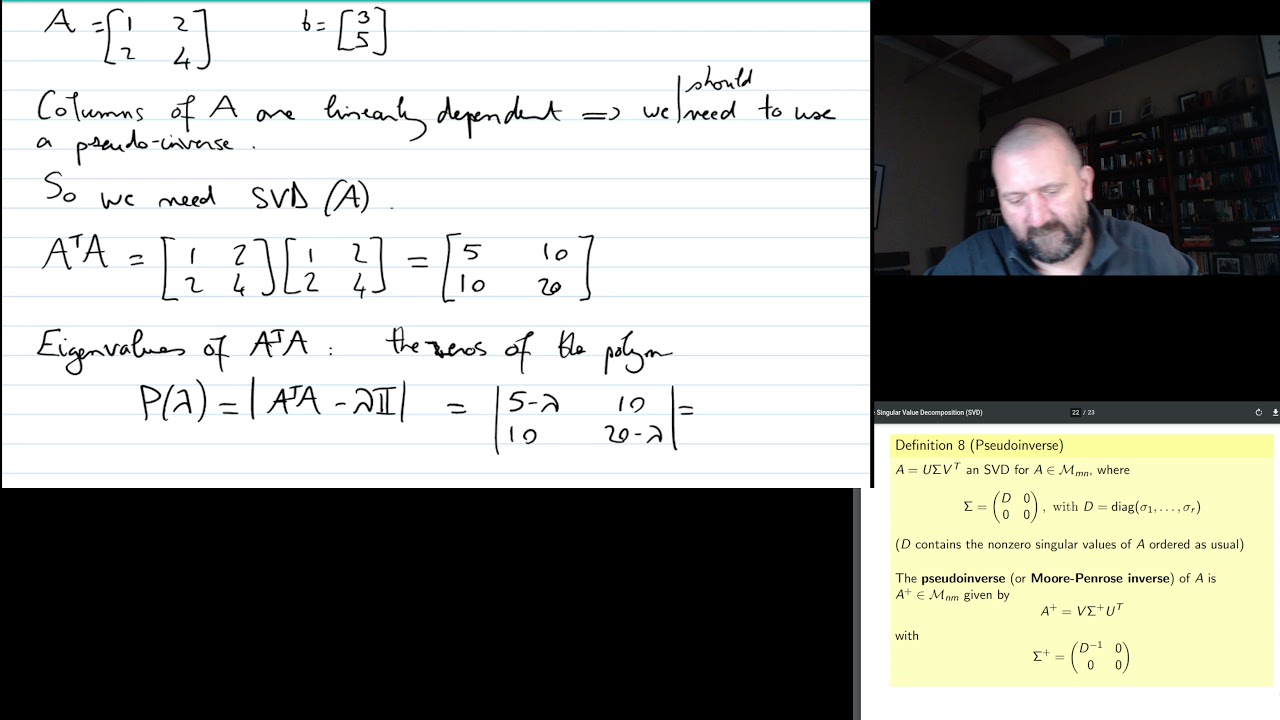
UofM - MATH 2740 - Lecture 09 - Part 2 - SVD and pseudo-inverse (example)
Keywords
Summary
198 words
Critical Evaluation
Value of the Information & Strength of the Argument
The value of this lecture lies in its clear, step-by-step demonstration of a complex linear algebra procedure. The instructor carefully explains each calculation, from forming A^T A to finding eigenvalues and eigenvectors, and then constructing the SVD and pseudo-inverse. The argumentation is solid: the instructor justifies each step, such as why the standard least squares theorem fails and how to handle zero singular values. The example is well-chosen to illustrate the complications that can arise, making it a valuable tutorial for students. The explanation of Gram-Schmidt orthogonalization to complete the orthogonal matrix U is particularly instructive. Overall, the lecture provides a thorough and rigorous treatment of the topic.
Scientific Rigor, Source Quality, Title Accuracy
The lecture is scientifically rigorous in its mathematical derivations. The instructor follows standard procedures for computing the SVD and pseudo-inverse, and the calculations are correct. However, no external sources are cited, and the lecture relies solely on the instructor’s presentation. The title accurately reflects the content, as it is a lecture on SVD and pseudo-inverse with a worked example. The lack of references is not a major issue for a tutorial, but it limits the ability to verify the content against other sources. The lecture is well-structured and the mathematical steps are clearly explained.
217 words
Title / Content Match
The title accurately describes the content: a lecture on SVD and pseudo-inverse with a worked example.
Quality & Reliability
8/10
The lecture is a clear, step-by-step mathematical derivation of the SVD and pseudo-inverse for a specific example. The instructor demonstrates the procedure thoroughly, including handling of zero singular values and Gram-Schmidt orthogonalization. The content is mathematically sound and well-explained, though it lacks external references and is based on a single instructor's presentation.
Key Moments
Markers derived by PSI from the transcript: the creator did not define chapters.
- Introduction: setting up the example matrix A and vector b, noting that A has linearly dependent columns.
- Computing A^T A and its eigenvalues (25 and 0).
- Finding eigenvectors of A^T A and normalizing them to form matrix V.
- Constructing the singular value matrix Σ with singular values 5 and 0.
- Computing the first left singular vector u1 using the formula u1 = (1/σ1) A v1.
- Applying Gram-Schmidt to find a second orthogonal vector u2 to complete U.
- Assembling the SVD: A = U Σ V^T.
- Computing the pseudo-inverse A^+ = V Σ^+ U^T.
- Solving the least squares problem using x = A^+ b and obtaining the final solution.
Contribution & Novelties
This lecture provides a clear, step-by-step example of computing the SVD and pseudo-inverse for a matrix with linearly dependent columns, which is a common but often glossed-over case. It demonstrates the necessity of Gram-Schmidt orthogonalization to complete the orthogonal matrix U when there are zero singular values. The lecture is particularly useful for students learning linear algebra and its applications to least squares problems.
Pour aller plus loin :
- Singular value decomposition — Overview of SVD, its properties, and applications.
- Moore–Penrose inverse — Definition and properties of the pseudo-inverse.
- Linear least squares — Connection between least squares and pseudo-inverse.
99 words
Radar Profile
The radar profile shows high scores across all dimensions, indicating a well-balanced and reliable educational resource. The lecture is technically detailed, provides substantial information, and is presented with clarity and rigor.