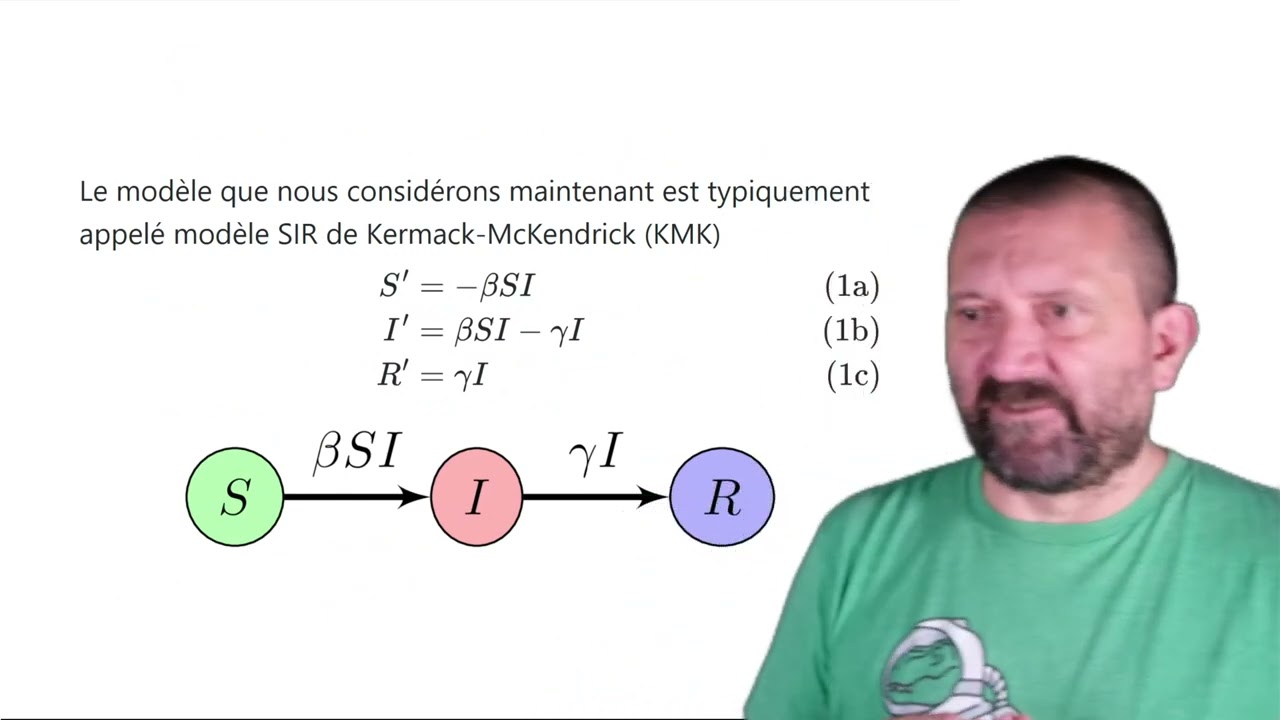
Cours 06 - Le modèle de Kermack et McKendrick
Keywords
Summary
181 words
Critical Evaluation
Value of the Information & Strength of the Argument
The video provides a solid mathematical foundation for understanding epidemic models. The argumentation is rigorous, with step-by-step derivations of the key equations. The instructor clearly explains the assumptions and their implications, such as the neglect of demographics and the meaning of the removed compartment. The use of the phase plane and the derivation of the final size equation are particularly valuable. The presentation is logical and builds on previous knowledge, making it accessible to students with a background in differential equations.
Scientific Rigor, Source Quality, Title Accuracy
The scientific rigor is high, as the content is based on the original 1927 paper by Kermack and McKendrick. The instructor mentions this paper and provides a link to his own course slides, which likely contain further references. The title accurately reflects the content. The video is a tutorial, and the instructor does not cite external sources beyond the original paper, but the mathematical derivations are self-contained and correct.
165 words
Title / Content Match
The title accurately reflects the content, which is a lecture on the Kermack-McKendrick model.
Quality & Reliability
8/10
The video is a clear and rigorous mathematical exposition of the Kermack-McKendrick model, based on the original 1927 paper. The presenter derives the key results step-by-step, including the epidemic threshold and final size equation. The content is accurate and well-structured, though it lacks explicit citations to external sources beyond the original paper.
Key Moments
Markers derived by PSI from the transcript: the creator did not define chapters.
- Introduction to the Kermack-McKendrick model and its historical context.
- Presentation of the model assumptions and the compartmental diagram.
- Derivation of the differential equations and the constant population property.
- Analysis of equilibria and the continuum of disease-free equilibria.
- Derivation of the relationship between I and S and the definition of R0.
- Discussion of the epidemic peak and the threshold condition R0 > 1.
- Numerical simulation example with Python code.
- Introduction to the final size of an epidemic and its public health importance.
- Derivation of the final size equation.
- Conclusion and remarks on the significance of the model.
Cited Sources
- Cours 06 - Le modèle de Kermack et McKendrick (slides) — The instructor refers to these slides as the basis for the lecture.
Concurring Sources
- Kermack-McKendrick theory — Wikipedia article on the Kermack-McKendrick model, which aligns with the content of the video.
Contribution & Novelties
The video provides a clear and detailed exposition of the Kermack-McKendrick model, emphasizing the derivation of the final size equation and the epidemic threshold. It is particularly useful for students and researchers seeking a rigorous mathematical introduction to epidemic modeling.
Pour aller plus loin :
- Kermack-McKendrick theory — Overview of the model and its extensions.
- Compartmental models in epidemiology — General framework for SIR-type models.
- Basic reproduction number — Definition and significance of R0.
74 words
Radar Profile
The radar profile shows high scores in all dimensions, indicating a well-balanced and reliable educational resource. The strongest aspects are the quality and quantity of information, as well as the technical level, which are all rated 8 out of 10. The overall reliability is also high, reflecting the rigorous mathematical treatment.