UofM - MATH 2740 - Lecture 23 - Part 2 - Markov chains in R
Keywords
Summary
115 words
Critical Evaluation
Value of the Information & Strength of the Argument
The video provides a hands-on, practical approach to implementing Markov chains in R, which is valuable for students learning both the theory and computational aspects. The instructor explains the reasoning behind each step, such as why the left eigenvector is needed and how to normalize it. He also demonstrates the difference between tracking the probability distribution and simulating individual paths, which is a key conceptual distinction. The argumentation is clear and logical, with code examples that illustrate the concepts. The debugging segments add authenticity and show how to troubleshoot common errors.
Scientific Rigor, Source Quality, Title Accuracy
The video is a lecture, so it does not cite external sources, but the mathematical content is standard and correctly presented. The title accurately reflects the content. The instructor’s explanations are rigorous, and he correctly applies the definitions of regular and absorbing Markov chains. The code is functional and well-commented. No external sources are needed for this tutorial, as it is self-contained.
168 words
Title / Content Match
The title accurately describes the content: a lecture on Markov chains in R, specifically part 2 of lecture 23.
Quality & Reliability
7/10
The video is a clear, step-by-step tutorial on implementing Markov chains in R, with code demonstrations and explanations. The mathematical concepts are correctly applied, and the instructor shows debugging processes. However, the video is a lecture recording with no external sources cited, and the green screen experiment causes minor sync issues.
Key Moments
Markers derived by PSI from the transcript: the creator did not define chapters.
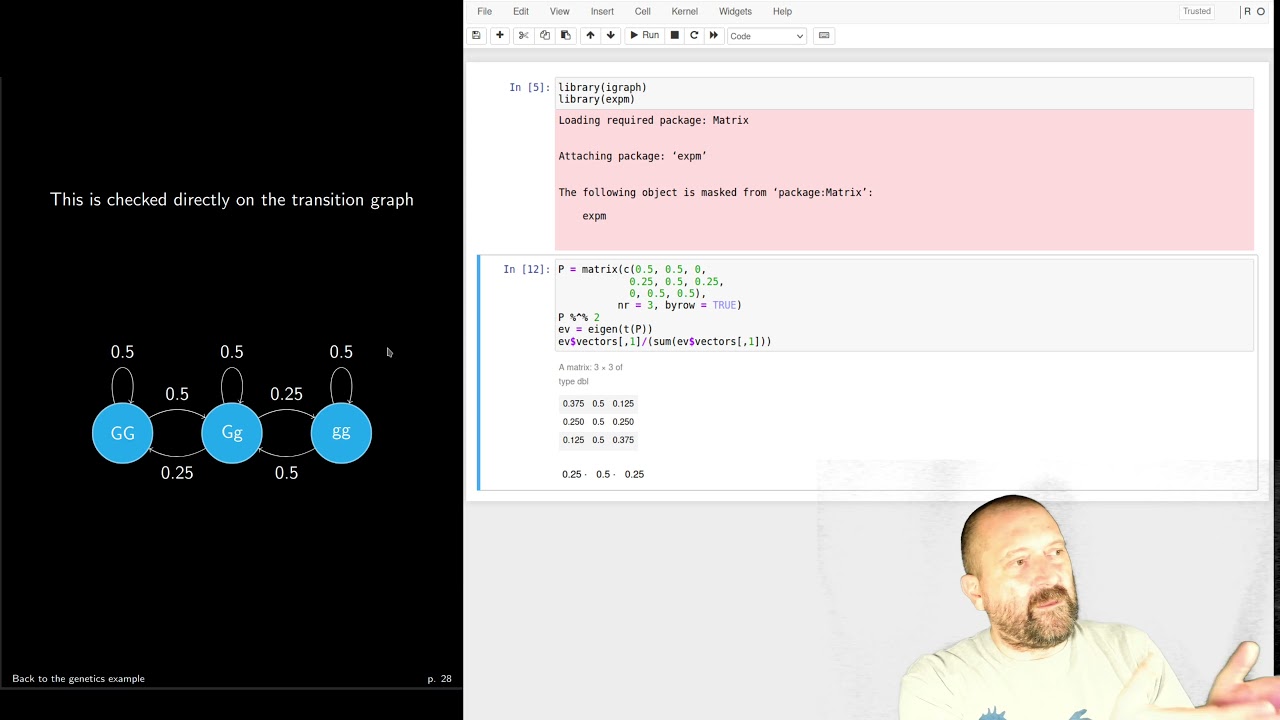
- Introduction and setup: loading the igraph library, defining the transition matrix P.
- Checking primitivity by computing P^2 and verifying all entries are positive.
- Computing eigenvalues and eigenvectors, finding the stationary distribution via the left eigenvector.
- Simulating the evolution of the chain by iterating probability vectors and observing convergence.
- Creating a custom R function to simulate individual paths of the Markov chain.
- Debugging the simulation function and testing it with different initial states.
- Plotting the simulated chain's state over time.
- Introduction to absorbing Markov chains and demonstrating absorption.
- Modifying the transition matrix to explore different behaviors and observing the effect.
- Constructing a larger absorbing chain programmatically and examining the resulting matrix.
Contribution & Novelties
The video provides a clear, practical tutorial on implementing Markov chains in R, which is valuable for students learning computational methods. It bridges theory and application by showing both the mathematical derivation and the code implementation. The instructor’s approach of simulating individual paths rather than just probability distributions offers a deeper understanding of stochastic processes.
Pour aller plus loin :
- Markov chain - Wikipedia — Overview of Markov chains, including definitions and properties.
- Stochastic matrix - Wikipedia — Explanation of transition matrices and their properties.
- R documentation for ’eigen’ — Reference for computing eigenvalues and eigenvectors in R.
98 words
Radar Profile
The radar profile shows a balanced performance across all dimensions, with slightly higher scores in quantity of information and technical level, indicating a comprehensive and technically sound tutorial. The lower score in quality of information and reliability reflects the lack of external sources and the informal nature of the lecture.