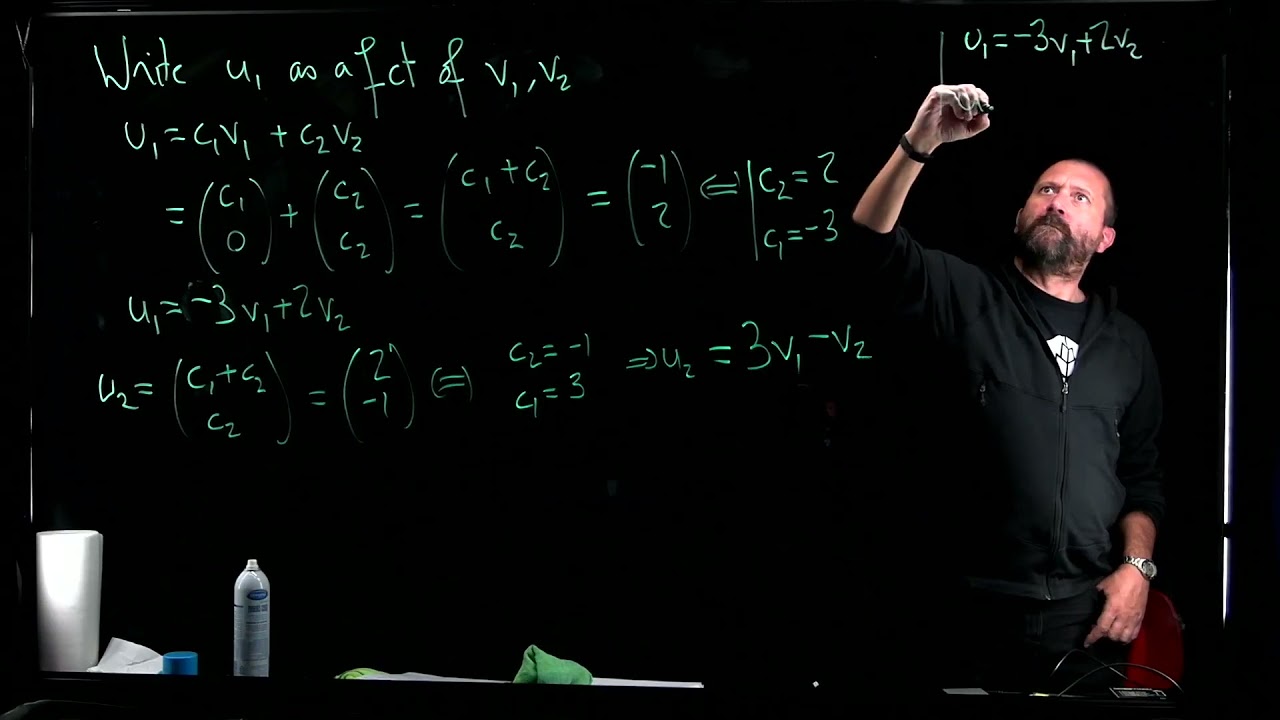
UofM - MATH 2740 - Lecture 11 - Part 2 - Examples of change of basis
Keywords
Summary
222 words
Critical Evaluation
Value of the Information & Strength of the Argument
The video provides valuable worked examples that illustrate the concept of change of basis, which is often abstract. The instructor carefully explains each step, from expressing basis vectors in terms of another basis to constructing the change of basis matrix. The argumentation is solid: he starts with a concrete vector in R^2, then moves to polynomials, showing the generality of the method. The reasoning is clear and logical, with no apparent errors. The examples are well-chosen to demonstrate the process and its application.
Scientific Rigor, Source Quality, Title Accuracy
The video is a lecture, so it does not cite external sources. The mathematical content is standard and correct, aligning with typical linear algebra curricula. The title accurately reflects the content, which is a focused tutorial on change of basis. The production quality is rough (faint pen, audio issues), but this does not affect the mathematical rigor. No comments were provided for analysis.
161 words
Title / Content Match
The title accurately describes the content: two examples of change of basis.
Quality & Reliability
8/10
The video is a clear, step-by-step tutorial on change of basis in linear algebra, with worked examples. The mathematical content is accurate and well-explained, though the production quality is rough (faint pen, audio issues). No external sources are cited, but the content is standard and correct.
Key Moments
Markers derived by PSI from the transcript: the creator did not define chapters.
- Introduction and setup: two bases for R^2 are defined.
- Example 1: Expressing vector x=(5,-1) in basis B and C.
- Computing the change of basis matrix from B to C.
- Applying the change of basis matrix to verify coordinates.
- Example 2: Introducing polynomial vector space P2 and bases B and C.
- Expressing polynomial p(x)=1+x^2 in basis B.
- Expressing p(x) in canonical basis C.
- Constructing the change of basis matrix for polynomials.
- Verifying the change of basis matrix by multiplication.
Contribution & Novelties
The video provides a clear, step-by-step demonstration of change of basis, which is a fundamental concept in linear algebra. It is particularly useful for students who need to see worked examples, as it bridges the gap between abstract theory and practical computation. The second example with polynomials illustrates that the concept applies beyond standard Euclidean spaces, reinforcing the generality of the method.
Pour aller plus loin :
- Change of basis - Wikipedia — Provides a comprehensive overview of the concept, including formulas and examples.
- Linear Algebra - Khan Academy — Offers interactive lessons on coordinate systems and change of basis.
- MIT OpenCourseWare - Linear Algebra — Includes lecture videos and notes on change of basis and related topics.
118 words
Radar Profile
The radar profile shows high scores in quality of information and reliability, reflecting the accurate mathematical content. The quantity of information is moderate, as the video is focused on two examples. The technical level is appropriate for an undergraduate linear algebra course.