Cours 05 - Fonctions d'incidence
Keywords
Summary
151 words
Critical Evaluation
Value of the Information & Strength of the Argument
The video provides a comprehensive overview of incidence functions, explaining their mathematical forms, underlying assumptions, and implications for modeling. The argumentation is solid, with clear derivations and references to key literature. The instructor effectively contrasts different incidence functions and demonstrates their impact on model dynamics through a specific example. The value lies in the clarity of exposition and the practical insights for modelers.
72 words
Title / Content Match
The title accurately reflects the content, which focuses on incidence functions in mathematical epidemiology.
Quality & Reliability
8/10
The video is a well-structured lecture on incidence functions in mathematical epidemiology, presenting both standard and less common forms, with references to classical papers. The mathematical derivations are clear and rigorous, though some slides contain minor typos. The content is reliable for educational purposes.
Key Moments
Markers derived by PSI from the transcript: the creator did not define chapters.
- Introduction to incidence functions and their importance in mathematical epidemiology.
- Distinction between incidence and force of infection, and their equivalence.
- Discussion of the two main components of incidence: contacts and transmission probability.
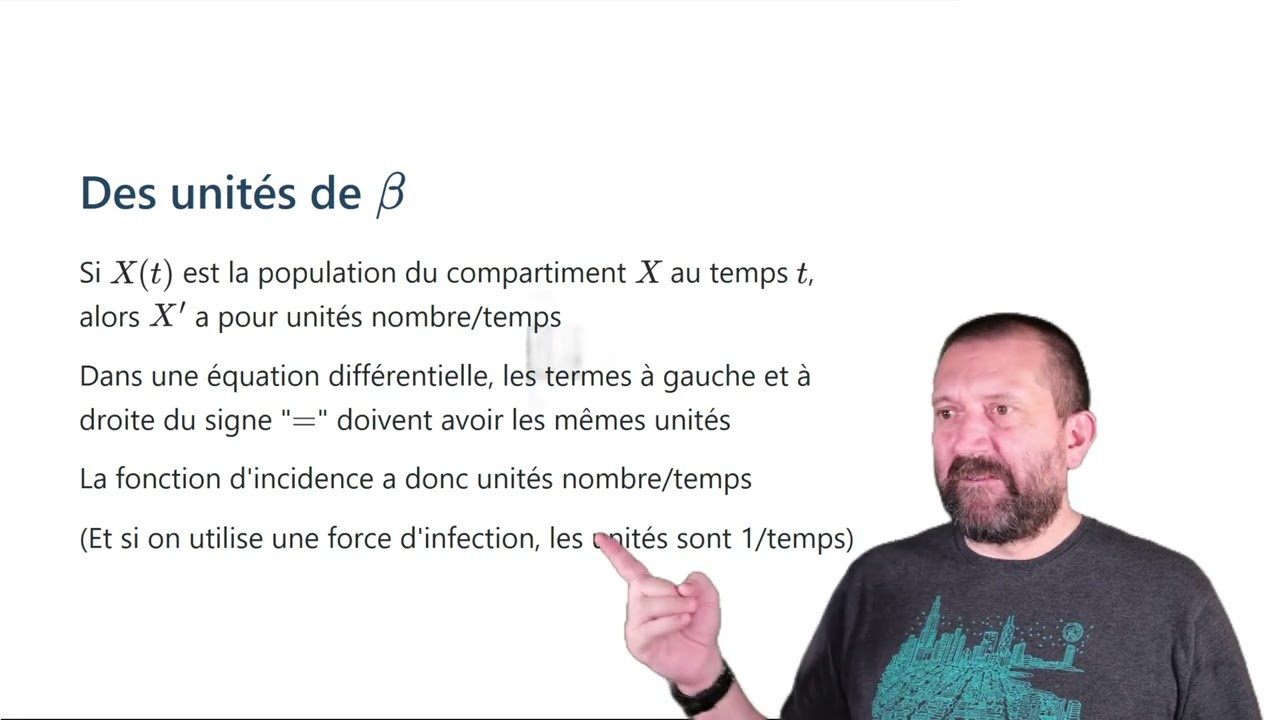
- Presentation of mass action and standard incidence, with units and assumptions.
- Equivalence of mass action and standard incidence when population is constant.
- Overview of other incidence functions: general, heterogeneous, negative binomial, and synthetic contact.
- Detailed example from Kribs on saturation, comparing smooth and switch-like functions.
- Analysis of the SIS model with logistic population dynamics and different incidence functions.
- Discussion of equilibria and stability for the two incidence functions.
- Conclusion and summary of key takeaways.
Cited Sources
- Cours 05 - Fonctions d'incidence (slides) — The slides for this lecture, containing the mathematical details and references.
Concurring Sources
- McCallum et al. (2001) - How should pathogen transmission be modelled? — Referenced in the video as a recommended reading on incidence functions.
Contribution & Novelties
The lecture provides a clear and systematic overview of incidence functions, highlighting their importance and the nuances in their selection. It goes beyond the standard mass action and standard incidence by presenting several less common forms and a detailed example of saturation. The discussion of units and the equivalence under constant population is particularly instructive.
Pour aller plus loin :
- McCallum et al. (2001) - How should pathogen transmission be modelled? — A foundational paper on incidence functions.
- Kribs-Zaleta (2006) - The effect of incidence function on the dynamics of an SIS model — The paper discussed in the video.
- Force of infection - Wikipedia — A general reference on the concept.
112 words
Radar Profile
The radar profile shows high scores in information quantity, quality, and reliability, with a slightly lower technical level, indicating a well-balanced and accessible lecture for an intermediate audience.