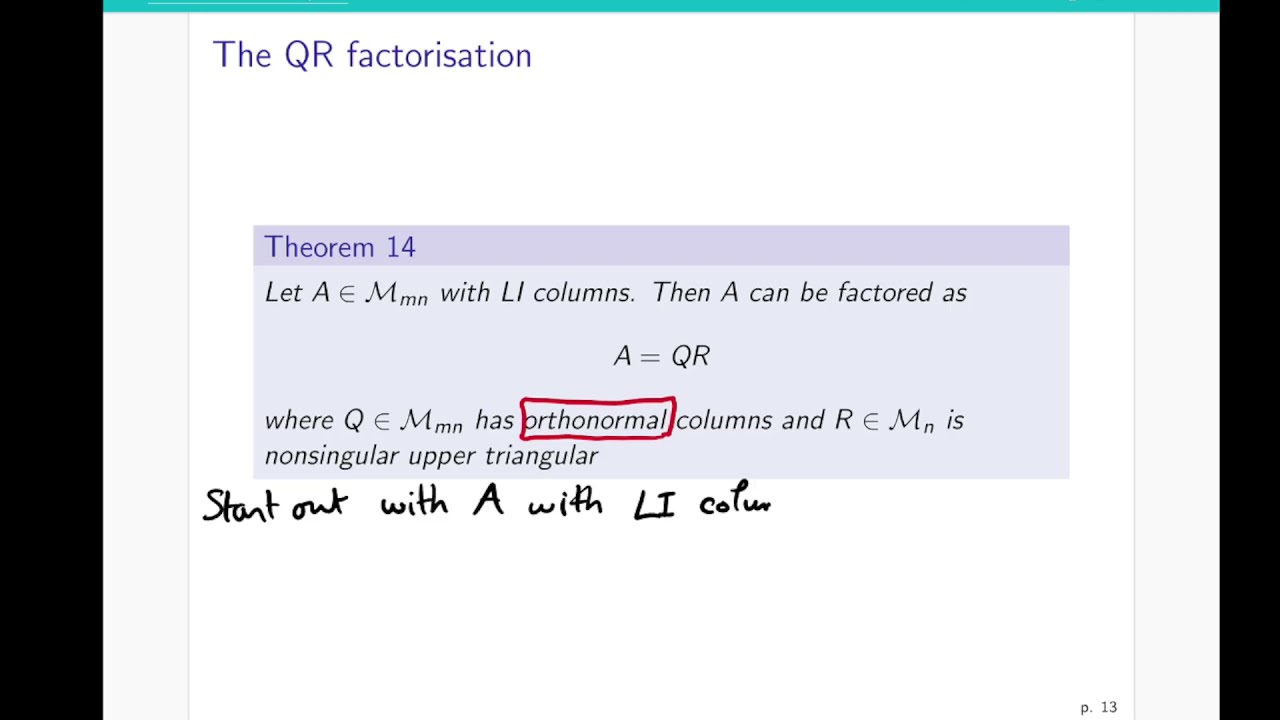
UofM - MATH2740 - Lecture 07 - Part 1 - Computing and using the QR factorisation
Keywords
Summary
127 words
Critical Evaluation
Value of the Information & Strength of the Argument
The lecture provides a solid foundation in QR factorization, with clear explanations and worked examples. The instructor carefully derives the formulas and verifies results, which strengthens the argumentation. The value lies in the step-by-step approach, making the method accessible. The use of R for implementation adds practical value, bridging theory and application. The argumentation is logical and coherent, with no unsupported claims.
Scientific Rigor, Source Quality, Title Accuracy
The lecture is rigorous in its mathematical derivations and checks. The instructor uses standard results from linear algebra and verifies computations. No external sources are cited, but the content is based on established theory. The title accurately describes the content. The lecture is well-structured, and the instructor acknowledges and corrects minor computational errors, demonstrating intellectual honesty.
133 words
Title / Content Match
The title accurately reflects the content: a lecture on computing and using the QR factorization.
Quality & Reliability
8/10
The lecture is a clear, step-by-step tutorial on QR factorization, with detailed derivations and numerical examples. The instructor demonstrates the method and verifies results, showing rigor. The content is standard linear algebra, well-established, and the presentation is accurate. Minor computational errors are acknowledged and corrected, but the overall reliability is high.
Key Moments
Markers derived by PSI from the transcript: the creator did not define chapters.
- Introduction to QR factorization and review of theorem
- Explanation of Gram-Schmidt process for QR
- Simple 2x2 example: computing Q and R
- Verification of QR product
- More complex 3x2 example with Gram-Schmidt
- Normalization and construction of Q
- Discussion of R computation via Q^T A
- Introduction to using QR in R
- Demonstration of qr() function and extracting Q and R
- Checking orthonormality of Q columns
Contribution & Novelties
The lecture provides a clear pedagogical exposition of QR factorization, emphasizing both theoretical derivation and practical implementation in R. It bridges the gap between hand computation and software usage, which is valuable for students. The examples illustrate common pitfalls, such as ill-conditioning in least squares, and how QR helps. The lecture also highlights the importance of checking conditions like linear independence.
Pour aller plus loin :
- QR decomposition - Wikipedia — Overview and applications.
- Gram-Schmidt process - Wikipedia — Detailed explanation of the orthogonalization method.
- Least squares - Wikipedia — Context for using QR in regression.
96 words
Radar Profile
The radar profile shows high scores in information quantity, quality, and reliability, with a slightly lower technical level. This indicates a comprehensive and accurate tutorial that is accessible to an intermediate audience.