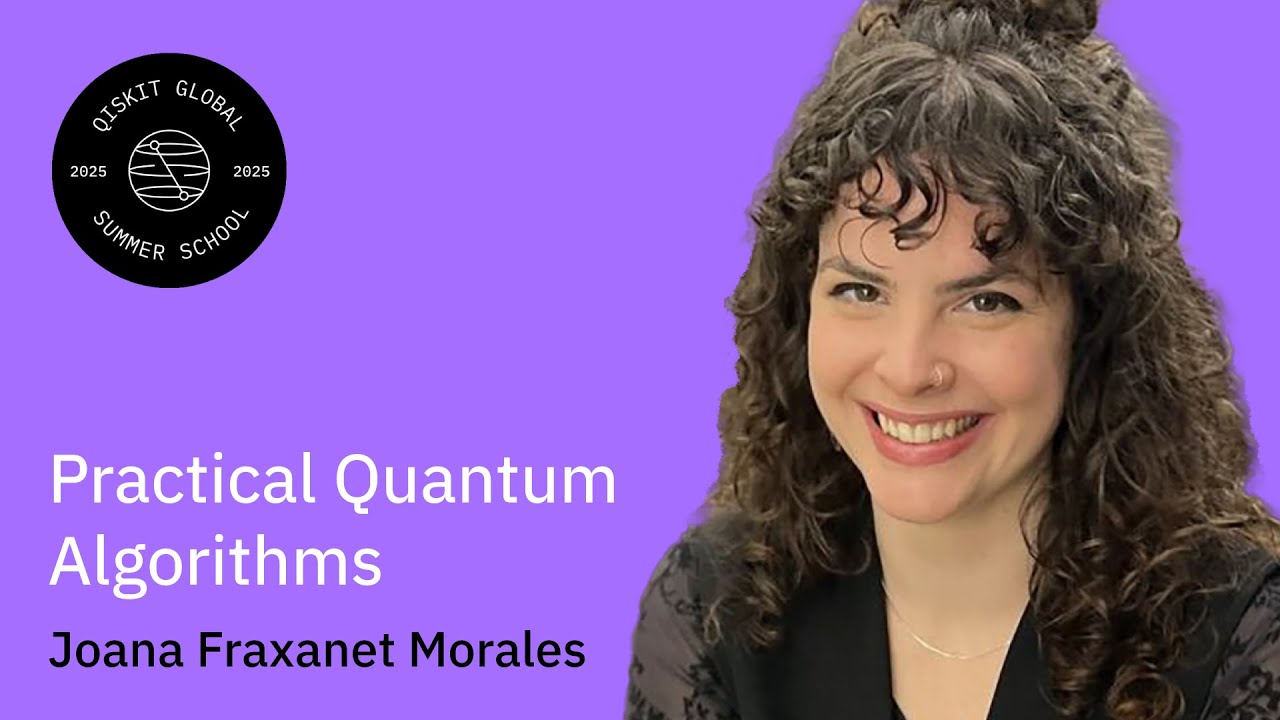
Practical Quantum Algorithms: Joana Fraxanet Morales | QGSS 2025
Keywords
Summary
170 words
Critical Evaluation
Value of the Information & Strength of the Argument
The talk provides a clear and structured overview of variational quantum algorithms, explaining the rationale behind each component and how they fit together. The speaker effectively argues for the hybrid approach, highlighting the strengths of quantum and classical processors. She supports her points with concrete examples, such as VQE for quantum chemistry and QAOA for optimization, and discusses practical considerations like ansatz selection and optimizer choice. The argumentation is solid, though it relies on established knowledge rather than novel insights. The value lies in its pedagogical clarity and practical guidance for implementing VQAs on current hardware.
Scientific Rigor, Source Quality, Title Accuracy
The talk demonstrates scientific rigor by accurately describing the principles and challenges of VQAs. The speaker references Qiskit documentation and courses, which are reliable sources for the tools discussed. However, she does not cite external research papers or provide detailed evidence for claims about scalability and reliability. The title accurately reflects the content, as the talk is indeed a practical guide to quantum algorithms. The presentation is well-organized and technically sound, though it could benefit from more explicit citations to primary literature.
193 words
Title / Content Match
The title accurately reflects the content: a practical guide to quantum algorithms, focusing on variational methods, presented by a researcher at Qiskit Global Summer School 2025.
Quality & Reliability
8/10
The talk is a well-structured tutorial by a researcher from IBM Quantum, covering variational quantum algorithms with clear explanations of concepts, practical steps, and references to Qiskit documentation. The content is technically accurate and up-to-date, though it does not include original research or external sources beyond the speaker's expertise.
Key Moments
Markers derived by PSI from the transcript: the creator did not define chapters.
- Introduction and motivation for variational quantum algorithms
- Overview of hybrid quantum-classical approach
- Building blocks of a variational quantum algorithm: ansatz, transpilation, measurement
- Discussion on ansatz selection and initial parameters
- Measurement strategies and observable grouping
- Classical optimization: gradient-based vs gradient-free methods
- Introduction to VQE and its applications
- VQE for quantum chemistry: mapping Hamiltonians to qubits
- Hardware-efficient ansatz vs physically motivated ansatz
- QAOA for combinatorial optimization
- Quantum machine learning examples: classifiers and generative models
- Challenges: noise, barren plateaus, and scalability
- Conclusion and future outlook
Cited Sources
- Qiskit Circuit Library — Referenced as a resource for various ansatz options.
- Quantum Computing in Practice course — Mentioned for learning about transpilation and optimization.
Concurring Sources
- Qiskit documentation on variational algorithms — Provides official documentation on VQE and QAOA implementations.
- IBM Quantum Learning platform — Offers courses and tutorials that align with the talk's content.
Contribution & Novelties
The talk provides a clear, structured tutorial on variational quantum algorithms, emphasizing practical implementation steps and current challenges. It serves as a valuable educational resource for those new to the field, offering a comprehensive overview of VQE, QAOA, and QML applications. The speaker’s insights into ansatz selection and optimization strategies are particularly useful for practitioners.
Pour aller plus loin :
- Variational Quantum Eigensolver — Overview of VQE and its applications.
- Quantum Approximate Optimization Algorithm — Explanation of QAOA and its use in combinatorial optimization.
- Barren plateaus in quantum neural network training landscapes — Key paper on a major challenge for VQAs.
- Error mitigation for short-depth quantum circuits — Foundational work on error mitigation techniques.
114 words
Radar Profile
The radar profile shows high scores in information quantity, quality, and technical level, indicating a dense and well-presented tutorial. The global reliability is also high, reflecting the speaker's expertise and the use of official resources. The overall rating of 4 stars is justified by the educational value and clarity, despite the lack of novel research.