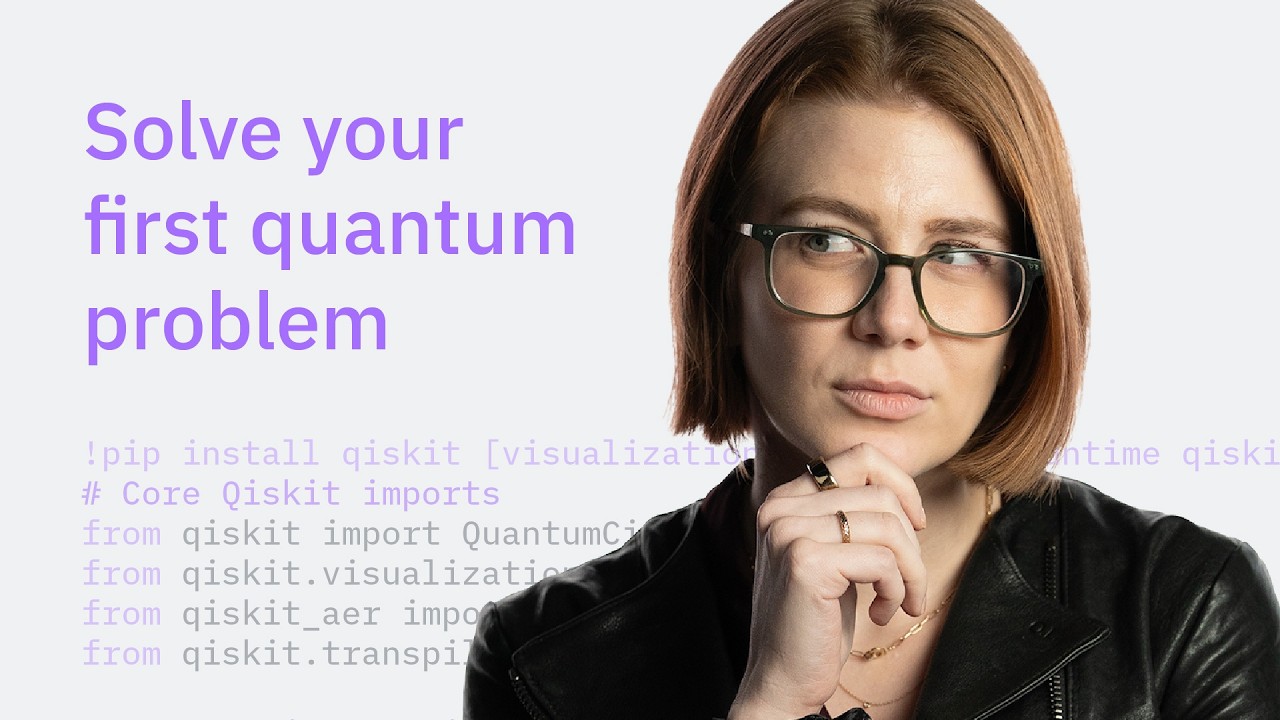
Your First Quantum Experiment | Use a Quantum Computer Today | Ep.3
Keywords
Summary
141 words
Critical Evaluation
Value of the Information & Strength of the Argument
The video provides a clear and valuable introduction to running a quantum experiment, bridging theory and practice. It effectively demonstrates the use of Qiskit primitives (Sampler and Estimator) to solve a physics problem, which is a core skill for quantum computing. The argumentation is solid: the instructor explains the physical model, the Hamiltonian, and the variational principle, and shows how the code implements these concepts. The step-by-step approach, following the Qiskit patterns, makes the reasoning easy to follow. The value is high for beginners, as it demystifies the process of using a real quantum computer.
Scientific Rigor, Source Quality, Title Accuracy
The video is scientifically rigorous, with accurate explanations of quantum mechanics concepts and Qiskit usage. The sources are limited to the official Qiskit learning resources, which are authoritative. The title accurately reflects the content, and the video stays on topic. The tutorial is well-structured and does not include any promotional content. The description provides a link to the written lesson, which is a valuable supplementary resource.
176 words
Title / Content Match
The title accurately reflects the content: the video guides viewers through their first quantum experiment, using a quantum computer to simulate a physical system.
Quality & Reliability
8/10
The video is a tutorial from the official Qiskit channel, which is a well-known and authoritative source for quantum computing education. The content is technically accurate, follows established Qiskit patterns, and provides practical guidance. The explanation of the Hamiltonian and the use of primitives is correct. Minor simplifications (e.g., the toy model) are appropriate for the target audience.
Key Moments
Markers derived by PSI from the transcript: the creator did not define chapters.
- Introduction: promise of solving a physics problem on a quantum computer.
- Explanation of the physical model: two spins with antiferromagnetic interaction and transverse magnetic field.
- Introduction of the Hamiltonian and its terms.
- Overview of Qiskit primitives: Sampler and Estimator.
- Start of coding: importing libraries and setting up the circuit for the Bell state.
- Optimization step: transpiling the circuit for a specific backend (IBM Toronto).
- Using the Sampler to measure spin states and plotting the histogram.
- Using the Estimator to calculate the energy of the system.
- Discussion of the variational principle and challenge to find a lower energy.
- Conclusion and preview of the next lesson.
Cited Sources
- Written lesson: Your First Quantum Experiment — The video references this written lesson as a companion resource for the course.
Concurring Sources
- Qiskit documentation — The video uses Qiskit, and the documentation provides detailed information on primitives and patterns.
Contribution & Novelties
The video provides a hands-on introduction to using quantum computers for a real physics problem, which is a valuable educational contribution. It demystifies the process of running experiments on IBM quantum hardware using Qiskit primitives. The focus on the variational principle and the challenge to find a lower energy state encourages active learning.
Pour aller plus loin :
- Quantum computing — Overview of quantum computing concepts.
- Hamiltonian (quantum mechanics) — Detailed explanation of the Hamiltonian operator.
- Variational method (quantum mechanics) — The variational principle used in the video.
- Qiskit documentation — Official documentation for Qiskit, including primitives.
97 words
Radar Profile
The radar profile shows high scores in quality of information and reliability, with slightly lower scores in quantity and technical level. This indicates a well-structured tutorial that is accurate and trustworthy, but may not cover an extensive amount of content or delve into advanced technical details.
💬 No comments were provided for analysis.