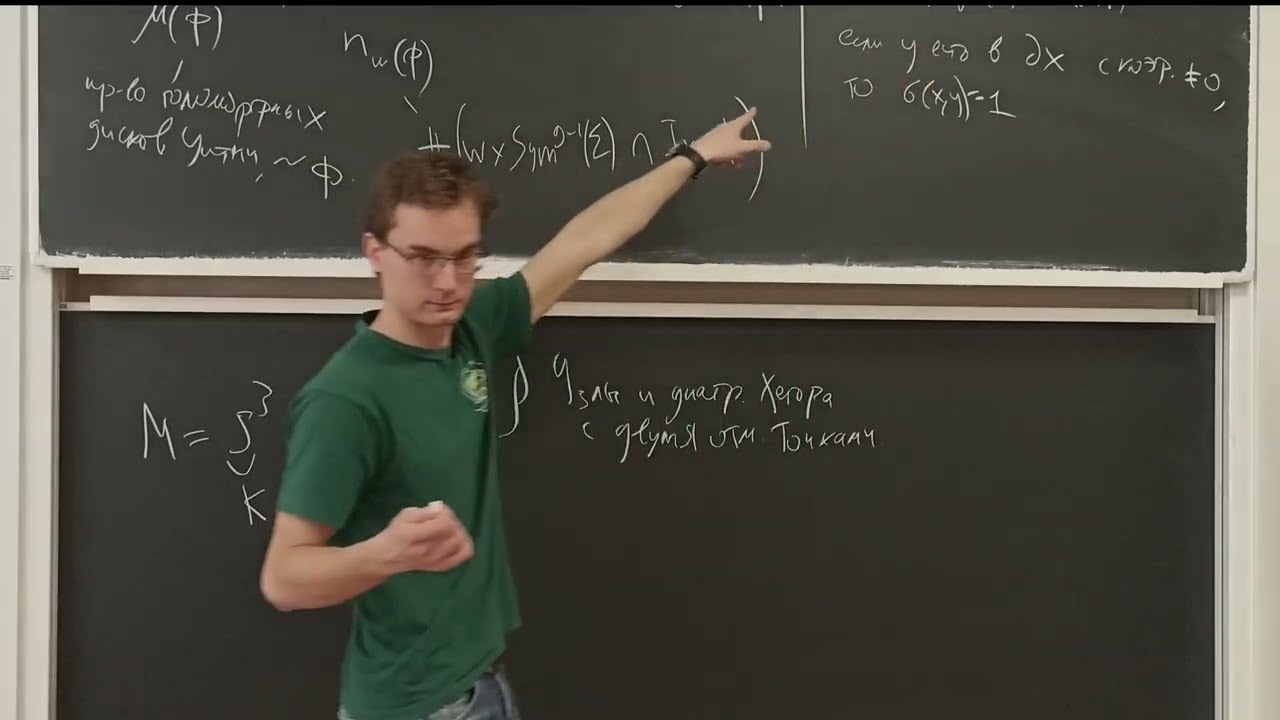
Heegaard Floer homology and the tau-invariant | QTC | Ivan Nasonov
Keywords
Summary
201 words
Critical Evaluation
Value of the Information & Strength of the Argument
The talk provides a solid introduction to Heegaard Floer homology for knots, with clear definitions and constructions. The speaker carefully explains the two-pointed Heegaard diagrams and the resulting bigrading, and he states the key theorem relating the graded Euler characteristic to the Alexander polynomial. The argumentation is rigorous, with proofs sketched or referenced. The discussion of the tau-invariant and its relation to the four-genus is well-motivated and highlights the importance of the invariant. The talk is valuable for researchers and graduate students in low-dimensional topology.
Scientific Rigor, Source Quality, Title Accuracy
The talk is scientifically rigorous, with precise definitions and statements. The speaker cites a key reference (Livingston’s computations) and builds on established work by Ozsváth and Szabó. The title accurately reflects the content. The presentation is well-structured, though it assumes familiarity with Heegaard Floer homology. No comments were provided, so no analysis of public reception is possible.
157 words
Title / Content Match
The title accurately reflects the content: the talk introduces Heegaard Floer homology and the tau-invariant, with a focus on their relation to knot concordance and the four-genus.
Quality & Reliability
8/10
The talk is a technical lecture by an expert, with rigorous definitions and proofs sketched. It cites a key reference (Livingston's computations) and builds on established theory. The presentation is clear but assumes advanced background.
Key Moments
Markers derived by PSI from the transcript: the creator did not define chapters.
- Introduction and review of Heegaard Floer homology for closed 3-manifolds.
- Definition of Heegaard diagrams with two basepoints and construction of knots.
- Construction of a Heegaard diagram from a knot diagram.
- Definition of the bigrading (Maslov and Alexander) on the Heegaard Floer complex.
- Statement of the theorem relating the graded Euler characteristic to the Alexander polynomial.
- Definition of the tau-invariant and its properties.
- Discussion of the relation between tau and the four-genus.
Cited Sources
- Computations of the Ozsvath-Szabo knot concordance invariant — Cited as a reference for computations of the tau-invariant.
Concurring Sources
- An introduction to Heegaard Floer homology — Mentioned in the description as a source for the theory.
Contribution & Novelties
The talk provides a clear and detailed introduction to Heegaard Floer homology for knots, with a focus on the tau-invariant and its applications. It emphasizes the categorification aspect, linking the Alexander polynomial to the bigraded homology theory. The construction of Heegaard diagrams with two basepoints is explained in detail, making the material accessible to those familiar with the basics. The talk also highlights the importance of the tau-invariant in knot concordance and its relation to the four-genus.
Pour aller plus loin :
- Heegaard Floer homology — Overview of the theory.
- Alexander polynomial — Classical knot invariant related to the graded Euler characteristic.
- Ozsváth–Szabó invariant — The tau-invariant and its properties.
- Knot concordance — Context for the four-genus and concordance invariants.
120 words
Radar Profile
The radar profile shows high scores in technical level and information quality, with slightly lower scores in quantity and reliability, reflecting the advanced nature of the talk and the limited number of sources cited.