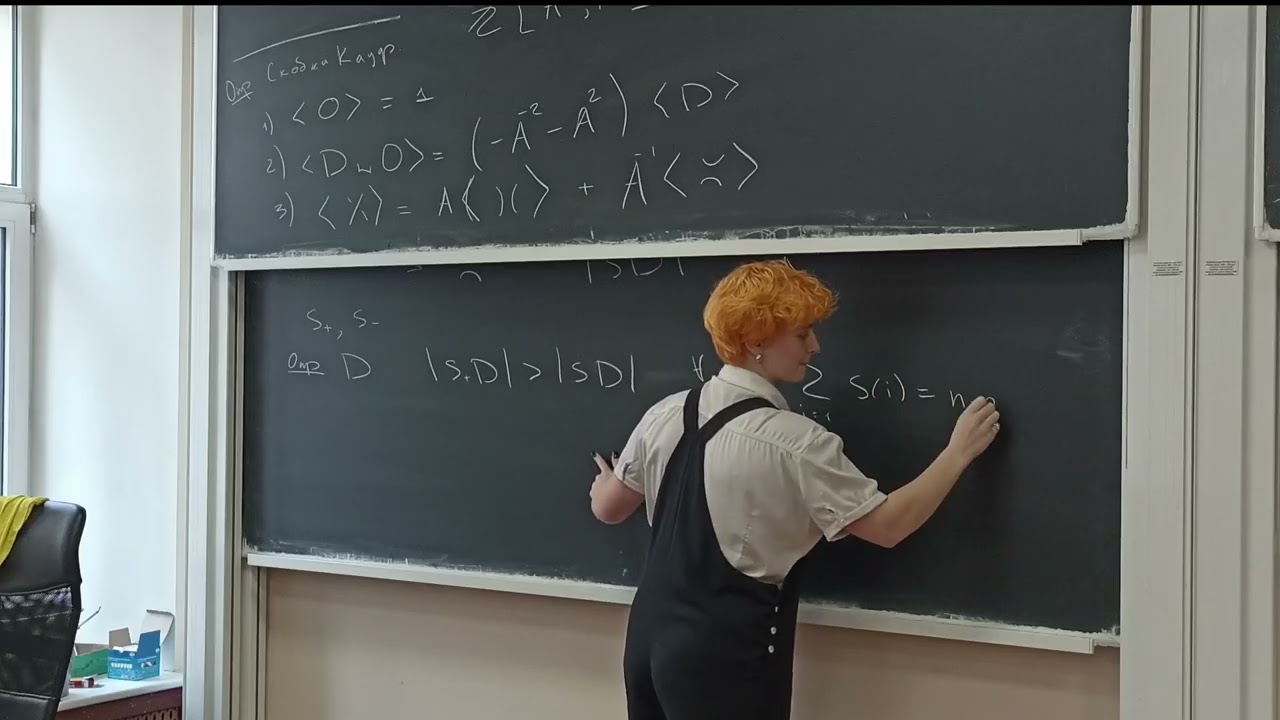
Полином Джонса и доказательство гипотез Тэйта | QTC | Виктория Георгиевская
Keywords
Summary
157 words
Critical Evaluation
Value of the Information & Strength of the Argument
The talk provides a clear and rigorous exposition of a classical proof, which is valuable for understanding the power of the Jones polynomial. The argumentation is solid: the speaker builds the proof step by step, from defining the Kauffman bracket to establishing key lemmas about adequate diagrams, and then applying them to prove the conjectures. The use of the Kauffman bracket’s state-sum formula and the analysis of degrees are well-motivated. The interactive nature of the talk allows for clarification of subtle points, such as the role of reducedness and the checkerboard coloring. The proof is presented in a self-contained manner, with all necessary definitions recalled, making it accessible to those with basic knot theory knowledge.
Scientific Rigor, Source Quality, Title Accuracy
The talk is scientifically rigorous, with a clear logical structure and careful definitions. The main source cited is W. B. R. Lickorish’s ‘An Introduction to Knot Theory’, a standard reference in the field, which lends credibility. The title accurately reflects the content, as the talk indeed focuses on the Jones polynomial and its application to Tait’s conjectures. The presentation is consistent with the mathematical literature, and the proof follows known arguments. The speaker also mentions that the classical proof was obtained in 1987, and a non-quantum proof was only found in 2017, providing historical context. Overall, the sources and the title are appropriate and well-aligned with the content.
238 words
Title / Content Match
The title accurately reflects the content: the talk focuses on the Jones polynomial and its application to proving Tait's conjectures.
Quality & Reliability
8/10
The talk is a rigorous mathematical lecture, presenting a classical proof of two of Tait's conjectures using the Jones polynomial. The argument is detailed, with definitions and lemmas, and the speaker engages with the audience to clarify points. The main source cited is a standard textbook (Lickorish). The presentation is technical and appears mathematically sound, though the transcription contains some informal exchanges and potential minor errors in color naming, but these do not undermine the core content.
Key Moments
Markers derived by PSI from the transcript: the creator did not define chapters.
- Introduction and statement of Tait's conjectures.
- Definition of reduced and alternating diagrams.
- Definition of the Kauffman bracket and its properties.
- Introduction of states and the state-sum formula for the Kauffman bracket.
- Definition of adequate diagrams and proof that reduced alternating diagrams are adequate.
- Lemma on the maximal and minimal degrees of the Kauffman bracket for adequate diagrams.
- Lemma on the number of components in the all-plus and all-minus resolutions.
- Construction of the Jones polynomial from the Kauffman bracket.
- Proof of the first Tait conjecture using the Jones polynomial.
- Proof of the second Tait conjecture and concluding remarks.
Cited Sources
- An Introduction to Knot Theory — Cited as the main reference for the talk.
Concurring Sources
- An Introduction to Knot Theory — Standard textbook covering the Jones polynomial and Tait conjectures.
Contribution & Novelties
The talk provides a clear and detailed exposition of the classical proof of Tait’s conjectures using the Jones polynomial, which is a significant historical result. The presentation emphasizes the combinatorial nature of the proof and the role of adequate diagrams. The talk is valuable for those seeking a deeper understanding of the Jones polynomial’s applications.
Pour aller plus loin :
- Jones polynomial — Overview of the invariant and its properties.
- Tait conjectures — Historical context and status of the conjectures.
- Kauffman bracket — Definition and relation to the Jones polynomial.
- Alternating knot — Definition and properties of alternating knots.
99 words
Radar Profile
The radar profile shows high scores in technical level and information quality, reflecting the advanced mathematical content and rigorous presentation. The scores for information quantity and reliability are also high, indicating a comprehensive and trustworthy talk. The overall profile is balanced, with no significant weaknesses.