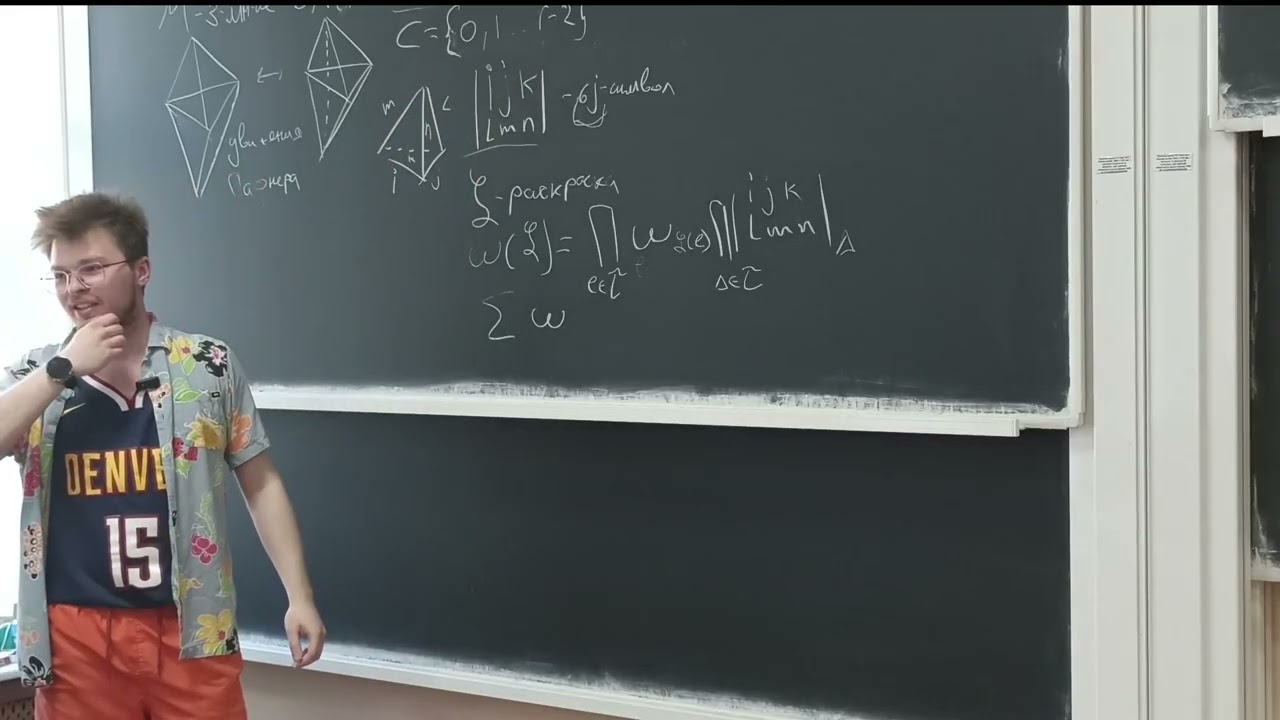
Инварианты Тураева-Виро, крашеные многочлены Джонса и гиперболический объём | QTC | Ярослав Нагибин
Keywords
Summary
151 words
Critical Evaluation
Value of the Information & Strength of the Argument
The talk provides a solid introduction to Turaev-Viro invariants, with clear definitions and derivations of key identities. The speaker’s argumentation is rigorous, as he carefully derives the weights for colors and tetrahedra, and explains the role of the Pachner move in ensuring invariance. The connection to colored Jones polynomials is well-motivated and the discussion of the Chen-Yang conjecture adds significant value, as it bridges combinatorial invariants with geometric properties. The presentation is self-contained to a large extent, though some steps are sketched rather than fully proved, which is acceptable for a seminar talk.
Scientific Rigor, Source Quality, Title Accuracy
The talk is scientifically rigorous, with the speaker demonstrating a deep understanding of the subject. The main source cited is the paper by Detcherry, Kalfagianni, and Yang (arXiv:1701.07818), which is directly relevant and appropriately referenced. The title accurately reflects the content, covering all three main topics. The presentation is well-structured, though the informal style and occasional asides may distract some viewers. Overall, the scientific quality is high, and the sources are credible.
180 words
Title / Content Match
The title accurately reflects the content: the talk covers Turaev-Viro invariants, colored Jones polynomials, and their relation to hyperbolic volume, as promised.
Quality & Reliability
8/10
The talk presents a rigorous mathematical exposition of Turaev-Viro invariants, including definitions, proofs of key identities, and connections to colored Jones polynomials and hyperbolic volume. The speaker demonstrates a deep understanding of the subject, and the content aligns with established research, including the cited arXiv paper. Minor caveats: the presentation is informal and some proofs are sketched rather than fully detailed.
Key Moments
Markers derived by PSI from the transcript: the creator did not define chapters.
- Introduction and overview of Turaev-Viro invariants.
- Definition of ideal triangulations and Pachner moves.
- Formal definition of Turaev-Viro state sum and weights.
- Derivation of weights for colors using Pachner move.
- Introduction of admissible colorings and 6j-symbols.
- Explicit formulas for 6j-symbols and quantum factorials.
- Connection to colored Jones polynomials and link complements.
- Discussion of Chen-Yang conjecture and hyperbolic volume.
- Proof sketch for figure-eight knot and Borromean rings.
- Conclusion and final remarks.
Cited Sources
- Turaev-Viro invariants, colored Jones polynomials and volume — Referenced as the main source for the connection between Turaev-Viro invariants and colored Jones polynomials, and for the proof of the Chen-Yang conjecture for specific knots.
Concurring Sources
- Turaev-Viro invariants, colored Jones polynomials and volume — The talk's content aligns with the results and methods presented in this paper.
Contribution & Novelties
The talk provides a clear and detailed exposition of Turaev-Viro invariants, bridging combinatorial state sums with geometric invariants via the Chen-Yang conjecture. It offers a pedagogical derivation of the weights and 6j-symbols, and demonstrates the power of these invariants in computing hyperbolic volume. The presentation is particularly valuable for its step-by-step explanation of the connection to colored Jones polynomials.
Pour aller plus loin :
- Turaev-Viro invariants — Overview of the invariants and their history.
- Colored Jones polynomial — Definition and properties.
- Hyperbolic volume — Geometric concept central to the Chen-Yang conjecture.
91 words
Radar Profile
The radar profile shows high scores in quantitative information, technical level, and reliability, indicating a dense and rigorous presentation. The slightly lower score in qualitative information suggests that while the content is accurate, it may be less accessible to a general audience.