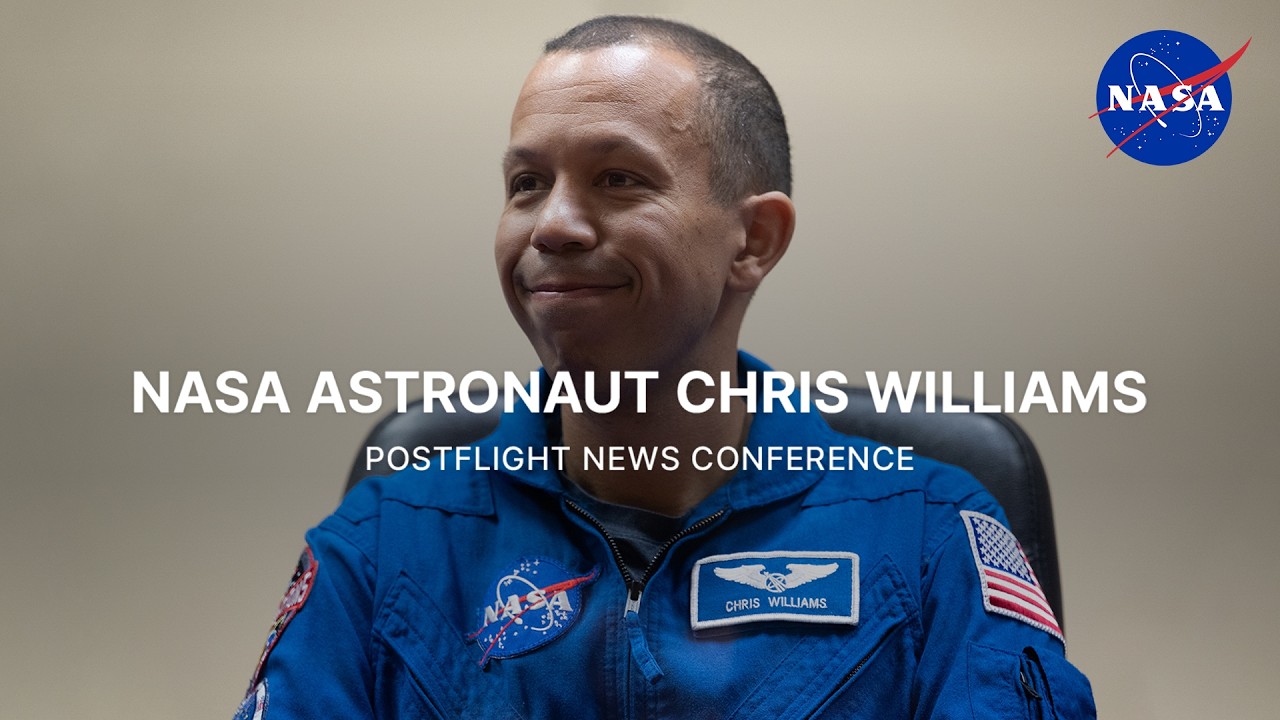
NASA Astronaut Chris Williams Postflight News Conference (Aug. 4, 2026)
Keywords
Summary
171 words
Critical Evaluation
The video is a NASA official postflight news conference, providing a firsthand account of an astronaut’s mission. The information is highly credible due to the source (NASA) and the speaker (astronaut Chris Williams). The content is primarily anecdotal, focusing on personal experiences and reflections rather than detailed scientific data. However, it offers valuable insights into the operational aspects of a long-duration space mission, including emergency procedures, spacewalk challenges, and the psychological aspects of living in space. The argumentation is coherent and well-structured, with Williams providing clear and thoughtful responses to questions. The scientific rigor is moderate, as the discussion touches on experiments but does not delve into technical details or results. The sources cited are NASA links provided in the description, which are authoritative and relevant. The title accurately reflects the content, and the video serves as an informative update on the mission. The public’s comments (if any) are not analyzed here, but the content itself is reliable and valuable for those interested in space exploration. The video does not contain any advertising sequences. Overall, it is a high-quality production that effectively communicates the astronaut’s experiences and the mission’s achievements.
190 words
Title / Content Match
The title accurately reflects the content: a postflight news conference with NASA astronaut Chris Williams.
Quality & Reliability
8/10
Content is a NASA official postflight news conference, featuring a NASA astronaut's firsthand account of an ISS mission. Information is credible and authoritative, though primarily anecdotal and not peer-reviewed. The description provides links to NASA resources for further verification.
Key Moments
Markers derived by PSI from the transcript: the creator did not define chapters.
- Introduction by Anna Schneider and opening remarks by Chris Williams.
- Williams discusses the shelter-in-place event due to a leak in a Russian module.
- Williams talks about his family's launch experience in Baikonur.
- Williams answers a social media question about the most challenging part of spacewalks.
- Williams describes his favorite experiment: growing alfalfa plants.
- Williams discusses the importance of family support during long-duration missions.
- Williams talks about his photography and outreach efforts from space.
Cited Sources
- Science conducted by Chris Williams — NASA link provided in the video description to learn more about the science Williams conducted.
- International Space Station — NASA link provided in the video description for more information about the ISS.
Concurring Sources
- NASA ISS Research — NASA's official page for ISS research, which would include details on the experiments mentioned.
- International Space Station — NASA's official page for the ISS, providing general information about the station.
Contribution & Novelties
The video provides a unique firsthand account of an astronaut’s mission, offering insights into the daily life, challenges, and emotional aspects of long-duration spaceflight. It highlights specific experiments and operational procedures, such as the shelter-in-place event and spacewalk preparations, which are not commonly detailed in official reports. The personal perspective adds value beyond official mission summaries.
Pour aller plus loin :
- NASA ISS Research — Official NASA resource for ISS research and experiments.
- Canadarm2 — Information on the robotic arm mentioned in the video.
- Neutral Buoyancy Laboratory — NASA’s training facility for spacewalks.
93 words
Radar Profile
The radar profile shows high scores in information quality and reliability, reflecting the authoritative source and credible speaker. The quantity of information is moderate, as the conference focuses on personal experiences rather than exhaustive technical details. The technical level is moderate, suitable for a general audience interested in space missions.