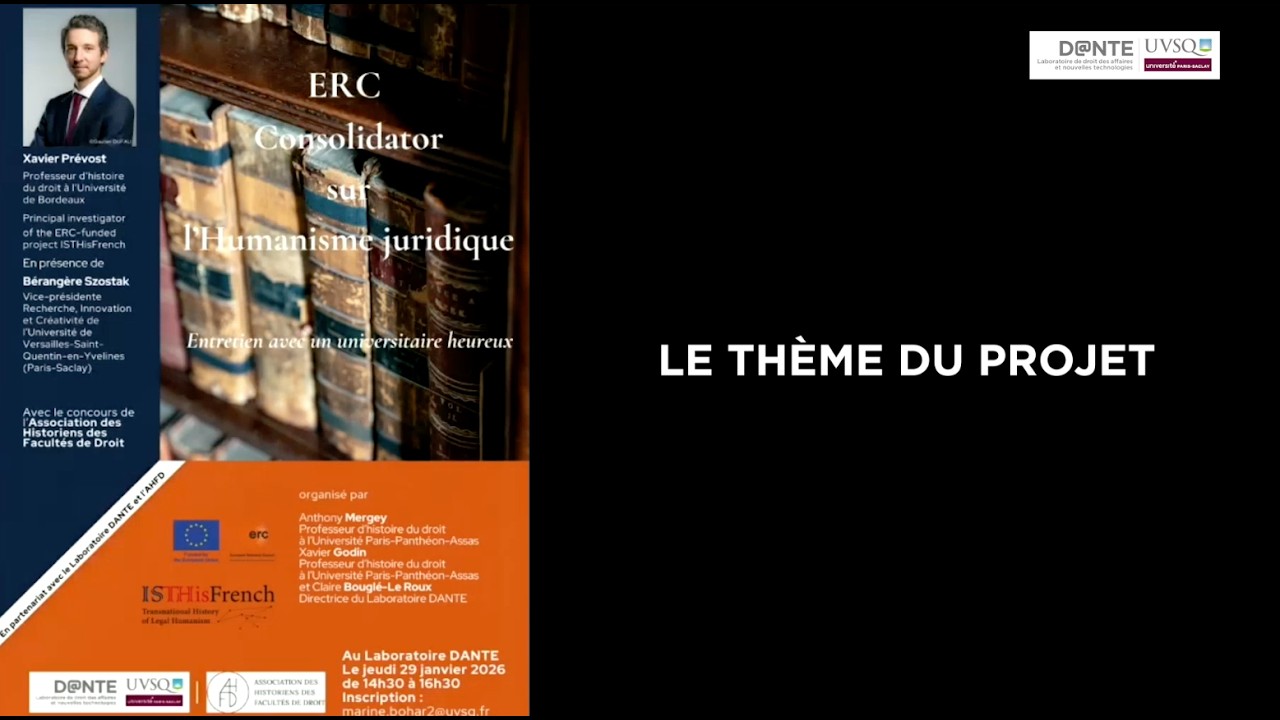
ERC Consolidator sur l'Humanisme juridique : le thème du projet
Keywords
Summary
219 words
Critical Evaluation
Value of the Information & Strength of the Argument
The video provides valuable insights into the research methodology and objectives of an ERC-funded project in legal history. The argumentation is solid, as Prévost clearly explains the rationale behind challenging the traditional label ‘mos gallicus’ and proposes a transnational approach. He supports his claims with references to his own research on Jacques Cujas and the historiography of legal humanism. The value lies in the critical examination of nationalistic narratives in legal history and the proposal of a more nuanced, transnational perspective.
Scientific Rigor, Source Quality, Title Accuracy
The scientific rigor is high, as the project is based on a systematic analysis of historiography and primary sources. The sources mentioned include the works of legal humanists and the historiography of the 19th and 20th centuries. The title accurately reflects the content, which focuses on the theme of the ERC project. The video does not include any advertising or sponsorship segments.
158 words
Title / Content Match
The title accurately reflects the content, which focuses on the theme of the ERC Consolidator project on legal humanism.
Quality & Reliability
8/10
The video is an interview with a professor of legal history, Xavier Prévost, who is the principal investigator of an ERC-funded project. The content is based on his expertise and the project's research plan. The information is presented in a clear and structured manner, with references to historical sources and methodologies. The quality is high, though it is an expert opinion rather than a peer-reviewed study.
Key Moments
Markers derived by PSI from the transcript: the creator did not define chapters.
- Introduction to the project and its focus on legal humanism during the Renaissance.
- Explanation of the term 'mos gallicus' and its traditional association with French legal humanism.
- Discussion of the hypothesis that the labeling of legal humanism as 'French' is due to legal nationalisms.
- Overview of the two main components of the project: historiographical analysis and study of Renaissance sources.
- Details on the need for a team, including postdocs and engineers, and the construction of a database.
- Case studies on key nodes of the European network: an individual, a book, and a place.
- Conclusion on the macro-historical synthesis and the need for archival research in various European regions.
Cited Sources
- ERC Consolidator Grant — Mentioned as the funding source for the project.
- Jacques Cujas — Subject of Prévost's doctoral thesis and a key figure in legal humanism.
Concurring Sources
- Mos gallicus — Provides background on the term and its usage.
Contribution & Novelties
The project offers a novel transnational perspective on legal humanism, challenging the nationalistic label ‘mos gallicus’ and proposing a more nuanced understanding of its European character. It combines historiographical analysis with fresh study of primary sources, using digital humanities tools. The project’s originality lies in its critical examination of how national legal histories have shaped our understanding of this movement.
Pour aller plus loin :
- Mos gallicus — Overview of the term and its historical context.
- Legal humanism — General introduction to the movement.
- Transnational history — Methodological approach relevant to the project.
93 words
Radar Profile
The radar profile shows high scores in quality, technical level, and reliability, with a slightly lower score in quantity of information. This indicates a focused and expert-driven presentation, with a strong emphasis on methodological rigor and scholarly depth.