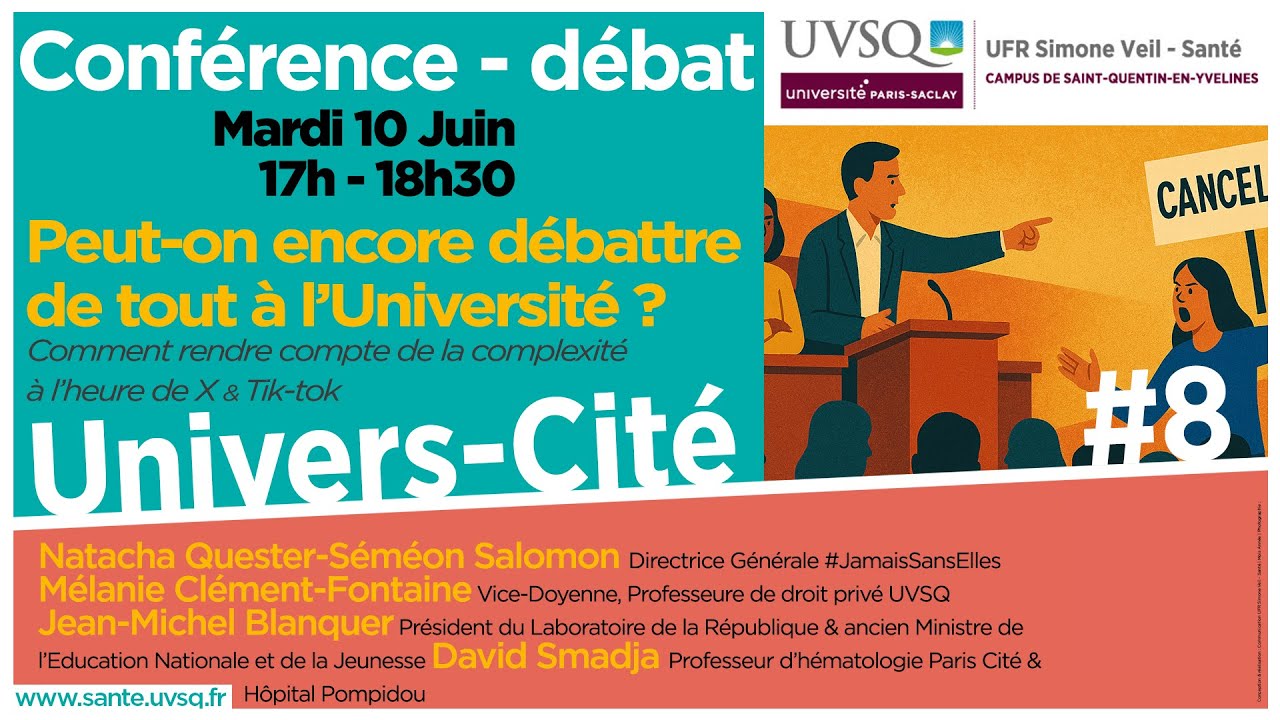
Peut-on encore débattre de tout à l'Université ? - Univers-Cité #8
Keywords
Summary
132 words
Critical Evaluation
Value of the Information & Strength of the Argument
The debate provides valuable insights into the challenges of academic freedom and misinformation. Speakers argue convincingly that universities must engage in open debate and maintain a presence on social media to counter falsehoods. The argumentation is grounded in personal experiences, such as the COVID-19 pandemic, which adds practical weight. However, the lack of formal citations and reliance on anecdotal evidence somewhat weakens the scientific rigor.
Scientific Rigor, Source Quality, Title Accuracy
The debate is rigorous in its exploration of the topic, with speakers drawing on their professional experiences. However, no formal sources are cited, and the discussion is largely opinion-based. The title accurately reflects the content, and the debate stays on topic. The presence of a former minister and academics lends credibility, but the lack of verifiable references limits its scientific quality.
141 words
Title / Content Match
The title accurately reflects the central question discussed throughout the debate.
Quality & Reliability
7/10
The debate features credible speakers including a former minister, academics, and professionals, but lacks formal citations and is based on personal experiences and opinions.
Key Moments
Markers derived by PSI from the transcript: the creator did not define chapters.
- Introduction by Dr. Philippe Charlier and opening remarks by the university president.
- Natacha Quester-Séméon discusses the role of social media during the COVID-19 pandemic.
- Jean-Michel Blanquer shares an anecdote about school closures and the asymmetry of truth.
- Discussion on the need for universities to engage on social media platforms.
- Mélanie Clément-Fontaine provides a legal perspective on freedom of expression.
- Q&A session with the audience begins.
Cited Sources
- UFR Simone Veil - Santé — Official website of the organizing faculty.
- UFR Simone Veil - Santé LinkedIn — Social media page for updates on future conferences.
Concurring Sources
- UNESCO - Freedom of Expression — International perspective on freedom of expression in education.
Dissenting Sources
- No discordant sources found — The debate did not present conflicting viewpoints; all speakers agreed on the importance of open debate.
Contribution & Novelties
The debate offers a unique multi-perspective discussion on academic freedom, combining insights from medicine, law, and politics. It highlights the evolving role of universities in the digital age and the need to combat misinformation. The discussion is timely and relevant.
Pour aller plus loin :
- Freedom of speech — Provides foundational concepts on the limits of free expression.
- Misinformation — Explores the spread and impact of false information.
- Science communication — Discusses methods for effectively communicating scientific information to the public.
81 words
Radar Profile
The radar profile shows high scores in information quantity and quality, with moderate technical level. This indicates a well-rounded discussion accessible to a general audience, with strong emphasis on societal implications.
💬 Sur les 0 commentaires analysés, aucune tendance n'a pu être dégagée.