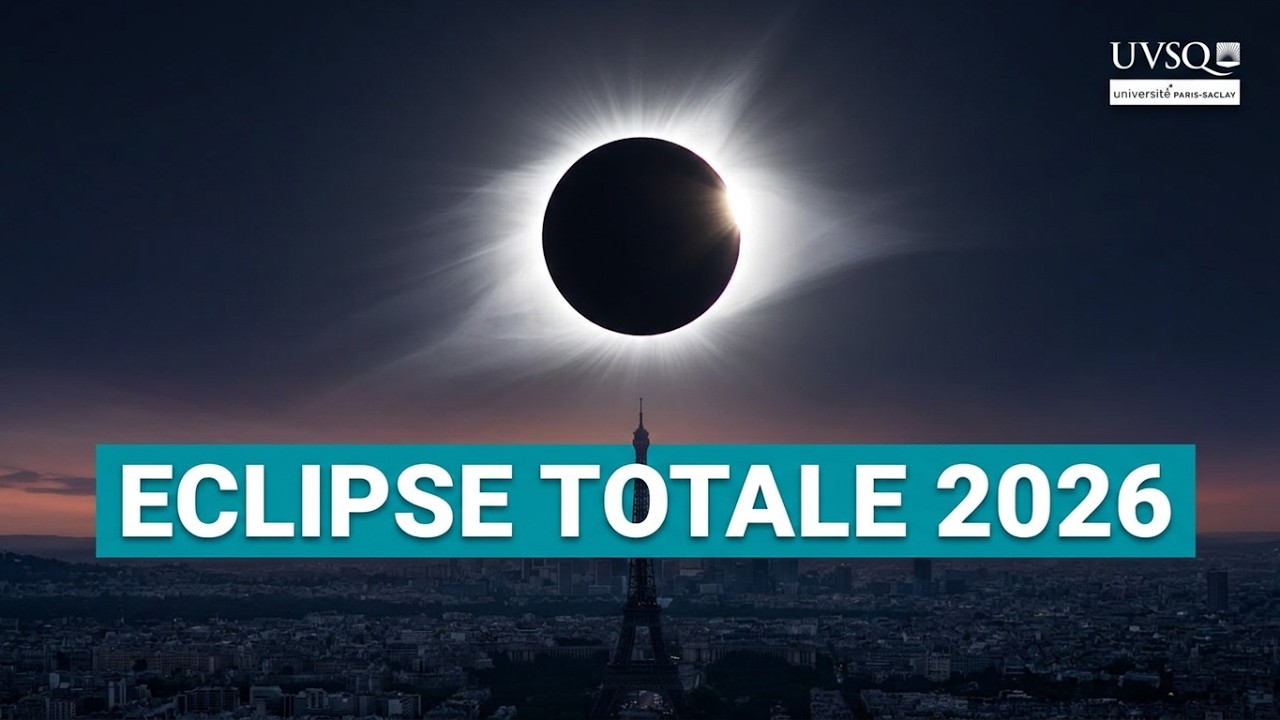
L'éclipse solaire du 12 aout 2026, expliquée par Mustapha Meftah, astrophysicien.
Keywords
Summary
131 words
Critical Evaluation
Value of the Information & Strength of the Argument
The presentation offers valuable educational content, systematically explaining the Sun’s properties and phenomena. The argumentation is solid, grounded in established physics and observational evidence. The speaker uses analogies (e.g., boiling water for convection) to make complex concepts accessible. He also highlights the relevance of solar research for understanding space weather and its technological impacts, citing real-world examples like the Starlink satellite loss. The talk is well-structured, progressing from basic facts to more advanced topics, and includes practical safety advice for eclipse viewing.
Scientific Rigor, Source Quality, Title Accuracy
The scientific rigor is high, with the speaker being a professional astrophysicist. He references historical figures like Galileo and Schwabe, and mentions specific missions and instruments (PICARD, SDO, LASCO). The title accurately reflects the content, which focuses on the eclipse while providing necessary background. The presentation does not cite specific papers, but the information aligns with current solar physics knowledge. The talk is aimed at a general audience, but the speaker maintains accuracy without oversimplifying to the point of error.
177 words
Title / Content Match
The title accurately reflects the content, which focuses on the solar eclipse of August 12, 2026, and provides a broad overview of solar physics leading up to it.
Quality & Reliability
8/10
The speaker is an astrophysicist at LATMOS, and the content is based on established solar physics. The presentation includes historical context, current missions, and practical advice. Some simplifications are made for a general audience, but the core science is accurate.
Key Moments
Markers derived by PSI from the transcript: the creator did not define chapters.
- Introduction and plan of the presentation
- The Sun's formation and the solar system
- Sun's rotation and internal structure
- The Sun's atmosphere: photosphere, chromosphere, corona
- Solar activity: sunspots, solar cycle, flares
- Space weather and its impact on Earth
- Observing the Sun from space: missions and instruments
- Solar eclipses: conditions and rarity
- The upcoming eclipse of August 12, 2026
- Safe eclipse viewing and conclusion
Cited Sources
- PICARD mission — Mentioned as a satellite developed by the speaker's lab for solar observation.
- SDO (Solar Dynamics Observatory) — Mentioned as a NASA mission observing the Sun in multiple wavelengths.
- LASCO (Large Angle and Spectrometric Coronagraph) — Mentioned as an instrument on SOHO used to observe the corona.
Concurring Sources
- NASA Solar Physics — General information on the Sun and solar phenomena.
- ESA Solar Orbiter — Mentioned as a European mission studying the Sun.
Contribution & Novelties
The talk provides a comprehensive overview of solar physics, connecting fundamental concepts to the upcoming eclipse. It emphasizes the importance of space-based observations and space weather forecasting. The speaker’s personal experience with instrument development adds a unique perspective.
Pour aller plus loin :
- Solar eclipse — General background on solar eclipses.
- Solar cycle — Explanation of the 11-year cycle.
- Space weather — Impact of solar activity on Earth.
68 words
Radar Profile
The radar profile shows high scores in information quantity, quality, and reliability, with a moderate technical level. This indicates a well-balanced presentation suitable for a general audience while maintaining scientific accuracy.
💬 No comments were provided for analysis.