Genetics: Homologous recombination and meiotic crossovers (Recommend 1.5x Speed)
Keywords
Summary
155 words
Critical Evaluation
Value of the Information & Strength of the Argument
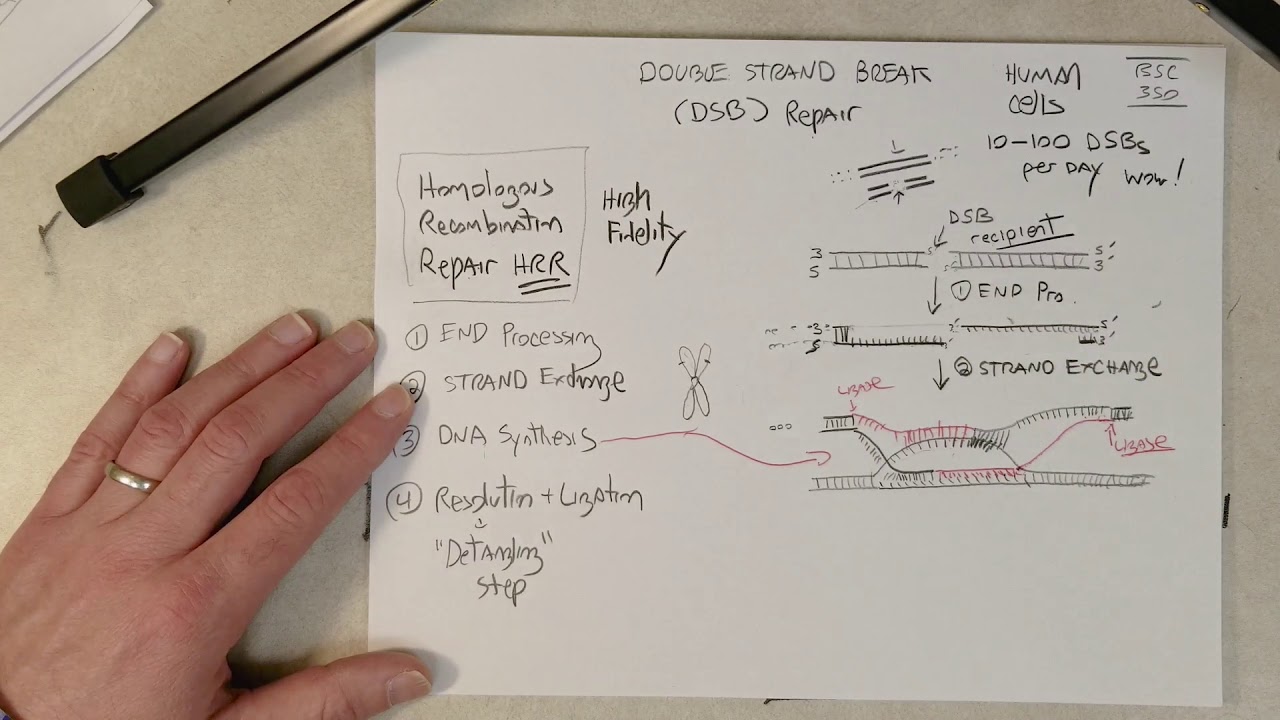
The video provides a solid, step-by-step explanation of homologous recombination repair, making it accessible for students. The instructor uses clear diagrams and analogies (e.g., detangler) to illustrate complex concepts. He also highlights the importance of HRR in meiosis and mentions the role of Spo11. However, the argumentation is largely descriptive without deep mechanistic detail or references to specific studies. The instructor acknowledges uncertainty about the frequency of DSBs, which adds credibility but also indicates a lack of rigorous sourcing. Overall, the content is valuable for introductory genetics students but lacks the depth and evidence-based approach of a research-level discussion.
Scientific Rigor, Source Quality, Title Accuracy
The video is a tutorial with no explicit citations to scientific literature. The instructor mentions that advanced details are covered in a later course, implying a curriculum-based approach rather than a research presentation. The title accurately reflects the content, focusing on homologous recombination and meiotic crossovers. The description provides no additional sources. The video’s scientific rigor is moderate: it presents established concepts accurately but without citing primary sources. The instructor’s admission of not having personally verified the DSB frequency statistic is a point of honesty but also highlights a lack of source verification. Overall, the title-content alignment is good, but the lack of sources limits the video’s scientific credibility.
223 words
Title / Content Match
The title accurately reflects the content, focusing on homologous recombination and meiotic crossovers.
Quality & Reliability
7/10
The video provides a clear and accurate overview of homologous recombination repair, but lacks citations to primary literature and contains some simplifications. The instructor acknowledges uncertainty about the frequency of DSBs and mentions advanced details are covered in a later course.
Key Moments
Markers derived by PSI from the transcript: the creator did not define chapters.
- Introduction to double-strand breaks and their frequency in human cells.
- Overview of the four steps of homologous recombination repair.
- Step 1: End processing - 5' ends are resected to create 3' overhangs.
- Step 2: Strand exchange - 3' overhangs invade donor template to form a displacement loop.
- Step 3: DNA synthesis - DNA polymerase fills in gaps using donor as template.
- Step 4: Resolution and ligation - endonucleases and ligases untangle and seal the DNA.
- Discussion of crossover vs non-crossover outcomes and their significance in meiosis.
- Role of Spo11 enzyme in introducing DSBs during meiosis.
- Summary and conclusion.
Contribution & Novelties
The video provides a clear, step-by-step explanation of homologous recombination repair, which is valuable for students. It connects the repair mechanism to meiotic crossovers, highlighting the role of Spo11. The instructor’s use of diagrams and analogies aids understanding. However, the content is not novel; it is a standard topic in genetics education. For further exploration, consider the following:
Pour aller plus loin :
- Homologous recombination - Wikipedia — Provides a comprehensive overview of the mechanism and its biological roles.
- Spo11 - Wikipedia — Details the enzyme responsible for initiating meiotic DSBs.
- Double-strand break repair model - Nature Reviews — A review article on DSB repair pathways, including homologous recombination.
109 words
Radar Profile
The radar profile shows balanced scores across information quantity, quality, technical level, and reliability, indicating a well-rounded educational video. The technical level is moderate, suitable for introductory genetics students, while the reliability is decent given the lack of citations.