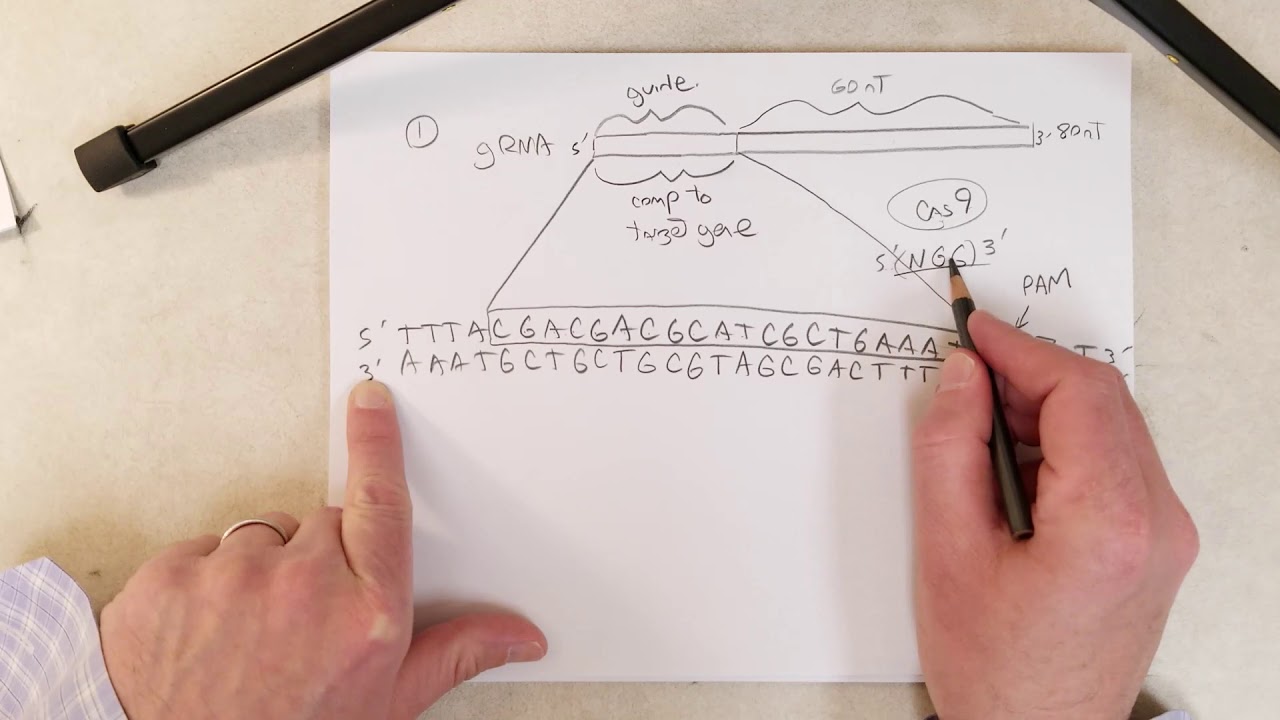
Genetics: L30-C, CRISPR: Gene editing with gRNAs (Recommend 1.5x Speed)
Keywords
Summary
133 words
Critical Evaluation
Value of the Information & Strength of the Argument
The video provides a clear and logical explanation of CRISPR-Cas9 gene editing, building on previous lectures. It effectively breaks down complex concepts into understandable steps, such as guide RNA design and the role of PAM sequences. The argumentation is solid, grounded in established molecular biology principles. The instructor uses diagrams and examples to illustrate the process, enhancing comprehension. However, the video lacks depth in discussing potential off-target effects and ethical considerations, which are important in real-world applications.
Scientific Rigor, Source Quality, Title Accuracy
The scientific rigor is high for an introductory lecture; the content is accurate and up-to-date. However, no specific sources are cited within the video or description, limiting its use as a reference. The title accurately reflects the content, which is focused on CRISPR gene editing with guide RNAs. The video is part of a structured course, suggesting it is peer-reviewed by the instructor. The lack of citations is a minor weakness, but the educational context mitigates this.
169 words
Title / Content Match
The title accurately reflects the content, which focuses on CRISPR gene editing with guide RNAs.
Quality & Reliability
8/10
The video is an educational lecture from a university genetics course, presented by an instructor. It explains CRISPR-Cas9 gene editing mechanisms accurately, covering key concepts such as guide RNA design, PAM sequences, and DNA repair pathways. The content aligns with established scientific knowledge, though it lacks citations to primary literature.
Key Moments
Markers derived by PSI from the transcript: the creator did not define chapters.
- Introduction to CRISPR technology and its use in gene editing.
- Comparison of natural CRISPR system with engineered single-guide RNA.
- Explanation of guide RNA structure and design.
- How to select a PAM sequence and design a guide RNA.
- Overview of gene mutation via NHEJ and HDR.
- Using a donor template for precise gene modification.
- Strategies to inhibit NHEJ to promote HDR.
- Summary and preview of next lecture.
Contribution & Novelties
The video provides a clear pedagogical explanation of CRISPR-Cas9 gene editing, focusing on the design and application of guide RNAs. It effectively bridges the gap between basic CRISPR biology and practical gene editing techniques. The explanation of how to design guide RNAs and the role of PAM sequences is particularly useful for students. The video also introduces the concept of using donor templates for precise gene modification, which is a key advancement in the field.
Pour aller plus loin :
- CRISPR gene editing - Wikipedia — Overview of CRISPR technology and its applications.
- Cas9 - Wikipedia — Detailed information on the Cas9 protein and its mechanism.
- Homology directed repair - Wikipedia — Explanation of HDR and its role in gene editing.
121 words
Radar Profile
The radar profile shows high scores in quality of information and technical level, indicating a well-structured and informative lecture. The quantity of information is moderate, as the video focuses on a specific topic. The overall reliability is high, reflecting the educational context and accurate content.