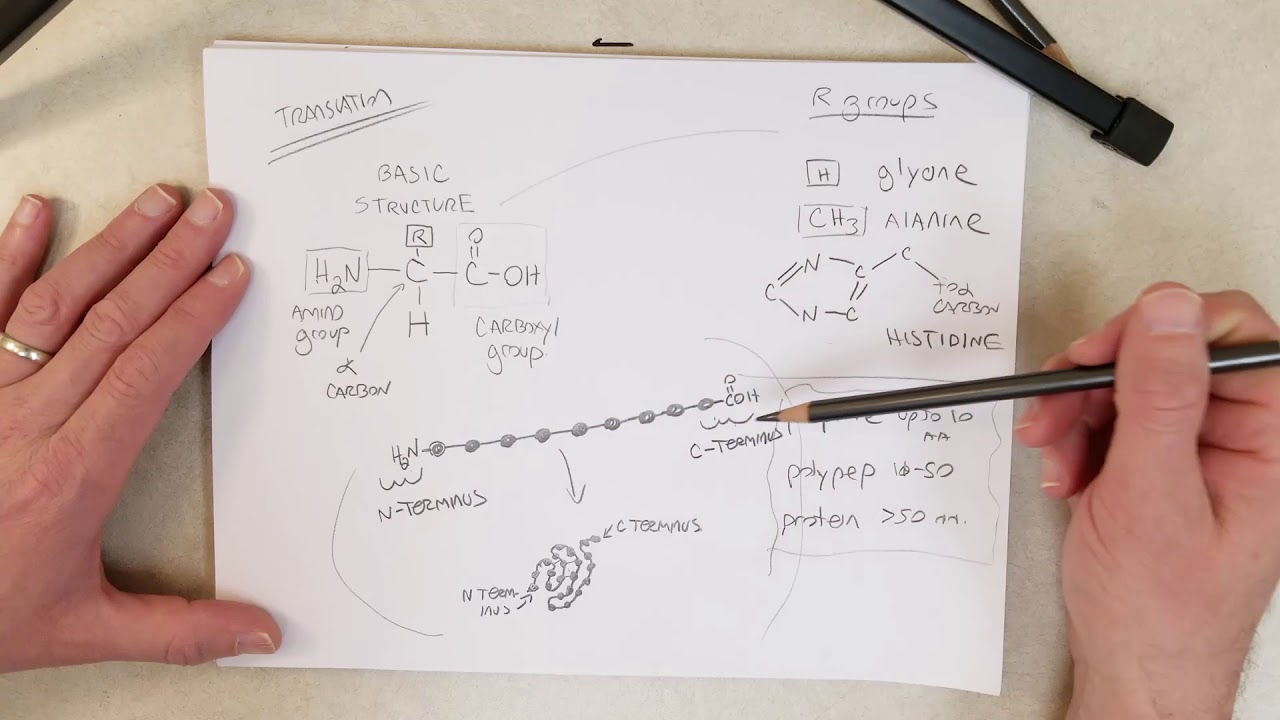
Genetics: L18-C, Amino acids and peptide bonds (Recommend 1.5x Speed)
Keywords
Summary
155 words
Critical Evaluation
Value of the Information & Strength of the Argument
The video provides a solid foundational explanation of amino acid structure and peptide bond formation, which is crucial for understanding protein synthesis. The argumentation is logical and clear, building from basic structure to the mechanism of bond formation. The instructor uses simple analogies and diagrams to aid comprehension. However, the video lacks depth in discussing the diversity of amino acid side chains and their chemical properties, which could enhance understanding. The explanation of the dehydration reaction is accurate but could benefit from more detailed molecular visualization. Overall, the information is valuable for introductory learners, but it does not delve into advanced topics or applications.
Scientific Rigor, Source Quality, Title Accuracy
The video is scientifically accurate, presenting standard biochemistry concepts without errors. However, it does not cite any external sources or references, which limits its scientific rigor. The title accurately reflects the content, and the video is well-structured for educational purposes. The absence of citations is typical for introductory tutorials, but for a more rigorous scientific evaluation, references to textbooks or primary literature would be expected. The video’s content aligns with established knowledge in molecular biology.
194 words
Title / Content Match
The title accurately reflects the content, focusing on amino acids and peptide bonds.
Quality & Reliability
7/10
The video provides a clear, accurate overview of amino acid structure and peptide bond formation, consistent with standard biochemistry. It is a basic educational tutorial without in-depth references or citations, but the content is correct and well-explained.
Key Moments
Markers derived by PSI from the transcript: the creator did not define chapters.
- Introduction to translation and amino acid structure
- General structure of amino acids: amino group, carboxyl group, R group
- Examples of R groups: glycine, alanine, histidine
- Peptide, polypeptide, and protein definitions
- N-terminus and C-terminus of amino acid chains
- Protein folding and disulfide bridges
- Mechanism of peptide bond formation: dehydration reaction
- Formation of peptide bond and peptide group
- Addition of amino acids to C-terminal end during synthesis
- Summary and preview of next video
Contribution & Novelties
This video provides a clear and concise introduction to amino acid structure and peptide bond formation, which is fundamental for understanding translation. It effectively explains the general structure of amino acids and the dehydration reaction that forms peptide bonds. The video is particularly useful for students who need a quick review of these concepts. However, it does not introduce novel information beyond standard textbook content.
Pour aller plus loin :
- Amino acid - Wikipedia — Comprehensive overview of amino acid structure and properties.
- Peptide bond - Wikipedia — Detailed explanation of peptide bond formation and characteristics.
- Translation (biology) - Wikipedia — Overview of the translation process in protein synthesis.
109 words
Radar Profile
The radar profile shows a balanced but moderate performance across all dimensions, with slightly higher scores in quality and reliability, indicating accurate but basic content. The low quantity of information and technical level suggest it is an introductory tutorial, suitable for beginners.