Problem 15.33
Keywords
Summary
137 words
Critical Evaluation
Value of the Information & Strength of the Argument
The video provides valuable educational content, clearly explaining complex genetic concepts such as replication slippage and the functional importance of untranslated regions. The argumentation is logical and well-structured, using a step-by-step approach to solve the problem. The instructor supports explanations with diagrams and connects the material to broader genetic principles. However, the discussion of part C is speculative, as acknowledged, and lacks empirical evidence.
Scientific Rigor, Source Quality, Title Accuracy
The scientific rigor is adequate for an introductory genetics course, with accurate explanations of mechanisms. However, no external sources are cited, and the video relies on textbook knowledge. The title accurately reflects the content, and the video is well-aligned with the problem statement. No comments were provided for analysis.
128 words
Title / Content Match
The title accurately reflects the content, which is a walkthrough of a specific genetics problem.
Quality & Reliability
7/10
The video is an educational tutorial by a genetics instructor, providing accurate explanations of trinucleotide repeat expansion mechanisms and their implications. It is based on established genetic concepts and textbook problems, but lacks citations to primary literature.
Key Moments
Markers derived by PSI from the transcript: the creator did not define chapters.
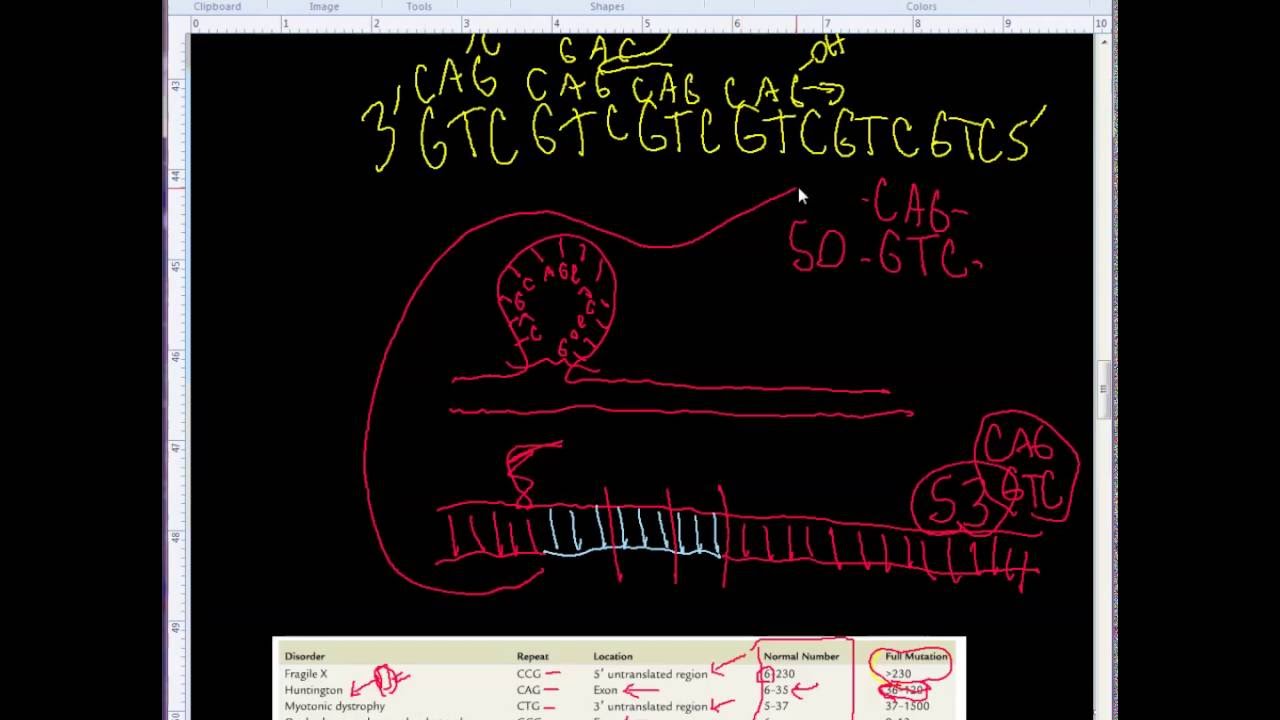
- Introduction to spontaneous mutations: depurination and replication slippage.
- Detailed diagram of replication slippage leading to repeat expansion.
- Introduction to the problem: list of disorders and their repeat motifs.
- Explanation of repeat locations: 5' UTR, exons, 3' UTR, introns.
- Discussion of part B: how mutations in non-coding regions affect protein production.
- Explanation of regulatory sequences in UTRs and their importance.
- Part C: speculation on why expansions in exons are smaller than in non-coding regions.
- Discussion of potential lethality of large expansions in coding regions.
- Conclusion and invitation to office hours for alternative explanations.
Contribution & Novelties
The video provides a clear pedagogical explanation of trinucleotide repeat expansion mechanisms, particularly replication slippage, and their role in genetic disorders. It emphasizes the functional importance of non-coding regions, which is often underappreciated. The speculative discussion in part C encourages critical thinking.
Pour aller plus loin :
- Trinucleotide repeat expansion — Overview of trinucleotide repeat disorders.
- Replication slippage — Detailed explanation of the mechanism.
- Fragile X syndrome — Example of a disorder caused by repeat expansion in a UTR.
- Huntington’s disease — Example of a disorder caused by repeat expansion in a coding exon.
94 words
Radar Profile
The radar profile shows high scores in information quality and technical level, indicating a solid educational resource. The quantity of information is moderate, and reliability is good but not exceptional due to lack of citations.