Problem 3.12
Keywords
Summary
187 words
Critical Evaluation
Value of the Information & Strength of the Argument
The video provides valuable instructional content by breaking down a complex genetics problem into manageable steps. The instructor explains the reasoning behind each step, such as why certain genotypes are written in a particular way and how to use the fork-line method. The argumentation is solid, as it relies on established Mendelian genetics principles and demonstrates the logic behind the ratios. The shortcuts presented are practical and well-justified, helping students understand the underlying patterns rather than just memorizing ratios. The video effectively argues that recognizing similarities between crosses can save time, which is a useful skill for exams.
Scientific Rigor, Source Quality, Title Accuracy
The scientific rigor is adequate for an educational tutorial. The content is accurate and aligns with standard genetics textbooks. However, the video does not cite any external sources, which limits its scholarly depth. The title ‘Problem 3.12’ is appropriate but not descriptive; it assumes the viewer knows the context. The video’s quality is consistent with a university-level genetics course, and the instructor’s explanations are clear and precise. No comments were provided, so no analysis of public reception is possible.
192 words
Title / Content Match
The title 'Problem 3.12' is concise and directly indicates the specific problem being solved, which is appropriate for a tutorial video.
Quality & Reliability
7/10
The video is a clear, step-by-step tutorial on solving a classic genetics problem involving Drosophila crosses. The reasoning is sound and follows standard Mendelian genetics principles. However, it lacks citations to external sources and is based on the instructor's explanation, which is reliable for educational purposes but not peer-reviewed.
Key Moments
Markers derived by PSI from the transcript: the creator did not define chapters.
- Introduction to the problem and notation for Drosophila traits.
- Explanation of the P1 cross for part (a) and gamete formation.
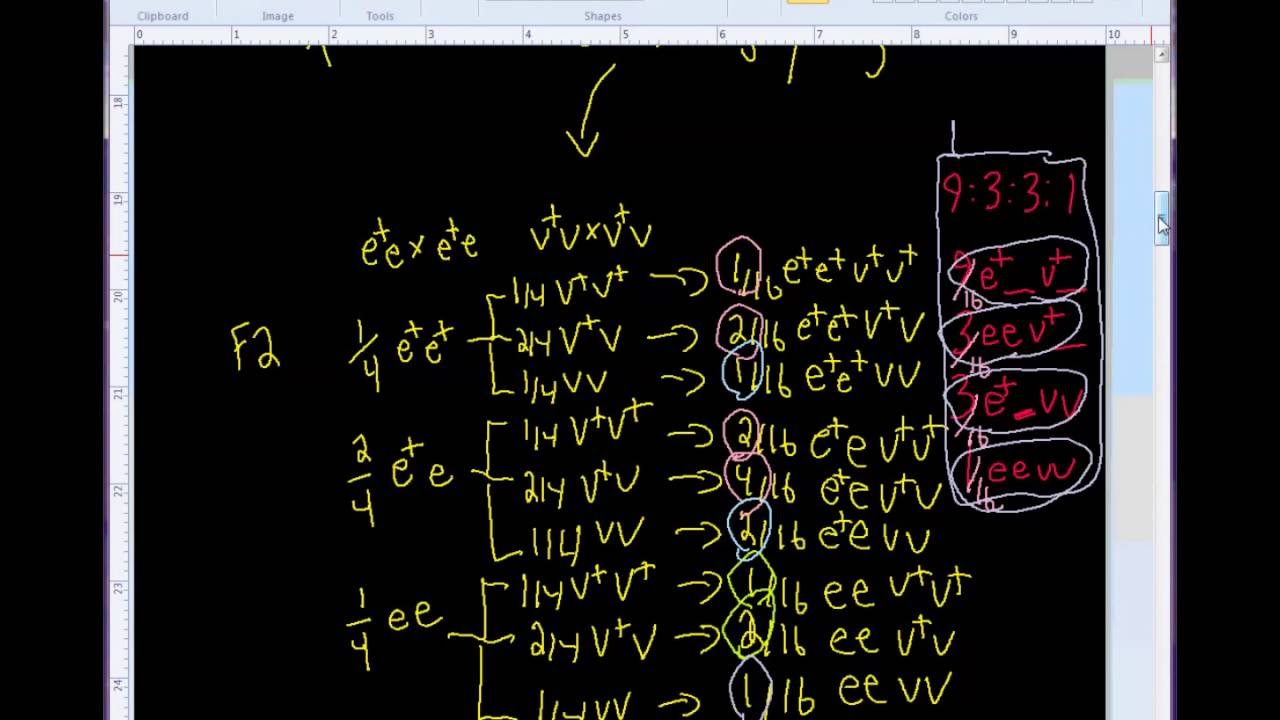
- Use of the fork-line method to determine F2 genotypic and phenotypic ratios.
- Counting phenotypes to confirm the 9:3:3:1 ratio.
- Introduction to part (b) and the shortcut of recognizing identical F1.
- Comparison of part (a) and part (b) crosses to show identical F2.
- Introduction to part (c) and the shortcut of ignoring homozygous body color.
- Solving part (c) as a monohybrid cross and deriving the 3:1 ratio.
Contribution & Novelties
The video’s original contribution lies in its pedagogical approach to solving genetics problems, emphasizing shortcuts that can save time on exams. It effectively demonstrates how to recognize when a dihybrid cross can be simplified to a monohybrid cross, and when two different crosses yield identical F2 generations. This practical insight is valuable for students.
Pour aller plus loin :
- Mendelian inheritance — Provides background on the principles of inheritance used in the video.
- Dihybrid cross — Explains the concept of a dihybrid cross and the expected ratios.
- Punnett square — A tool used to predict genotypes and phenotypes, relevant to the video’s methodology.
103 words
Radar Profile
The radar profile shows a balanced performance across all dimensions, with slightly higher scores in quality of information and fiability, reflecting the video's accurate and clear content. The lower score in technical level indicates that the video is accessible to beginners, while the quantity of information is moderate, covering the problem thoroughly but not extensively.