Problem 13.4
Keywords
Summary
166 words
Critical Evaluation
Value of the Information & Strength of the Argument
The video provides a clear and accurate explanation of the genetic code’s degeneracy, using a specific example to illustrate the concept. The argumentation is logical: it walks through the experimental setup, identifies the codons, and then uses a codon table to show the amino acid assignments. The reasoning is sound and the conclusion is correct. However, the video is informal and lacks citations, but it effectively demonstrates the problem-solving process.
Scientific Rigor, Source Quality, Title Accuracy
The scientific rigor is adequate for an educational tutorial: the genetic code and the experimental methods are accurately described. No external sources are cited, but the content is based on established knowledge. The title is appropriate and matches the content. The video is a single take, which leads to some verbal hesitations, but the information is correct.
142 words
Title / Content Match
The title 'Problem 13.4' is concise and matches the content, which is a walkthrough of a specific textbook problem.
Quality & Reliability
7/10
The video is an educational tutorial by a university genetics course, explaining a specific problem about the genetic code. The content is scientifically accurate, but it is a casual, one-take recording with no citations or references. The explanation is clear and correct, but the production quality is informal.
Key Moments
Markers derived by PSI from the transcript: the creator did not define chapters.
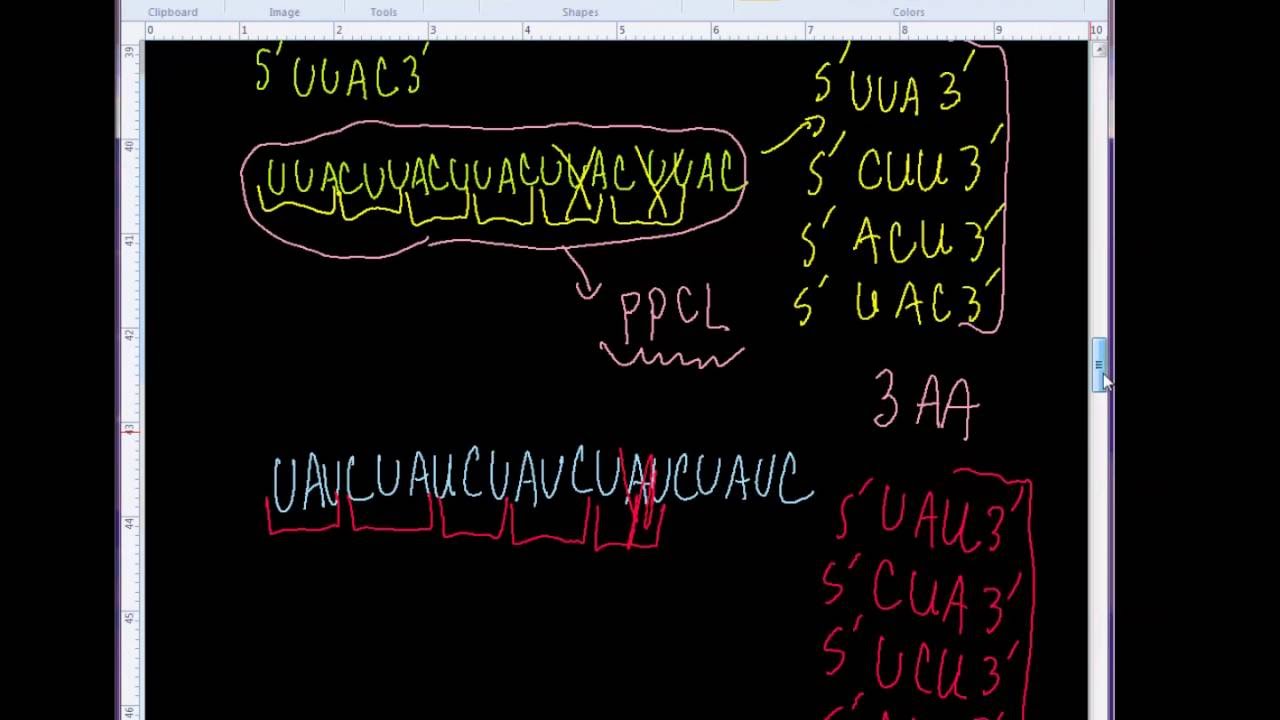
- Introduction to the problem and context of genetic code discovery.
- Explanation of homopolymers and random copolymers.
- Introduction to repeating copolymers and Khorana's method.
- Identification of codons from UUAC repeating unit.
- Identification of codons from UAUC repeating unit.
- Use of codon table to determine amino acids for UUAC codons.
- Explanation of degeneracy and why UUA and CUU both code for leucine.
- Determination of amino acids for UAUC codons.
- Conclusion summarizing the answer and key concepts.
Contribution & Novelties
The video offers a step-by-step solution to a textbook problem, reinforcing the concept of genetic code degeneracy. It provides a practical example of how repeating copolymers were used to decipher the code. For further exploration, one can look into the original experiments by Nirenberg, Khorana, and others, as well as the structure of the genetic code.
Pour aller plus loin :
- Genetic code — Overview of the genetic code and its properties.
- Nirenberg and Leder experiment — Details on the experiment that helped decipher the code.
- Khorana’s work on polynucleotide synthesis — Background on the scientist who developed the repeating copolymer method.
102 words
Radar Profile
The radar profile shows a balanced performance across all dimensions, with slightly higher scores in information quality and reliability, reflecting the accurate but informal nature of the tutorial. The technical level is moderate, suitable for an introductory genetics course.