Lecture 21 PCR Fall 2016
Keywords
Summary
139 words
Critical Evaluation
Value of the Information & Strength of the Argument
The lecture provides a solid foundational explanation of PCR, breaking down the process into logical steps and components. The argumentation is clear and didactic, using analogies and visual aids to reinforce understanding. The explanation of primer Tm and its impact on annealing temperature is particularly valuable, as it addresses a common source of experimental failure. The lecture effectively conveys the practical importance of PCR in genetic engineering and research.
Scientific Rigor, Source Quality, Title Accuracy
The content is scientifically accurate and aligns with standard molecular biology textbooks. However, the lecture does not cite specific sources or references, relying instead on established knowledge. The title accurately reflects the content, as it is a lecture on PCR. The presentation is well-structured and logically organized, with a clear progression from the purpose of PCR to its components and steps.
145 words
Title / Content Match
The title accurately reflects the content: a lecture on PCR.
Quality & Reliability
7/10
The lecture is an educational presentation by a university instructor, providing a clear and accurate overview of PCR principles. It is based on established molecular biology knowledge, but lacks citations to primary literature and does not address recent advances or potential limitations in depth.
Key Moments
Markers derived by PSI from the transcript: the creator did not define chapters.
- Introduction to PCR and its purpose in genetic engineering.
- Explanation of the seven components needed for PCR.
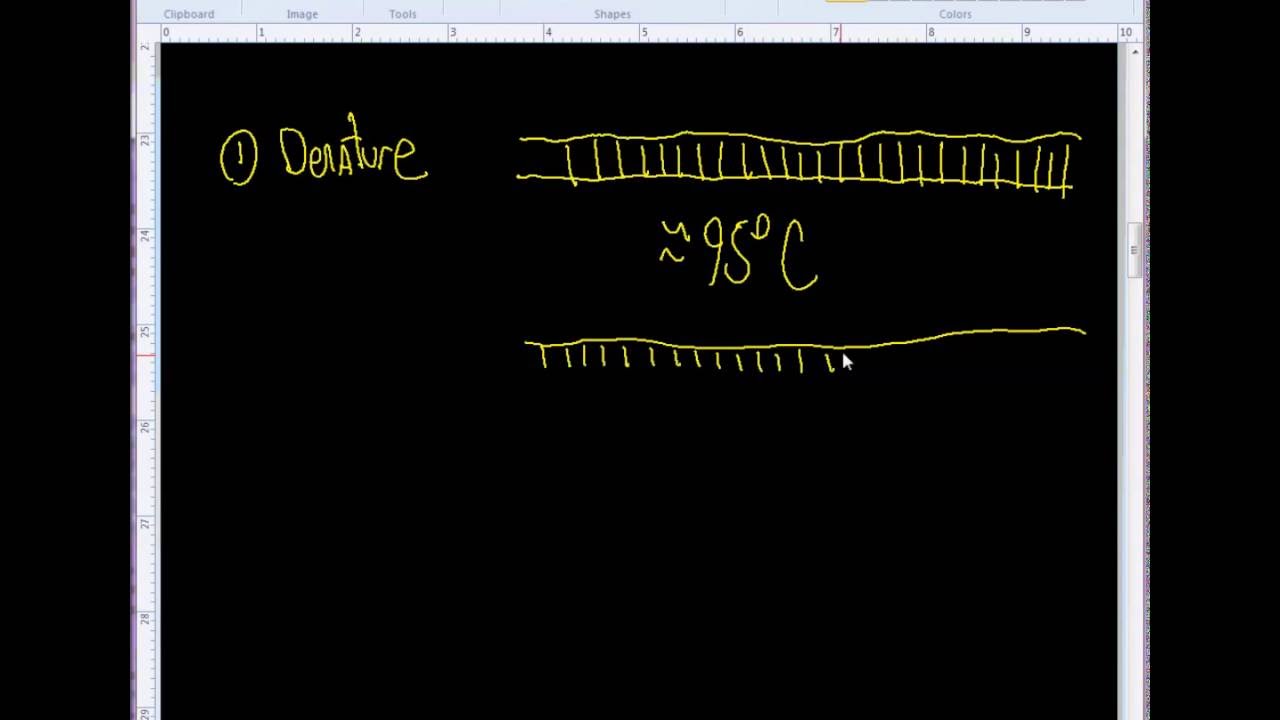
- Overview of the three main steps: denaturation, annealing, and extension.
- Detailed discussion of the denaturation step at 95°C.
- Explanation of the annealing step and primer binding.
- Description of the extension step and polymerase activity.
- Calculation of amplification using the formula 2^n.
- Discussion of primer design and melting temperature (Tm).
- How to choose annealing temperature based on primer Tm.
- Summary and practical considerations for PCR.
Contribution & Novelties
The lecture provides a clear and accessible introduction to PCR, emphasizing the practical aspects of primer design and temperature optimization. It serves as a valuable educational resource for students learning molecular biology techniques.
Pour aller plus loin :
- Polymerase chain reaction - Wikipedia — Comprehensive overview of PCR, its history, and applications.
- PCR in Molecular Biology - NCBI — Technical details on PCR protocols and primer design.
- Primer Design - NCBI — Tool and guidelines for designing PCR primers.
79 words
Radar Profile
The radar profile shows a balanced performance across all dimensions, with slightly higher scores in information quality and technical level, reflecting the lecture's educational focus. The lower score in information quantity suggests that while the content is accurate, it does not cover advanced topics or recent developments in PCR technology.