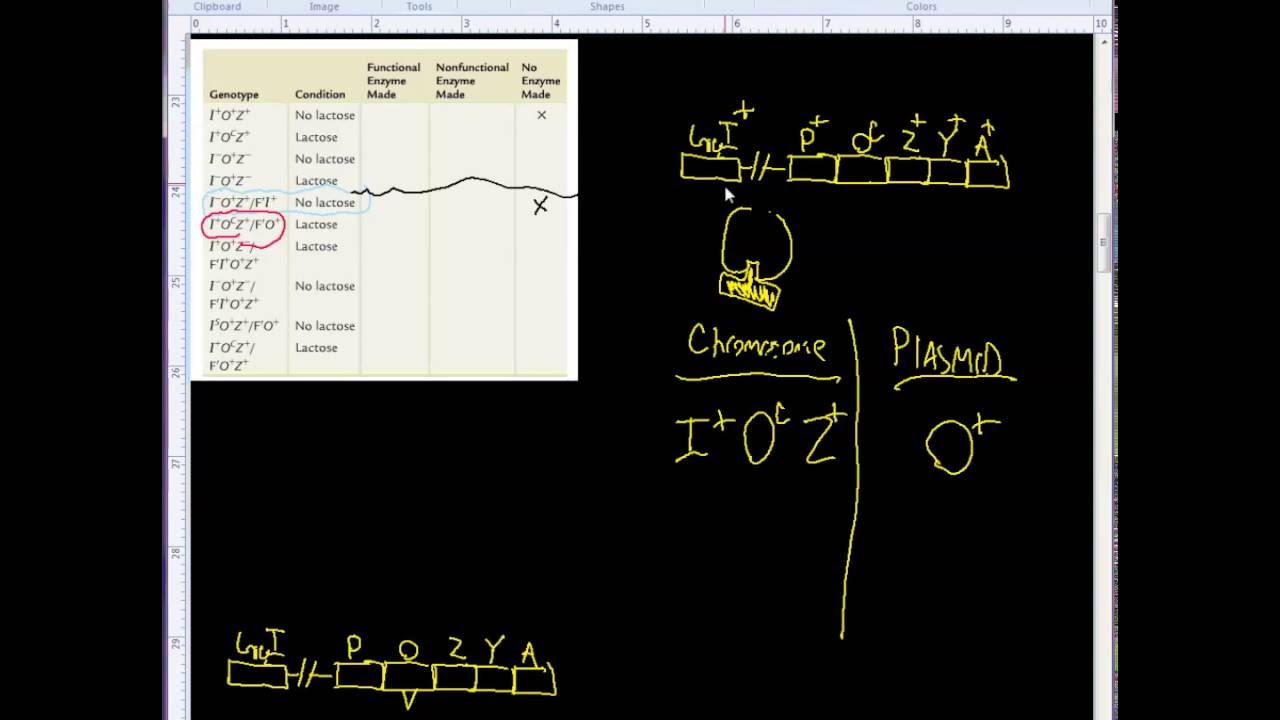
Problem 16.6
Keywords
Summary
180 words
Critical Evaluation
Value of the Information & Strength of the Argument
The video provides a thorough and logical explanation of the lac operon, breaking down each genotype and condition in a systematic manner. The instructor’s reasoning is clear and well-structured, making it easy to follow the predictions. The value lies in its educational effectiveness, as it reinforces key concepts of gene regulation and mutation effects. The argumentation is solid, as each prediction is justified based on the molecular mechanisms of the lac operon, such as repressor binding, allosteric shifts, and the impact of mutations on protein function.
Scientific Rigor, Source Quality, Title Accuracy
The video is scientifically rigorous, as it accurately applies the principles of lac operon regulation. The instructor demonstrates a deep understanding of the topic and correctly predicts the outcomes for each genotype. The sources are not explicitly cited, but the content is consistent with standard genetics textbooks and course materials. The title accurately reflects the content, as it is a direct solution to a specific problem. The video does not include any external sources or references, but the explanation is self-contained and relies on established knowledge.
187 words
Title / Content Match
The title accurately reflects the content, as the video is a direct solution to problem 16.6 from a genetics course.
Quality & Reliability
8/10
The video provides a clear, step-by-step explanation of lac operon genetics, using standard genetic notation and logical reasoning. The instructor demonstrates a thorough understanding of the topic and effectively walks through each genotype and condition. The content is accurate and aligns with established genetic principles.
Key Moments
Markers derived by PSI from the transcript: the creator did not define chapters.
- Introduction and overview of the lac operon structure.
- Explanation of the first genotype (lacI+, lacO+, lacZ+) with no lactose.
- Analysis of the second genotype with constitutive mutation (Oc) and lactose present.
- Discussion of lacI- mutation and its effect on enzyme production.
- Comparison of lacI- with and without lactose.
- Introduction of plasmid with lacI+ and analysis of genotype with Oc on chromosome.
- Analysis of genotype with lacI+ on chromosome and lacI+ on plasmid, with lactose present.
- Analysis of the same genotype but without lactose, showing no enzyme production.
- Explanation of super-repressor (Is) mutation and its effect.
- Final genotype analysis with Oc on chromosome and O+ on plasmid, lactose present.
Contribution & Novelties
The video provides a clear, step-by-step tutorial on solving lac operon problems, which is valuable for students learning gene regulation. It offers a systematic approach to analyzing genotypes and predicting enzyme production, which can be applied to similar problems. The instructor’s explanations are detailed and reinforce understanding of key concepts.
Pour aller plus loin :
- Lac operon — Provides a comprehensive overview of the lac operon, its regulation, and mutations.
- Gene regulation — Explains the broader context of gene regulation in prokaryotes.
- Allosteric regulation — Describes the mechanism by which lactose binding induces conformational changes in the repressor.
98 words
Radar Profile
The radar profile shows high scores in quantity and quality of information, indicating a comprehensive and accurate tutorial. The technical level is also high, reflecting the advanced nature of the topic. The overall reliability is strong, making this a valuable educational resource.