Problem 11.3
Keywords
Summary
156 words
Critical Evaluation
Value of the Information & Strength of the Argument
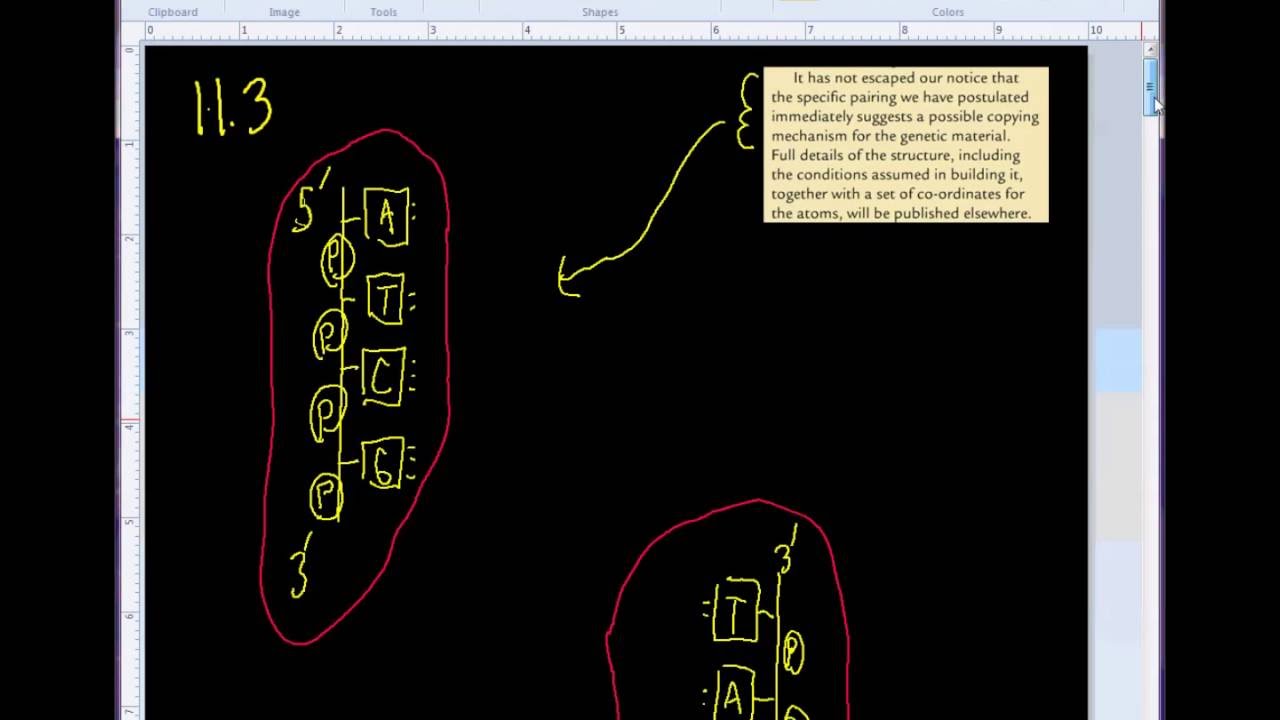
The video provides a clear and accurate explanation of the three modes of DNA replication, which is valuable for students learning the concepts. The argumentation is logical, starting from the structure of DNA and deriving the possible replication mechanisms. The instructor uses simple diagrams to visually demonstrate each mode, which aids understanding. However, the video does not present experimental evidence or discuss the Meselson-Stahl experiment in detail, which limits its depth. The argumentation is solid for an introductory level but lacks critical analysis of the evidence.
Scientific Rigor, Source Quality, Title Accuracy
The scientific rigor is acceptable for an educational video. The instructor correctly attributes the initial insight to Watson and Crick and mentions the Meselson-Stahl experiment, but does not cite specific sources or provide references. The title ‘Problem 11.3’ is not descriptive, but it is likely part of a course series. The content is accurate and aligns with standard genetics knowledge. No comments were provided, so no analysis of public reception is possible.
173 words
Title / Content Match
The title 'Problem 11.3' is generic and does not convey the content, but it is likely part of a course series. The content matches the problem statement.
Quality & Reliability
7/10
The video provides a clear and accurate explanation of the three proposed modes of DNA replication, correctly attributing the initial insight to Watson and Crick and referencing the Meselson-Stahl experiment. However, it lacks detailed experimental evidence and does not cite specific sources beyond the textbook.
Key Moments
Markers derived by PSI from the transcript: the creator did not define chapters.
- Introduction to Problem 11.3 and the question about DNA replication modes.
- Watson and Crick's quote about the copying mechanism.
- Diagram of DNA double helix and explanation of complementarity.
- Introduction of conservative replication mode.
- Explanation of semi-conservative replication.
- Explanation of dispersive replication.
- Mention of Meselson-Stahl experiment as the key experiment.
- Conclusion and summary of the modes.
Cited Sources
- Watson and Crick's 1953 paper on DNA structure — The instructor quotes from the paper: 'It has not escaped our notice that the specific pairing we have postulated immediately suggest a possible copying mechanism for the genetic material.'
- Meselson-Stahl experiment — Mentioned as the experiment that determined the mode of DNA replication.
Concurring Sources
- Meselson-Stahl experiment — Confirms that semi-conservative replication is the actual mode in organisms.
Contribution & Novelties
The video provides a clear and accessible explanation of the three modes of DNA replication, which is useful for students. It does not present new research but serves as an educational resource. The instructor’s use of diagrams helps visualize the concepts.
Pour aller plus loin :
- Meselson-Stahl experiment — Detailed description of the experiment that confirmed semi-conservative replication.
- DNA replication — Overview of the process and its mechanisms.
- Watson and Crick’s paper — Original 1953 paper on the double helix structure.
81 words
Radar Profile
The radar profile shows moderate scores across all dimensions, with quality of information and reliability being relatively higher, while quantity of information and technical level are lower. This suggests a concise, accurate, but not deeply technical video.