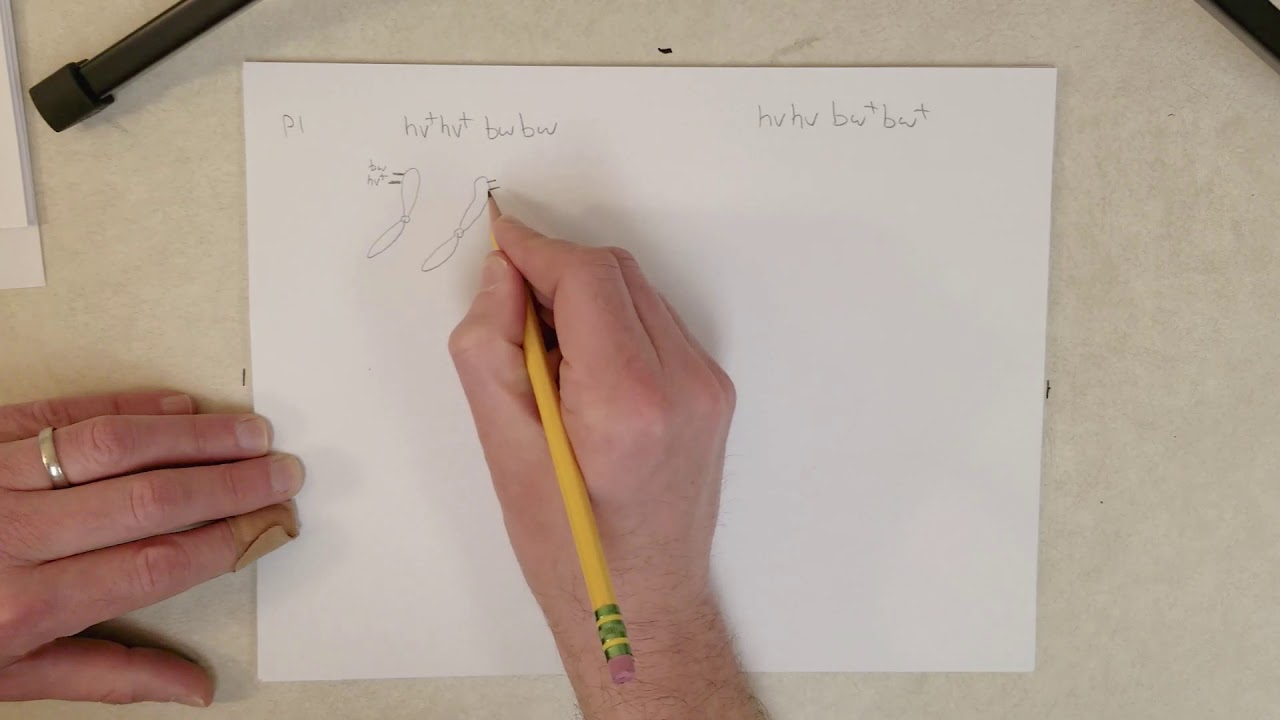
Genetics: L6-C, Linkage and Non-Mendelian Ratios (Recommend 1.5x Speed)
Keywords
Summary
168 words
Critical Evaluation
Value of the Information & Strength of the Argument
The video provides a solid foundation for understanding genetic linkage, a key concept in genetics. The argumentation is logical and builds on previous knowledge, using a concrete example to illustrate the principles. The instructor clearly explains why linked genes produce non-Mendelian ratios and introduces the notation system that will be used in subsequent lectures. The explanation of crossing over and its dependence on distance is accurate and sets up future topics. The value lies in its pedagogical clarity and the step-by-step approach, making it accessible for students. The argumentation is sound, with no evident errors or oversimplifications that would mislead.
Scientific Rigor, Source Quality, Title Accuracy
The video is scientifically rigorous, presenting standard genetics concepts accurately. It does not cite external sources, but the content is well-established and commonly taught in genetics courses. The title accurately reflects the content, and the recommendation for 1.5x speed is appropriate. The video is part of a university course, indicating that the material has been reviewed for accuracy. The presentation is clear and well-structured, with a logical flow from introduction to notation to the explanation of recombination. The adéquation between title and content is excellent.
200 words
Title / Content Match
The title accurately reflects the content: it covers linkage and non-Mendelian ratios, and the recommendation for 1.5x speed is appropriate given the pace.
Quality & Reliability
8/10
The video is a clear, pedagogically sound introduction to genetic linkage, using Drosophila as an example. The instructor explains concepts step-by-step, uses appropriate notation, and correctly describes the basis of non-Mendelian ratios. No sources are cited, but the content is standard genetics curriculum. The video is part of a university course, indicating academic oversight.
Key Moments
Markers derived by PSI from the transcript: the creator did not define chapters.
- Introduction to linkage and its effect on ratios.
- Description of the heavy and brown genes in Drosophila.
- Setting up the cross between parental flies.
- Prediction of 9:3:3:1 ratio if independent assortment.
- Introduction of notation for linked alleles on homologous chromosomes.
- Explanation of gamete production in linked genes.
- Discussion of recombination and crossing over.
- Impact of distance on recombination frequency.
- Conclusion and preview of upcoming lectures.
Contribution & Novelties
This video provides a clear and concise introduction to genetic linkage, a fundamental concept in genetics. It effectively explains why linked genes produce non-Mendelian ratios and introduces a notation system that is essential for understanding gene mapping. The video’s strength lies in its pedagogical approach, using a concrete example and step-by-step reasoning. It sets the stage for more advanced topics such as recombination frequency and gene mapping.
Pour aller plus loin :
- Genetic linkage - Wikipedia — Provides a comprehensive overview of linkage, including historical context and applications.
- Crossing over - Wikipedia — Explains the mechanism of crossing over and its role in recombination.
- Gene mapping - Wikipedia — Discusses methods for determining the position of genes on chromosomes, which is the next topic in the course.
127 words
Radar Profile
The radar profile shows high scores in quality and reliability, with moderate scores in quantity and technical level. This indicates a focused, accurate tutorial that provides essential information without excessive depth, suitable for an introductory genetics course.