Problem 15.28
Keywords
Summary
191 words
Critical Evaluation
Value of the Information & Strength of the Argument
The video provides a clear, logical explanation of each mutation, connecting the type of mutation to its phenotypic outcome. The instructor demonstrates sound reasoning, such as explaining why a nonsense mutation near the end of the gene is less severe, and why a frameshift mutation is more severe than a clean deletion of multiple codons. The argumentation is solid and pedagogically effective, using concrete examples and calculations. The value lies in its practical application of genetic concepts to a problem, reinforcing understanding of mutation types and their effects.
Scientific Rigor, Source Quality, Title Accuracy
The video is scientifically accurate in its explanation of genetic mutations, though it does not cite external sources. The title accurately reflects the content. The instructor’s calculations and explanations are correct, and the reasoning is rigorous. However, the informal style and lack of references to primary literature or textbooks reduce the scientific rigor slightly. The video is a tutorial, so it does not present original research but rather applies established knowledge.
174 words
Title / Content Match
The title 'Problem 15.28' accurately reflects the content, which is a walkthrough of a specific textbook problem.
Quality & Reliability
8/10
The video is a detailed, step-by-step explanation of a genetics problem, demonstrating correct application of genetic principles (nonsense, missense, frameshift mutations) and logical reasoning. The instructor's calculations and explanations are accurate and pedagogically sound, though the informal style and lack of cited sources slightly reduce the score.
Key Moments
Markers derived by PSI from the transcript: the creator did not define chapters.
- Introduction to the problem and context about betazoids and the mind reader gene.
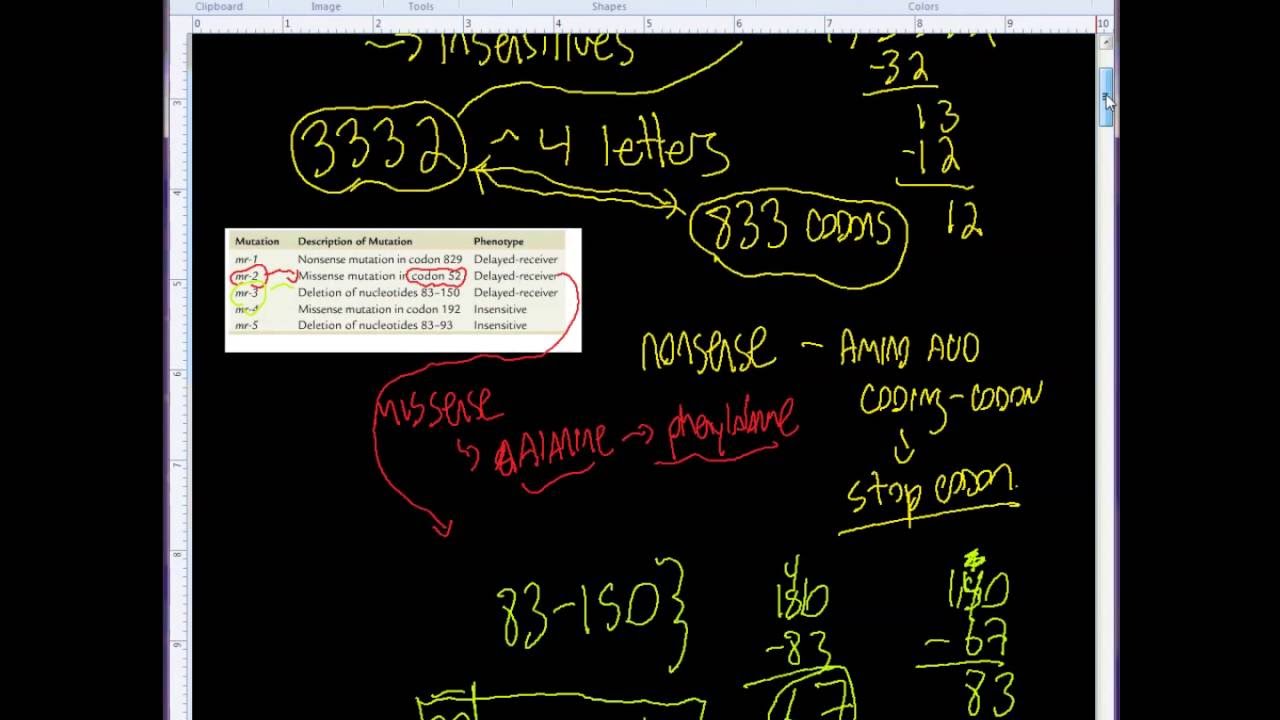
- Explanation of the gene length and number of codons (833).
- Analysis of MR1: nonsense mutation at codon 829, leading to delayed receiver.
- Analysis of MR2: missense mutation at codon 52, leading to delayed receiver.
- Analysis of MR3: deletion of nucleotides 83-150 (17 codons), leading to delayed receiver.
- Analysis of MR4: missense mutation at codon 192, leading to insensitive phenotype.
- Analysis of MR5: deletion of nucleotides 83-93 (11 nucleotides), causing frameshift and insensitive phenotype.
- Explanation of frameshift mutations and their severe effects.
- Summary and conclusion of the problem.
Contribution & Novelties
The video provides a clear, step-by-step approach to solving a genetics problem, emphasizing the importance of reading frame and the severity of frameshift mutations. It offers a practical application of mutation types (nonsense, missense, deletion) to phenotypes, which is valuable for students. The use of a fictional example (betazoids) makes the content engaging.
Pour aller plus loin :
- Frameshift mutation — Explains the concept and consequences of frameshift mutations.
- Nonsense mutation — Details on nonsense mutations and their effects.
- Missense mutation — Overview of missense mutations and their impact.
89 words
Radar Profile
The radar profile shows balanced scores across all dimensions, with slightly lower quantitative information due to the focused nature of the problem-solving video. The high scores in quality and reliability reflect the accurate and clear explanations.