Problem 4.25
Keywords
Summary
182 words
Critical Evaluation
Value of the Information & Strength of the Argument
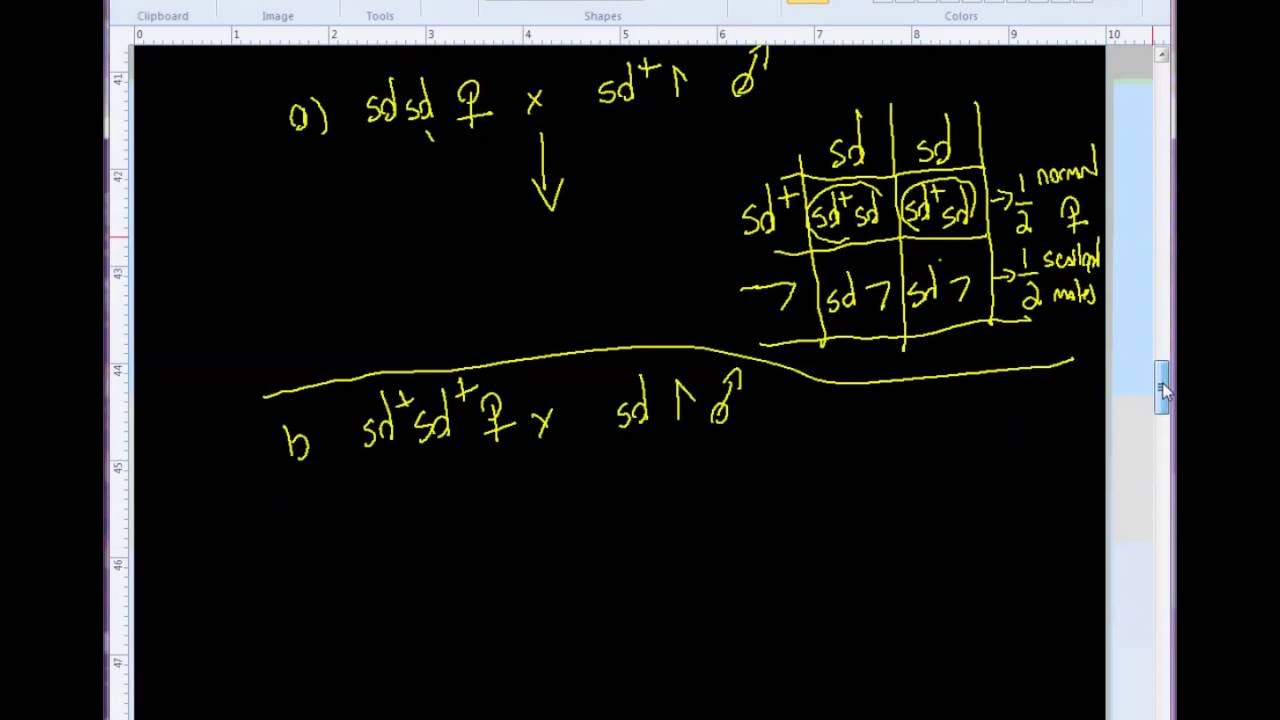
The video provides a clear, step-by-step solution to a classic genetics problem, demonstrating the application of Punnett squares to X-linked inheritance. The instructor explains the reasoning behind each cross, including the concept of hemizygosity in males and the crisscross pattern. The argumentation is logical and easy to follow, though it relies on rote problem-solving rather than deeper conceptual discussion. The value lies in its pedagogical utility for students learning genetics, but it offers no new insights beyond standard textbook material.
Scientific Rigor, Source Quality, Title Accuracy
The video is scientifically accurate, adhering to established principles of Mendelian genetics and X-linked inheritance. However, it does not cite any sources, and the instructor’s informal style (e.g., ‘I love X linkage’) may detract from its perceived rigor. The title ‘Problem 4.25’ is appropriate but vague, as it does not indicate the topic. The content matches the title, as it directly solves the problem. The lack of citations is a minor weakness, but the content is consistent with standard genetics knowledge.
176 words
Title / Content Match
The title accurately reflects the content, which is a step-by-step solution to Problem 4.25 from a genetics textbook.
Quality & Reliability
7/10
The video is an instructional tutorial by a university genetics course, explaining X-linked inheritance in Drosophila. The content is accurate and follows standard genetic principles, but it lacks citations and depth, and the presentation is informal.
Key Moments
Markers derived by PSI from the transcript: the creator did not define chapters.
- Introduction to the problem: X-linked recessive mutation scalloped (sd) in Drosophila.
- Setting up Part A: cross between scalloped female (sd/sd) and normal male (sd+/Y).
- Punnett square for Part A, showing F1 results: all females normal, all males scalloped.
- Explanation of crisscross inheritance pattern for X-linked traits.
- Setting up Part B: reciprocal cross between normal female (sd+/sd+) and scalloped male (sd/Y).
- Punnett square for Part B, showing F1 results: all offspring normal.
- Comparison of F1 results between reciprocal crosses, highlighting differences due to X-linkage.
- F2 cross for Part A: F1 normal females crossed with F1 scalloped males.
- Punnett square for Part A F2, showing 1:1:1:1 ratio of phenotypes.
- F2 cross for Part B: F1 normal females crossed with F1 normal males.
- Punnett square for Part B F2, showing 1/2 normal females, 1/4 normal males, 1/4 scalloped males.
- Conclusion and reminder for office hours.
Contribution & Novelties
The video provides a clear, step-by-step solution to a classic genetics problem, reinforcing the principles of X-linked inheritance. It is particularly useful for students who need a visual demonstration of Punnett squares and the crisscross pattern. However, it does not introduce new concepts or original research.
Pour aller plus loin :
- X-linked recessive inheritance — Provides background on X-linked inheritance patterns.
- Drosophila melanogaster — Overview of the model organism used in the problem.
- Punnett square — Explanation of the tool used to predict genotypes and phenotypes.
86 words
Radar Profile
The radar profile shows moderate scores across all dimensions, with slightly higher reliability and information quality compared to technical depth. This reflects a solid but basic educational content, suitable for introductory genetics students.