Problem 5.14
Keywords
Summary
125 words
Critical Evaluation
Value of the Information & Strength of the Argument
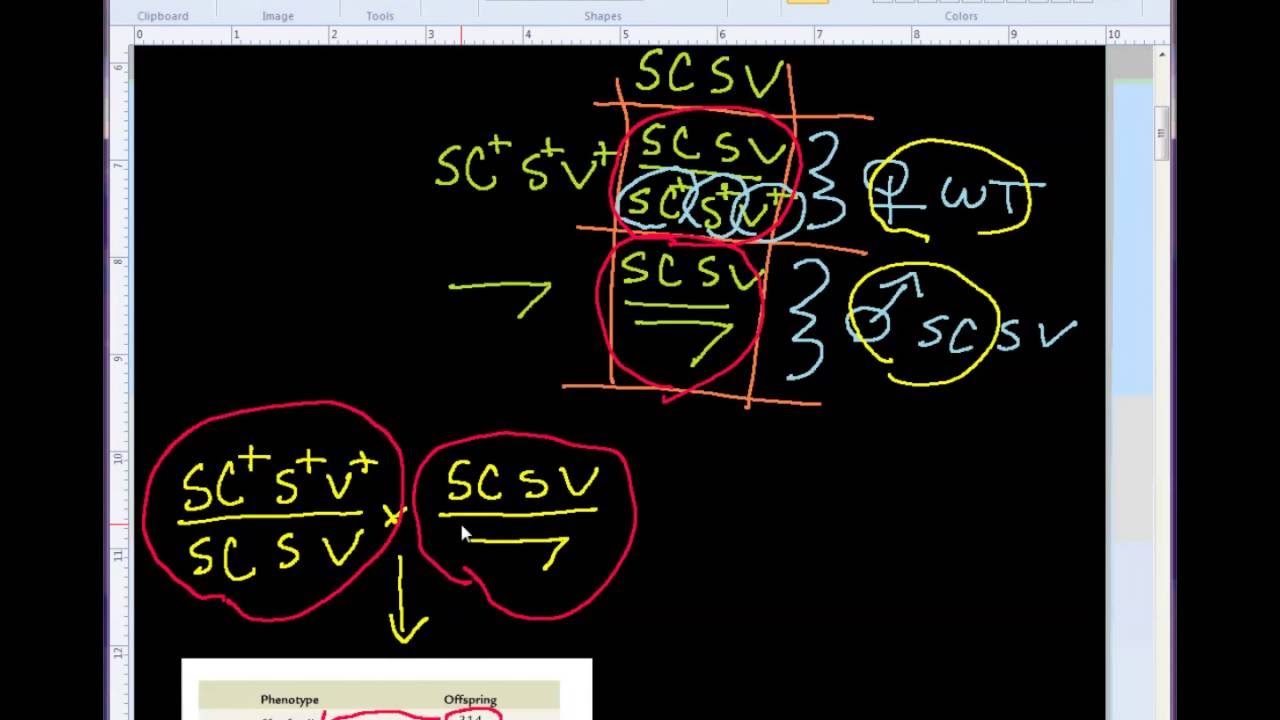
The video provides a thorough, step-by-step solution to a classic genetics problem, which is highly valuable for students learning gene mapping. The instructor clearly explains each step, from setting up the cross to interpreting phenotype data and calculating recombination frequencies. The argumentation is logical and self-correcting: when the initial gene order prediction fails, the instructor identifies the issue and tests an alternative, demonstrating a robust scientific approach. The use of visual diagrams and color coding enhances comprehension. The video effectively illustrates the principles of three-point crosses, including single and double crossovers, and the importance of identifying the middle gene.
Scientific Rigor, Source Quality, Title Accuracy
The video is scientifically rigorous, adhering to standard genetics methodology for three-point crosses. The instructor correctly applies the principles of recombination and gene mapping, and the calculations are accurate. The title ‘Problem 5.14’ is appropriate for an educational video, clearly indicating the specific problem being solved. No external sources are cited, but the content is based on established genetics concepts. The video is a tutorial, so it does not present original research but rather explains a textbook problem. The explanation is consistent with standard genetics textbooks.
200 words
Title / Content Match
The title 'Problem 5.14' is concise and directly indicates the specific problem being solved, which is appropriate for an educational video.
Quality & Reliability
8/10
The video is a clear, step-by-step tutorial on solving a three-point cross problem in Drosophila genetics. The instructor explains each step logically, corrects an initial error in gene order, and provides detailed calculations. The content is accurate and aligns with standard genetics principles.
Key Moments
Markers derived by PSI from the transcript: the creator did not define chapters.
- Introduction to Problem 5.14 and setup of P1 cross
- Explanation of F1 genotypes and phenotypes
- Presentation of F2 phenotype data
- Initial prediction of gene order (sable in middle) and prediction of gamete classes
- Matching F2 data to predicted gamete classes and identifying discrepancy
- Testing alternative gene order (vermilion in middle) and confirming it fits data
- Calculation of recombination frequency between scute and vermilion (33 cM)
- Calculation of recombination frequency between vermilion and sable (10 cM)
- Summary and conclusion
Contribution & Novelties
The video provides a clear, step-by-step solution to a three-point cross problem, which is a fundamental technique in genetic mapping. It demonstrates the process of determining gene order and calculating map distances, which is essential for understanding recombination and linkage. The instructor’s method of testing different gene orders when the initial prediction fails is a valuable problem-solving approach.
Pour aller plus loin :
- Three-point cross — Overview of three-point crosses and their use in gene mapping.
- Recombination frequency — Explanation of recombination frequency and its calculation.
- Centimorgan — Definition and use of centimorgan as a unit of genetic distance.
99 words
Radar Profile
The radar profile shows high scores in information quantity, quality, and reliability, with a slightly lower technical level, indicating a well-explained tutorial that is accessible to students. The balance between technical depth and clarity is appropriate for an educational video.