Problem 5.27
Keywords
Summary
150 words
Critical Evaluation
Value of the Information & Strength of the Argument
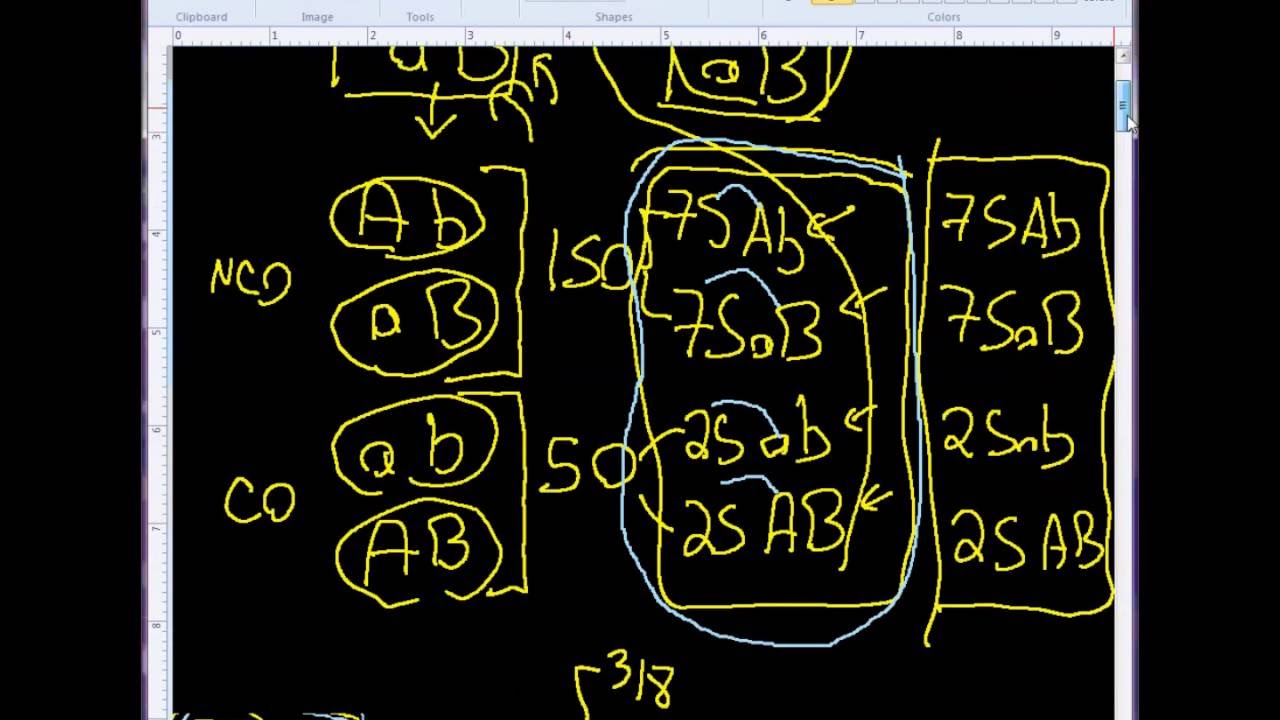
The video provides a clear and detailed walkthrough of a classic genetics problem, demonstrating the application of the forked-line method to calculate phenotypic ratios from linked genes with known recombination frequency. The instructor explains each step logically, from determining gamete ratios to combining them and simplifying phenotypes. The argumentation is solid, as he verifies the final answer against the solutions manual, ensuring accuracy. The value lies in its pedagogical clarity, making a complex problem accessible to students.
Scientific Rigor, Source Quality, Title Accuracy
The video is scientifically rigorous in its methodology, following standard genetic principles for linked genes and crossing over. The instructor references the problem from a textbook (implied) and checks the solution against a manual, though no specific sources are cited. The title ‘Problem 5.27’ is appropriate as it directly indicates the content. The video is a tutorial, so it does not rely on external sources but rather on established genetic theory. The adequacy between title and content is perfect.
171 words
Title / Content Match
The title 'Problem 5.27' accurately reflects the content, which is a detailed solution to that specific genetics problem.
Quality & Reliability
7/10
The video is a step-by-step tutorial on solving a genetics problem involving linked genes and crossing over. The instructor demonstrates a clear method (forked-line) and verifies the answer against a solutions manual. The content is accurate and pedagogically sound, though it lacks formal citations and is based on a single problem.
Key Moments
Markers derived by PSI from the transcript: the creator did not define chapters.
- Introduction to the problem and setup.
- Explanation of gamete types and recombination frequency.
- Calculation of gamete ratios (75% non-crossover, 25% crossover).
- Introduction of forked-line method for combining gametes.
- Detailed multiplication of gamete combinations.
- Listing all 16 possible genotypes and their ratios.
- Conversion of genotypes to phenotypes.
- Simplification of phenotypic ratios.
- Verification of answer with solutions manual.
- Conclusion and encouragement for students.
Contribution & Novelties
The video offers a clear, step-by-step solution to a linked gene problem, demonstrating the forked-line method in detail. It is particularly useful for students struggling with such problems. The instructor’s verification with the solutions manual adds credibility.
Pour aller plus loin :
- Genetic linkage — Provides background on linked genes and recombination.
- Centimorgan — Explains the unit of genetic distance used in the problem.
- Forked-line method — A technique for predicting offspring ratios in genetics.
75 words
Radar Profile
The radar profile shows balanced scores across all dimensions, with slightly higher quality and reliability compared to quantity and technical level. This indicates a well-structured tutorial that is accurate and reliable, though it may not cover a broad range of information or delve into advanced technical details.