LINE-induced mutation (Recommend 1.5x Speed)
Keywords
Summary
169 words
Critical Evaluation
Value of the Information & Strength of the Argument
The video provides valuable educational content, clearly explaining a complex genetic mechanism. The argumentation is solid, based on a peer-reviewed study, and the presenter logically connects the molecular details to the clinical phenotype. The explanation of how the L1 insertion creates a new splice site and leads to partial function is particularly insightful. However, the video is a tutorial, so it does not present new research but rather interprets existing findings. The presenter also acknowledges uncertainties, such as the exact mechanism of splice site selection, which adds to the credibility.
Scientific Rigor, Source Quality, Title Accuracy
The scientific rigor is high for an educational video. The presenter cites a specific peer-reviewed article (Goncalves et al., 2018, in Genes) and accurately describes the findings. The quality of sources is good, though only one primary source is mentioned. The title is appropriate and informative. The video is well-structured and aligns with the course context. No comments were provided for analysis.
167 words
Title / Content Match
The title accurately reflects the content, focusing on a LINE-induced mutation, and the recommendation for 1.5x speed is appropriate given the pace.
Quality & Reliability
8/10
The video is an educational lecture from a university genetics course, presenting a specific case study from a peer-reviewed article (Goncalves et al., 2018, in Genes). The content is accurate and well-explained, with clear molecular mechanisms. However, it is a tutorial and not a primary research presentation, and some details (e.g., exact splice site usage) are simplified.
Key Moments
Markers derived by PSI from the transcript: the creator did not define chapters.
- Introduction to L1 retrotransposons and their role in causing mutations.
- Explanation of Duchenne and Becker muscular dystrophies, and the dystrophin gene.
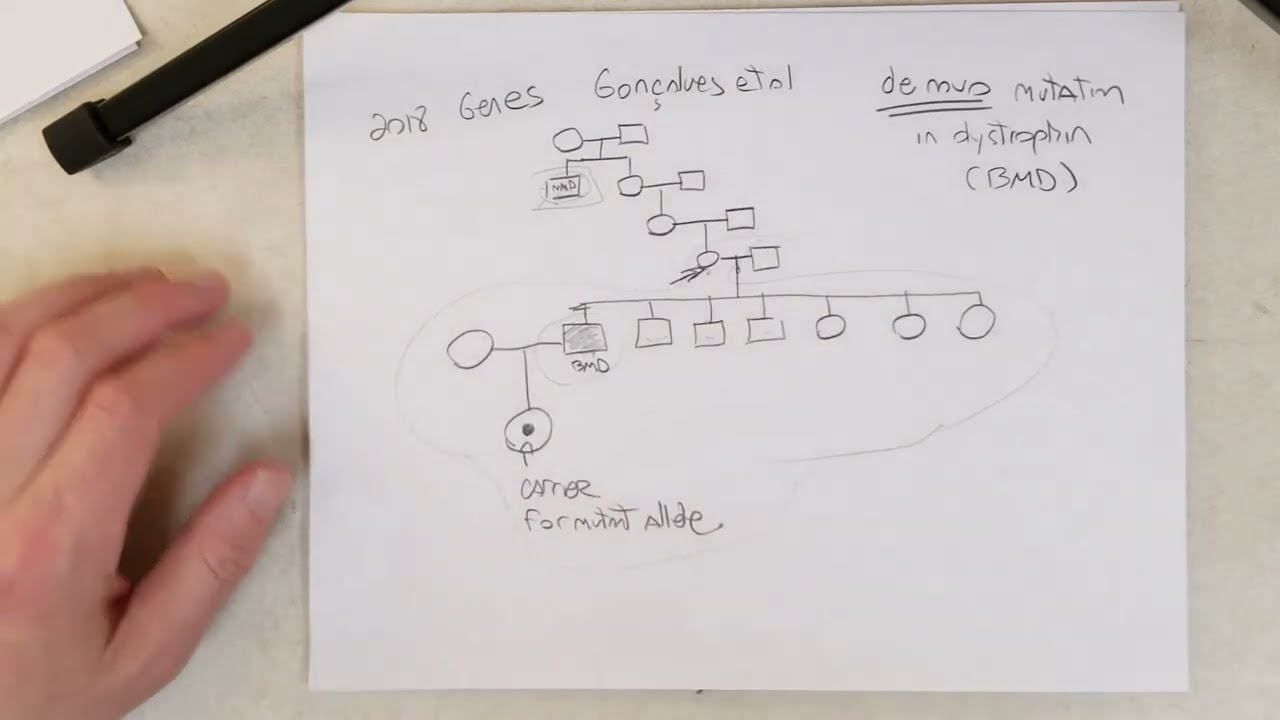
- Introduction to the 2018 study by Goncalves et al. and the de novo mutation.
- Description of the family pedigree and the affected individual.
- Detailed diagram of the L1 insertion between exons 51 and 52.
- Explanation of how the L1 element creates a new splice site and becomes an exon.
- Illustration of the splicing process and the resulting mRNA with exon 51.5.
- Discussion of how the partial function of dystrophin leads to BMD instead of DMD.
- Conclusion and summary of the key points.
Cited Sources
- Goncalves et al. (2018) in Genes — The study characterizing the de novo L1 insertion in the dystrophin gene causing Becker muscular dystrophy.
Concurring Sources
- Goncalves et al. (2018) in Genes — The primary study cited in the video, which the presenter uses to explain the case.
Contribution & Novelties
The video provides a clear educational explanation of a specific L1 retrotransposon insertion causing a human disease, highlighting the molecular mechanism of alternative splicing that leads to a milder phenotype. It effectively bridges basic genetics concepts with clinical implications.
Pour aller plus loin :
- LINE-1 retrotransposon — Overview of L1 elements and their impact on genomes.
- Dystrophin gene — Details on the gene and its role in muscular dystrophy.
- Becker muscular dystrophy — Clinical features and genetic basis.
- Alternative splicing — Mechanism that allows production of multiple mRNA isoforms.
89 words
Radar Profile
The radar profile shows high scores in information quantity and quality, with a moderate technical level, indicating a well-balanced educational video. The reliability is high, reflecting the use of a peer-reviewed source. The overall profile suggests a solid tutorial that is both informative and trustworthy.