Genetics: L11-BB / L10-F: Euploidy, Aneuploidy, and Nondisjunction (Recommend 1.5x Speed)
Keywords
Summary
144 words
Critical Evaluation
Value of the Information & Strength of the Argument
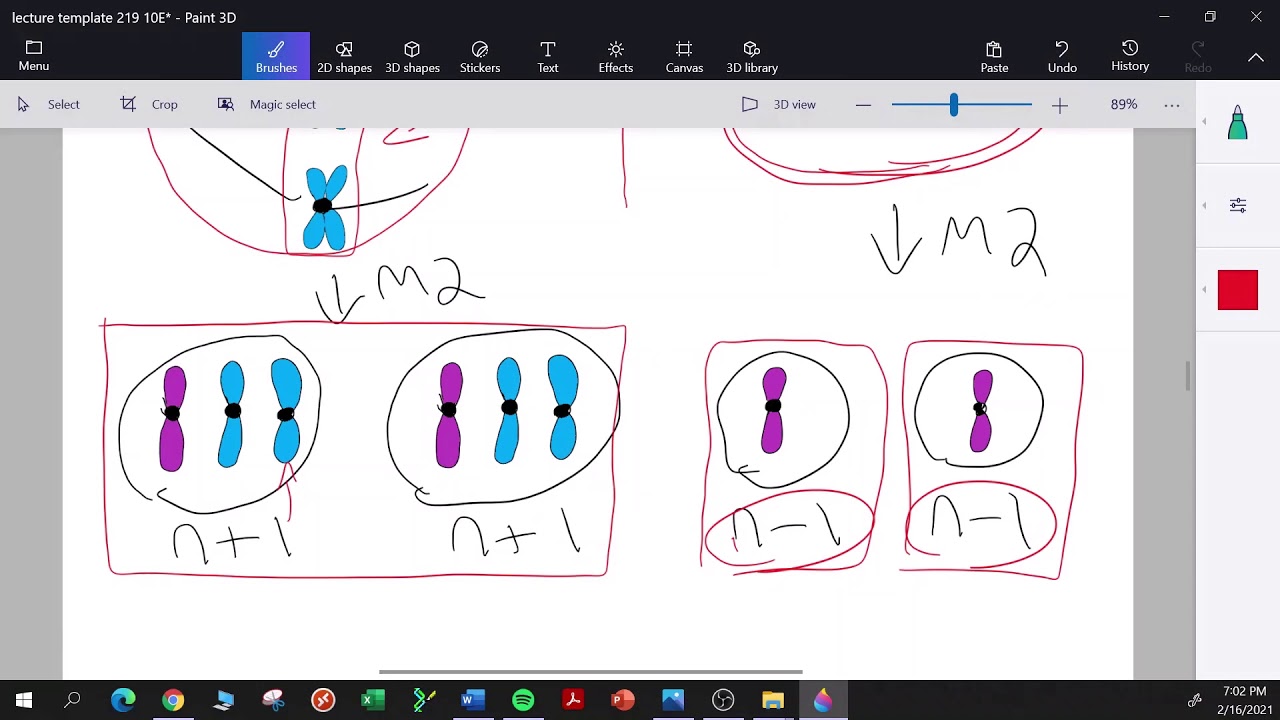
The video provides a clear and structured explanation of euploidy and aneuploidy, using diagrams to illustrate nondisjunction during meiosis I and II. The instructor effectively contrasts the outcomes of nondisjunction at different stages, highlighting that nondisjunction in meiosis I leads to all gametes being aneuploid, while in meiosis II, half are normal. The argumentation is logical and builds from basic definitions to more complex examples. The inclusion of data on aneuploidy rates in human gametes and embryos adds empirical support, though the instructor does not provide specific citations for these figures. The explanation of why certain aneuploidies are viable while others are not is insightful, linking chromosome size and gene content to developmental outcomes.
Scientific Rigor, Source Quality, Title Accuracy
The video is scientifically accurate and aligns with established genetics knowledge. The instructor mentions a review article and a study on aneuploidy in human gametes, but does not provide direct citations or links in the description. The title accurately reflects the content, which is a focused lecture on euploidy, aneuploidy, and nondisjunction. The presentation is clear and well-organized, with diagrams that enhance understanding. However, the lack of explicit source citations for the data presented reduces the overall rigor. The video appears to be part of a university course, suggesting a reliable educational context.
222 words
Title / Content Match
The title accurately reflects the content, which covers euploidy, aneuploidy, and nondisjunction in detail.
Quality & Reliability
7/10
The video provides a clear and accurate explanation of euploidy, aneuploidy, and nondisjunction, with diagrams and examples. The instructor cites a review article and mentions specific data on aneuploidy rates in human gametes and embryos, but does not provide direct citations for all claims. The content is consistent with established genetics knowledge.
Key Moments
Markers derived by PSI from the transcript: the creator did not define chapters.
- Introduction to euploidy and aneuploidy definitions.
- Explanation of nondisjunction during meiosis I.
- Diagram illustrating nondisjunction in meiosis I.
- Explanation of nondisjunction during meiosis II.
- Diagram illustrating nondisjunction in meiosis II.
- Discussion of aneuploidy rates in human gametes and embryos.
- Aneuploidy in miscarriages and stillbirths.
- Aneuploidy in live births and viable aneuploidies.
- Summary and conclusion.
Cited Sources
- Review article on aneuploidy in human gametes — Mentioned in the video as a source for data on aneuploidy rates in sperm and oocytes.
Concurring Sources
- Genetics Home Reference - Aneuploidy — Provides background on aneuploidy and its effects.
Contribution & Novelties
The video provides a clear and accessible explanation of euploidy and aneuploidy, with a focus on nondisjunction mechanisms. It effectively uses diagrams to illustrate the outcomes of nondisjunction during meiosis I and II. The discussion of aneuploidy rates across different stages of human development (gametes, embryos, miscarriages, live births) is valuable, highlighting the selective pressure against most aneuploidies. The video also emphasizes that only certain aneuploidies are viable, which is an important concept for understanding human genetic disorders.
Pour aller plus loin :
- Nondisjunction (Wikipedia) — Provides a comprehensive overview of nondisjunction and its consequences.
- Aneuploidy (Wikipedia) — Detailed information on aneuploidy types and effects.
- Down syndrome (Wikipedia) — Example of a viable aneuploidy (trisomy 21).
116 words
Radar Profile
The radar profile shows high scores in quality of information and technical level, with moderate scores in quantity and reliability. This indicates a well-explained but relatively short video with limited external sourcing.