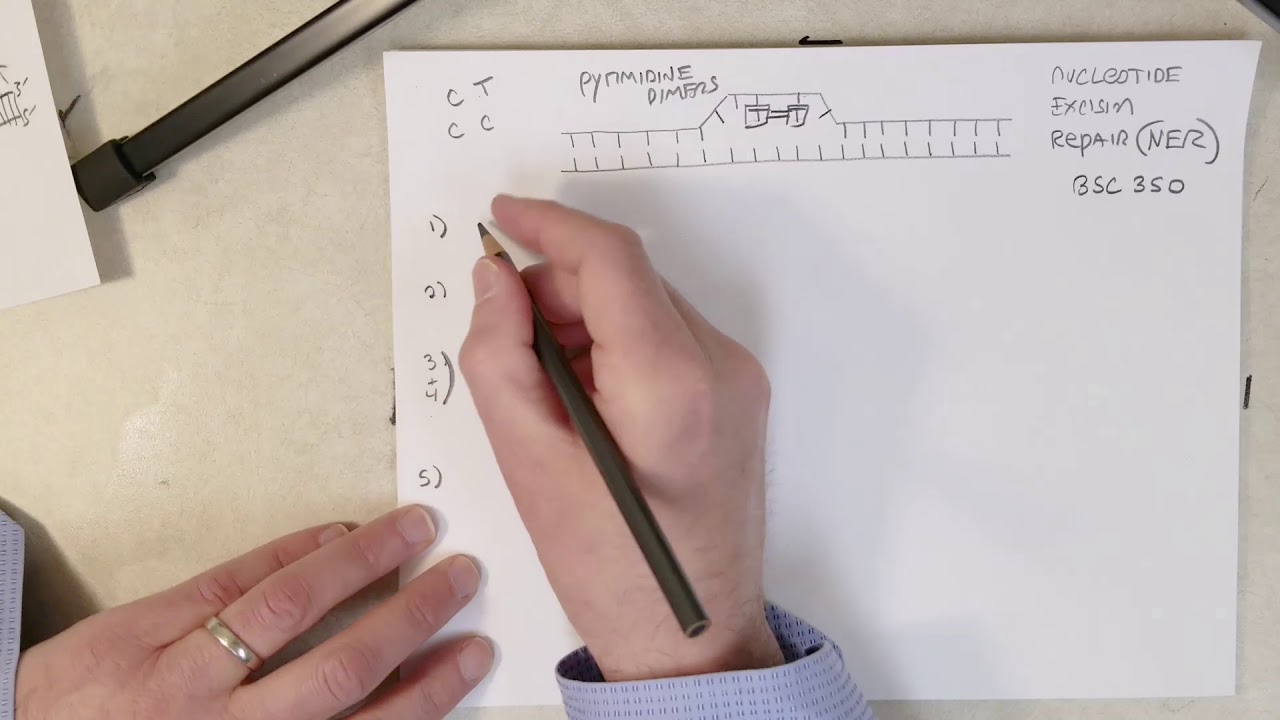
Genetics: L19-GA2, Nucleotide Excision Repair (Recommend 1.5x Speed)
Keywords
Summary
129 words
Critical Evaluation
Value of the Information & Strength of the Argument
The video provides a clear and accurate explanation of nucleotide excision repair, breaking down the process into logical steps. The argumentation is sound, as it correctly describes the role of thymine dimers, the excision of a single-stranded DNA segment, and the subsequent repair synthesis and ligation. The presenter effectively uses diagrams and analogies to illustrate the process, making it accessible for an introductory genetics audience. However, the video lacks depth in discussing the specific proteins involved and the regulatory mechanisms, which is acknowledged by the presenter and deferred to a more advanced course. Overall, the information is valuable for understanding the basic concept of NER and its importance in preventing mutations.
Scientific Rigor, Source Quality, Title Accuracy
The video is a lecture from a university genetics course, so it is based on established scientific knowledge. The presenter does not cite specific sources, but the content aligns with standard molecular biology textbooks. The title accurately reflects the content, and the video is well-structured for educational purposes. The description provides minimal additional information, but the video itself is self-contained. The presenter mentions that more mechanistic details are covered in BSC 350, indicating a clear educational pathway. Overall, the scientific rigor is adequate for an introductory lecture, though it does not provide references for further reading.
222 words
Title / Content Match
The title accurately reflects the content, which is a lecture on nucleotide excision repair.
Quality & Reliability
7/10
The video provides a clear and accurate overview of nucleotide excision repair, consistent with established molecular biology knowledge. It is a basic educational tutorial without detailed mechanistic depth, but the information presented is correct and well-structured.
Key Moments
Markers derived by PSI from the transcript: the creator did not define chapters.
- Introduction to nucleotide excision repair (NER) and its importance.
- Explanation of thymine dimer formation due to UV radiation.
- Overview of the five steps of NER.
- Step 1: NER proteins identify the damage.
- Step 2: NER proteins cut out the damaged DNA segment.
- Steps 3-4: DNA polymerase fills the gap.
- Step 5: DNA ligase seals the nick.
- Connection to xeroderma pigmentosum and unscheduled DNA synthesis.
Contribution & Novelties
This video provides a concise and clear introduction to nucleotide excision repair, suitable for students learning genetics. It effectively breaks down the process into five steps and connects it to real-world implications like skin cancer and xeroderma pigmentosum. The presenter also links the content to previous lectures on complementation groups and unscheduled DNA synthesis, reinforcing the material.
Pour aller plus loin :
- Nucleotide excision repair - Wikipedia — Provides a comprehensive overview of NER, including the proteins involved and the mechanism.
- Xeroderma pigmentosum - Wikipedia — Details the genetic disorder caused by defects in NER.
- DNA repair - Wikipedia — Broader context on various DNA repair mechanisms.
107 words
Radar Profile
The radar profile shows a balanced performance across all dimensions, with slightly higher scores in quality of information and fiability, reflecting the accurate but basic content. The lower score in technical level indicates that the video is introductory, which is appropriate for its target audience.