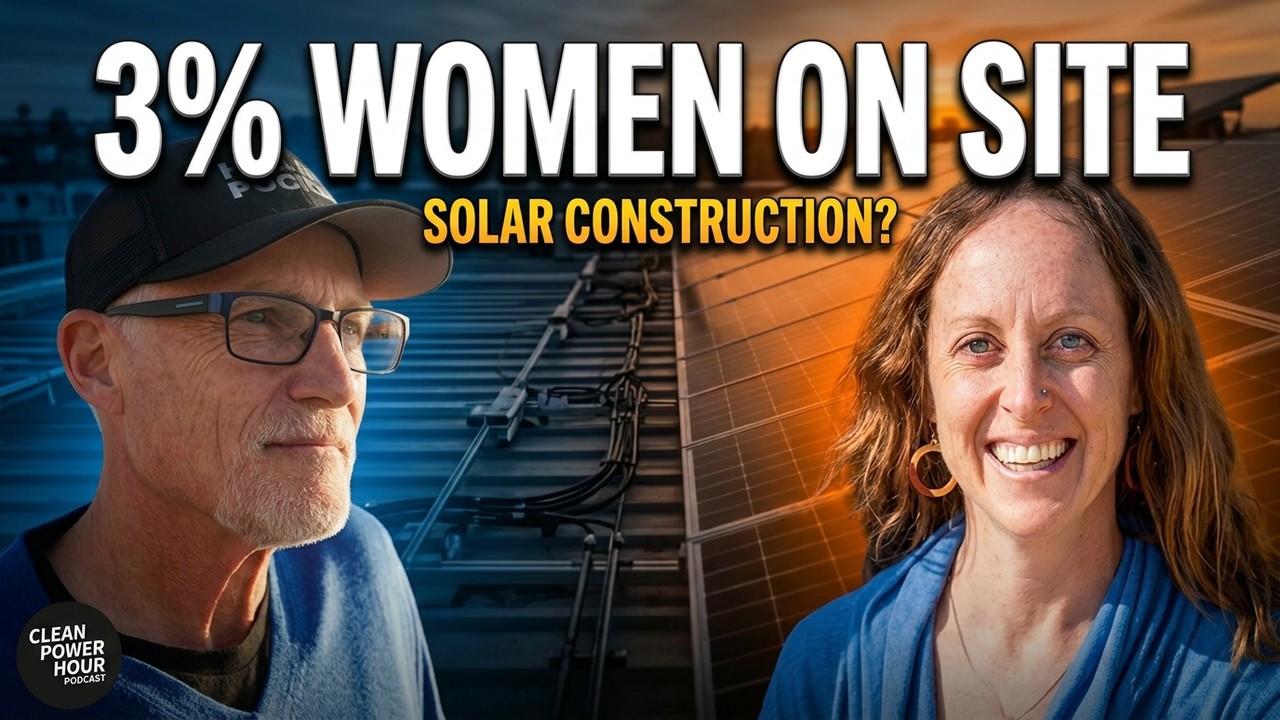
Solar Construction Has a Women Problem — Here’s How We Fix It
Keywords
Summary
145 words
Critical Evaluation
Value of the Information & Strength of the Argument
The value of the information lies in its practical insights from an experienced professional. Riley provides concrete examples of barriers and solutions, such as the lack of women in field roles and the importance of mentorship. The argumentation is based on personal experience and anecdotal evidence, which is compelling but not statistically robust. The discussion is balanced, acknowledging that not all women are suited for the trades and that systemic changes are needed.
Scientific Rigor, Source Quality, Title Accuracy
The scientific rigor is moderate; the conversation relies on anecdotal evidence and references to industry data without deep analysis. The sources mentioned (e.g., solar job census) are not cited with specific references. The title accurately reflects the content. The guest’s credentials (NABCEP PVIP, licensed electrician) add credibility. The episode includes a sponsor segment (CPS America) and a promotional segment for Tim’s consulting services, which are clearly separated from the main content.
159 words
Title / Content Match
The title accurately reflects the content, which focuses on the underrepresentation of women in solar construction and potential solutions.
Quality & Reliability
7/10
The discussion is based on personal experience and anecdotal evidence, with references to industry data (e.g., solar job census) but lacks rigorous statistical analysis. The guest is a certified professional, adding credibility. The episode is an interview, not a peer-reviewed study.
Key Moments
Markers derived by PSI from the transcript: the creator did not define chapters.
- Introduction of the topic and guest Riley Neugebauer.
- Discussion of statistics: women represent 25-30% of solar workforce but only 1-3% in construction roles.
- Barriers to entry: lack of exposure, cultural stigma, and workplace culture.
- Riley's personal journey from environmental studies to solar installation.
- The role of mentorship and visibility in supporting women in trades.
- Practical steps for employers: marketing representation, employee resource groups, flexible work.
- Organizations like Grid Alternatives and Remote Energy that train women.
- The labor shortage in skilled trades and the need for diversity.
- Closing thoughts and call to action.
Cited Sources
- Clean Power Hour — The podcast's official website, mentioned as a resource.
- Wired for Sun (Book) — A book mentioned in the description, likely related to solar industry.
- Solar for Women — The nonprofit founded by Riley Neugebauer, discussed in the episode.
- Riley Neugebauer LinkedIn — LinkedIn profile of the guest, provided for further connection.
Concurring Sources
- Solar Job Census — Referenced in the episode as a source for solar workforce statistics.
External References
Contribution & Novelties
The episode provides a firsthand account of the challenges women face in solar construction and offers actionable solutions. It highlights the gap between overall solar workforce diversity and field roles, which is often overlooked. The discussion with Riley Neugebauer brings a unique perspective as a woman in the trades and founder of a nonprofit.
Pour aller plus loin :
- Grid Alternatives — Organization that trains women and underrepresented groups in solar installation.
- Remote Energy — Nonprofit providing solar training, with a focus on women.
- Solar Energy International (SEI) — Offers women’s lab programs for solar training.
- NABCEP — Certification body for solar professionals, relevant to the guest’s credentials.
108 words
Radar Profile
The radar profile shows moderate scores across all dimensions, with slightly higher scores in information quantity and quality, reflecting the informative but not deeply technical nature of the discussion. The low technical score indicates the content is accessible to a general audience.
💬 No comments were provided for analysis.